
E00928
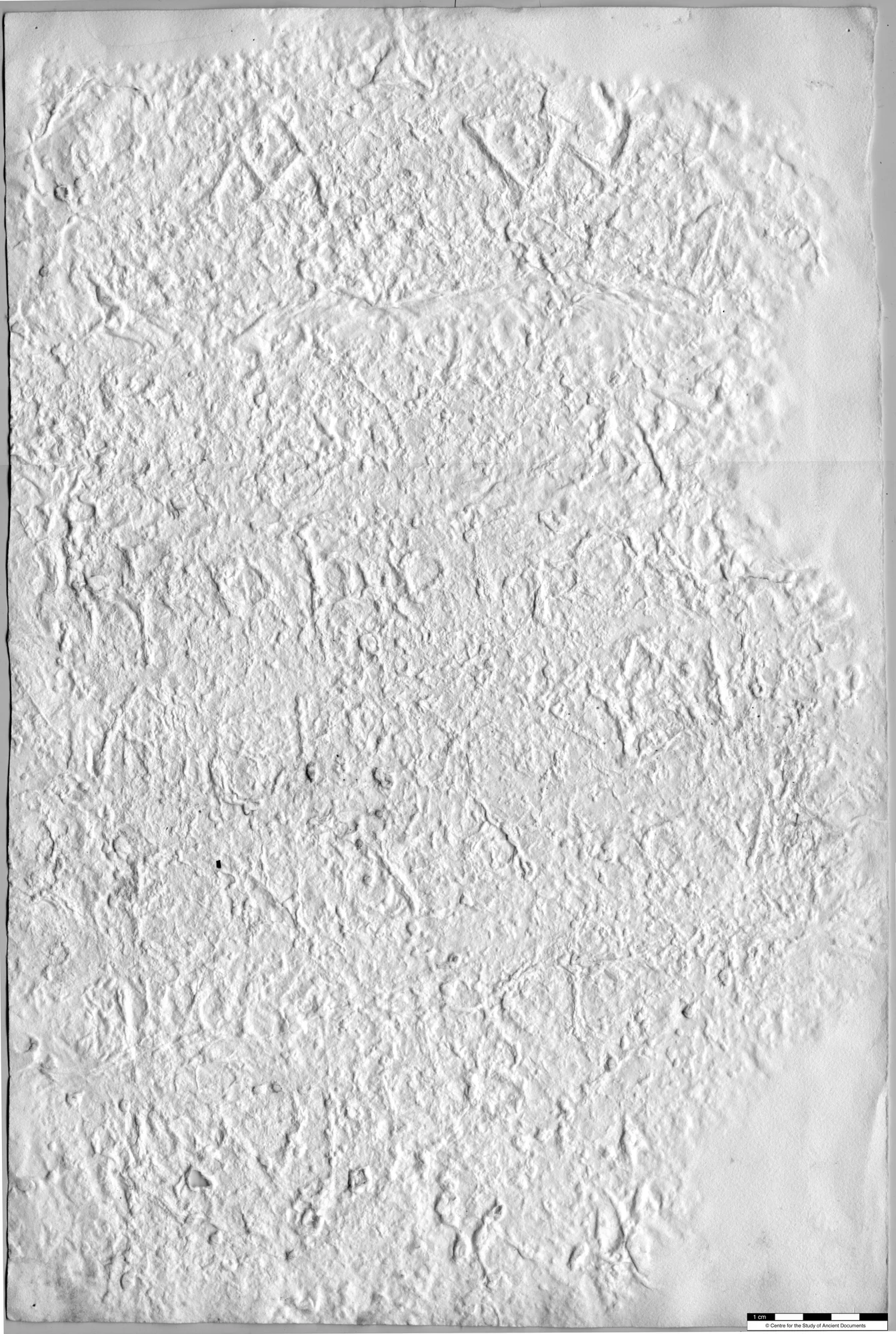
Scarcely legible Greek inscription marking boundaries of an estate belonging to a church, probably of *John (the Baptist, S00020), or, which is less plausible, of *Thyrsos (martyr of Bithynia, S00612). Found at Kana (Lycaonia, central Asia Minor). Probably 6th c.
- Language
- Greek
- Date from
- 500
- Date to
- 600
- Evidence type
- Inscriptions
- Evidence subtype
- Formal inscriptions (stone, mosaic, etc.)
- Evidence region
- Asia Minor
- Evidence location
- Kana; Nicomedia, Νικομήδεια, Nikomēdeia, Izmit, Πραίνετος, Prainetos, Nicomedia
- Cult region
- Asia Minor
- Cult location
- Kana; Nicomedia, Νικομήδεια, Nikomēdeia, Izmit, Πραίνετος, Prainetos, Nicomedia
- Cult date from
- 500
- Cult date to
- 600
Text
Inscription on a boundary stone.
Callander's reading:
ὅροι τοῦ
ἁγίου καὶ
ἐνδόξου
ΙΟΔΟΤΕΡΟΣ (?)
Θύρσου
4. μάρτυρος or ἱερομάρτυρος Delehaye || 4-5. Ιοδοτερος | Θύρσου Callander
'Boundaries of the holy and glorious martyr (?) Thyrsos.'
Text: Callander 1906, no. 22.
Reading by the editors of Monumenta Asiae Minoris Antiqua XI from a squeeze made by Michael Ballance:
Α + Ω
+ ὅροι το̣ῦ
ἁγίου κ̣α̣ὶ
ἐνδόξ̣ο̣υ
Ἰω̣ά[ν]̣ο[υ] ̣τ[οῦ]
̣Β̣α̣π[τιστοῦ]
'Α + Ω + Boundaries (of the church) of the holy and glorious John the Baptist (?).'
Text and translation (lightly modified): MAMA XI, no. 357.
Source
A badly weathered boundary stone found in 1904 by an expedition led by William Ramsay and first edited by Thomas Callander in 1906. The editors of the eleventh volume of Monumenta Asiae Minoris Antiqua claim that it may be identical with a white limestone stele, seen by Michael Ballance in 1957. H. 1.24 m; W. 0.37 m; letter height 0.015-0.04 m. When recorded by Ballance, the stele was reused in the wall of a yard.
Discussion
The inscription marked the boundaries of an estate belonging to a church. The identity of its patron saint has been disputed. Callander read the name of the saint as Thyrsos. As he published only a transcription of the text, without a drawing or photograph, the reading had to be accepted by other scholars.
François Halkin comments that the martyr Thyrsos was quite popular as he was also venerated in Lycaonia and Constantinople (see Halkin 1953, p. 93, n. 4). Sozomen writes that a martyr shrine of *Thyrsos was built in the capital by Caesarius, consul of 397 and praetorian prefect of the East, at the tomb of his wife and that the martyr appeared in a vision to Pulcheria, showing her where the relics of the *Forty Martyrs of Sebasteia had been buried (see Soz. HE IX 2). Though the church historian does not say, how the relics of *Thyrsos were brought to Constantinople, the story gives the impression that they could be originally venerated by some Macedonian / Pneumatomachi monks (followers of the teachings of the patriarch of Constantinople Macedonius, 342-359, that questioned the divinity of the Holy Ghost). For the hagiographical writings on a certain *Thyrsos, a martyr of Bithynia, and his companions, see BHG 1845-1846.
Epithets of the martyr are given in lines 3-5. Callander says that “the reading in l. 4 is hopeless”, but given that the word, he read as ΙΟΔΟΤΕΡΟΣ, is preceded by epithets ἁγίου καὶ ἐνδόξου Hippolyte Delehaye said that one could hardly interpret it otherwise than μάρτυρος. ΙΟ could be easily mistaken for Μ and ΔΟ for ΑΡ. The epithet ἱερομάρτυς, also considered by Delehaye, is not attested in late antique Anatolian inscriptions.
However, the editors of the eleventh volume of Monumenta Asiae Minoris Antiqua claim that the stone may be identical with a white limestone stele, they edited under no. 357. It was seen by Michael Ballance in 1957. Ballance made a squeeze and a photograph that allowed for correcting Callander's reading (if both objects are really identical). The church was apparently dedicated to *John the Baptist (and not Thyrsos). In addition, the editors suppose that the same church was mentioned on a boundary stone, found c. 50 km to the east of Kana (see E00929) and that one of these signs could have been displaced.
Though this inscription does not say so explicitly, boundary stones were usually bestowed upon sanctuaries by emperors.
Bibliography
Edition:
Monumenta Asiae Minoris Antiqua XI, no. 357.
Callander, T., "Explorations in Lycaonia and Isauria", in: W.M. Ramsay, Studies in the History and Art of the Eastern Provinces of the Roman Empire (Aberdeen: Aberdeen University Press, 1906), no. 22.
Inscriptiones Christianae Graecae database, no. 132: http://www.epigraph.topoi.org/ica/icamainapp/inscription/show/132
Further reading:
Destephen, S., "Martyrs locaux et cultes civiques en Asie Mineure", in: J.C. Caillet, S. Destephen, B. Dumézil, H. Inglebert, Des dieux civiques aux saints patrons (IVe-VIIe siècle) (Paris: éditions A. & J. Picard, 2015), 89.
Halkin, F., "Inscriptions grecques relatives à l'hagiographie, IX, Asie Mineure", Analecta Bollandiana 71 (1953), 93, n. 4.
Delehaye, H., Les origines du culte des martyrs (Bruxelles : Société des Bollandistes, 1912), 191 (cf. pp. 69; 102; 274).
Images
Associated saints
| Saint | Name in source | Certainty |
|---|---|---|
| John the Baptist (S00020) | Ἰωάννης ὁ Βαπτιστῆς | Uncertain |
| Thyrsos and companions, martyrs of Bithynia (S00612) | Θύρσος | Uncertain |
Cult classifications
- Cult Places
- Cult building - independent (church)
- Non Liturgical Activity
- Awarding privileges to cult centres; Seeking asylum at church/shrine
Record author
Pawel Nowakowski
Entry date
03/12/2015
Citation
Pawel Nowakowski, Cult of Saints, E00928 — https://csla.history.ox.ac.uk/record.php?recid=E00928