
E00987
Greek inscription on a boundary stone of a church of *Mary (Mother of Christ, S00033), also called the God-Bearer. Found at Koukousos (Roman province of Armenia II, eastern Asia Minor). Probably late 5th or 6th c.
- Language
- Greek
- Date from
- 490
- Date to
- 600
- Evidence type
- Inscriptions
- Evidence subtype
- Formal inscriptions (stone, mosaic, etc.)
- Evidence region
- Asia Minor
- Evidence location
- Koukousos; Nicomedia, Νικομήδεια, Nikomēdeia, Izmit, Πραίνετος, Prainetos, Nicomedia
- Cult region
- Asia Minor
- Cult location
- Koukousos; Nicomedia, Νικομήδεια, Nikomēdeia, Izmit, Πραίνετος, Prainetos, Nicomedia
- Cult date from
- 490
- Cult date to
- 600
Text
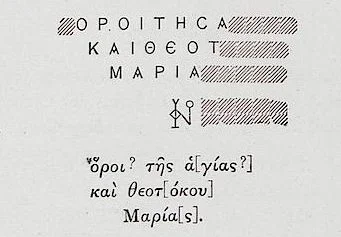
[[+]] ὅροι τῆς ἁ[γίας]
καὶ Θεοτ[όκου]
Μαρία[ς]
(a monogram)
'[[+]] Boundaries (of the church) of the holy and the God-Bearer Mary.'
Text: Sitlington Sterrett 1883-1884, no. 280.
Source
A round column, found in 1884 by John Robert Sitlington Sterrett in the eastern cemetery at Göksun (Koukousos, Armenia II, eastern Asia Minor). It was broken into two parts. The cross at the beginning of the first line was probably erased.
Discussion
The inscription is on a boundary stone of a church or an estate belonging to a church of *Mary, Mother of Christ. This is a rare case, where Mary is called in an inscription by her name and not just as the God-Bearer (Theotokos).
The monogram in line 4, consists of letters Ν, Ο, Υ, and perhaps Θ and Τ. The editor did not attempt to decipher its meaning.
Though this inscription does not say so explicitly, boundary stones were usually bestowed upon sanctuaries by emperors.
Dating: Probably late 5th or 6th c. (as may other boundary stones were are dated by emperors of this period).
Bibliography
Edition:
Sillington Sterrett, J.R., "An Epigraphical Journey in Asia Minor" (Papers of The American School of Classical Studies at Athens 2, 1883-1884, Boston 1888: Damrell and Upham, 1888), no. 280.
Reference works:
Bulletin épigraphique (1952), 154.
Images
Associated saints
| Saint | Name in source | Certainty |
|---|---|---|
| Mary, Mother of Christ (S00033) | Θεοτόκος Μαρία | Certain |
Cult classifications
- Cult Places
- Cult building - independent (church)
- Non Liturgical Activity
- Awarding privileges to cult centres; Seeking asylum at church/shrine
Record author
Pawel Nowakowski
Entry date
14/12/2015
Citation
Pawel Nowakowski, Cult of Saints, E00987 — https://csla.history.ox.ac.uk/record.php?recid=E00987