
E01021
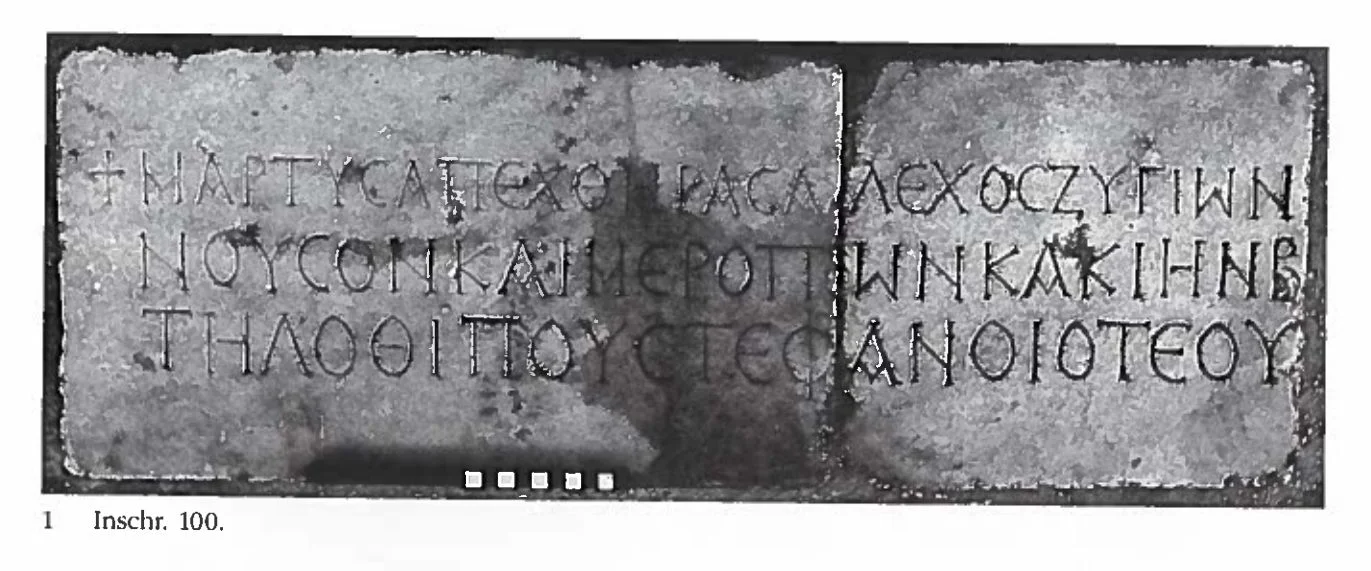
Fragmentary Greek inscription with a poem invoking an unnamed female martyr and virgin, very possibly *Thekla (follower of the Apostle Paul, S00092). Found near Tyana (Cappadocia, central Asia Minor). Probably 5th/6th c.
- Language
- Greek
- Date from
- 400
- Date to
- 600
- Evidence type
- Inscriptions; Literary
- Evidence subtype
- Formal inscriptions (stone, mosaic, etc.); Poems
- Evidence region
- Asia Minor
- Evidence location
- Tyana; Nicomedia, Νικομήδεια, Nikomēdeia, Izmit, Πραίνετος, Prainetos, Nicomedia
- Cult region
- Asia Minor
- Cult location
- Tyana; Nicomedia, Νικομήδεια, Nikomēdeia, Izmit, Πραίνετος, Prainetos, Nicomedia
- Cult date from
- 400
- Cult date to
- 600
Text
In hexameter verses:
+ μάρτυς, ἀπεχθήρασα λέχος ζυγίων [ὑμεναίων,]
νοῦσον καὶ μερόπων κακίην β[˘ ˘ –́ ˘ ˘ –́ ˘]
τηλόθι που στεφάνοιο τεοῦ [δυνάμει (?) ἀπέλαυνε]
3. δυνάμει (?) Feissel (in a letter dated 17.09.2016)
'+ O martyr who hated the wedding bed, [- - - drive] away the illness, and the evil of the mortals [- - - by the power (?)] of your crown.'
Text: I. Tyana , no. 100.
Source
Two conjoining marble plaques, found in a field at Kalay Göl/Direktaş (near ancient Tyana, Cappadocia, eastern Asia Minor). H. 0.27 m; W. 0.78 m; Th. 0.07 m; letter height 0.035 m. Kept in a private house in Bahçeli, Zağer Mahalle. Photographed by Dietrich Berges.
Discussion
The inscription offers us a poem consisting of three hexameter verses, praising an undefiled female martyr and asking her to repel sickness and evil away probably by the power of her martyr crown. Reinhold Merkelbach and Josef Stauber plausibly suppose that the invoked martyr is Thekla, given that she was the most popular female martyr in Anatolia, and that the hagiographical writings on her life stress her devotion to virginity and open rejection of marriage. They believe that the poem was composed by a person seeking for healing, which implies that, if the inscription was found in situ, a healing shrine of Thekla was located near Tyana.
Tyana was one of the most prominent cities in Cappadocia, the capital of the province of Cappadocia Secunda (after its creation by the emperor Valens in 372) and the rival city of Kaisareia/Caesarea.
Dating: probably 5th-6th c. (based on the contents and the metre).
Bibliography
Edition:
Die Inschriften vonTyana, no. 100 (after Berges' photograph).
Steinepigramme aus dem Griechischen Osten III, no. 13/07/06.
Further reading:
Destephen, S., "Martyrs locaux et cultes civiques en Asie Mineure", in: J.C. Caillet, S. Destephen, B. Dumézil, H. Inglebert, Des dieux civiques aux saints patrons (IVe-VIIe siècle) (Paris: éditions A. & J. Picard, 2015), 101.
Images
Associated saints
| Saint | Name in source | Certainty |
|---|---|---|
| Martyrs, unnamed or name lost (S00060) | Certain | |
| Thekla, follower of the Apostle Paul (S00092) | Uncertain |
Cult classifications
- Non Liturgical Activity
- Composing and translating saint-related texts; Prayer/supplication/invocation
- Recorded Miracles
- Healing diseases and disabilities
Record author
Pawel Nowakowski
Entry date
27/12/2015
Citation
Pawel Nowakowski, Cult of Saints, E01021 — https://csla.history.ox.ac.uk/record.php?recid=E01021