
E01153
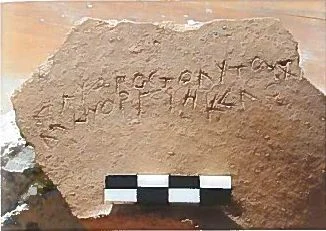
An ostracon with a fragmentary Greek inscription mentioning unnamed *Apostles, and possibly *Philip the Deacon and Evangelist (S00604). Found at Hierapolis (Phrygia, west central Asia Minor). Probably late antique.
- Language
- Greek
- Date from
- 400
- Date to
- 1300
- Evidence type
- Images and objects; Inscriptions
- Evidence subtype
- Inscribed objects; Other portable objects (metalwork, ivory, etc.)
- Evidence region
- Asia Minor
- Evidence location
- Hierapolis; Nicomedia, Νικομήδεια, Nikomēdeia, Izmit, Πραίνετος, Prainetos, Nicomedia
- Cult region
- Asia Minor
- Cult location
- Hierapolis; Nicomedia, Νικομήδεια, Nikomēdeia, Izmit, Πραίνετος, Prainetos, Nicomedia
- Cult date from
- 400
- Cult date to
- 1300
Text
An ostracon, found near the Byzantine church, to the east of the agora.
Inscription:
[- - -] ἅγυ ἀπόστολυ τοῦ Χ[ριστοῦ - - -]
[- - -] ΜΗΥΟΡΓΟΥ ἡ καλο[υμένη - - -]
1. ἅγυ (= ἅγ<ι>οι) ἀποστόλυ τοῦ Χ[ριστοῦ Ritti, ἁγυ ἀπόστολυ τ(οῦ) Huttner || ἅγι ὑ ἀπόστολυ τοῦ Arthur || 2. ΜΗΥΟΡΓΟΥ ἡ καλο[υμένη Huttner, μη υοριου (?) ἡ χαλου[μένη Arthur
'[- - -] the holy Apostles of Christ [- - -] also called [- - -]'
Text: Arthur 2006, 121, modified.
Discussion
Paul Arthur, the first editor of the inscription, supposed that it mentioned a single, unnamed Apostle, whom he identified as Philip, since Hierapolis was a major place of his cult. However, Ulrich Huttner rightly points out that the word 'Apostle' in line 1 is in the plural form. Therefore, the inscription refers to a group of unspecified Apostles. The purpose of this fragmentary text is unclear.
We hypothetically suggest that, providing that Huttner's reading is correct, line 2 may contain a quotation of Acts 8:10: οὗτός ἐστιν ἡ δύναμις τοῦ θεοῦ ἡ καλουμένη Μεγάλη/'This man is the power of God called Great', here modified as οὗτός ἐστιν ἡ δύναμις τοῦ δη]μ<ιου>ργοῦ ἡ καλο[υμένη Μεγάλη/'This man is the power of the Creator called Great', instead of the regular form. A possible connection between our ostracon and the passage from Acts 8 is probable, as this chapter describes the encounter of Philip (probably the Deacon and Evangelist) with Simon the Magician. Another possibility, kindly suggested to us by Francesco Guizzi in a letter, is that line 2 contains a personal name.
Bibliography
Edition:
Ritti, T., Storia e istituzioni di Hierapolis. Hierapolis di Frigia IX (Istanbul: Ege Yayınları, 2017), 228 (line 1).
Arthur, P., Byzantine and Turkish Hierapolis (Pamukkale): an archaeological guide (Istanbul: Ege Yayınları, 2006), 121.
Inscriptiones Christianae Graecae database, no. 934: http://www.epigraph.topoi.org/ica/icamainapp/inscription/show/934
Images
Associated saints
| Saint | Name in source | Certainty |
|---|---|---|
| Apostles, unnamed or name lost (S00084) | ἀπόστολυ | Certain |
| Philip the Deacon and Evangelist (S00604) | Uncertain | |
| Philip, the Apostle (S00109) | Uncertain |
Cult classifications
- Non Liturgical Activity
- Composing and translating saint-related texts; Prayer/supplication/invocation
Record author
Pawel Nowakowski
Entry date
26/02/2016
Citation
Pawel Nowakowski, Cult of Saints, E01153 — https://csla.history.ox.ac.uk/record.php?recid=E01153