
E01176
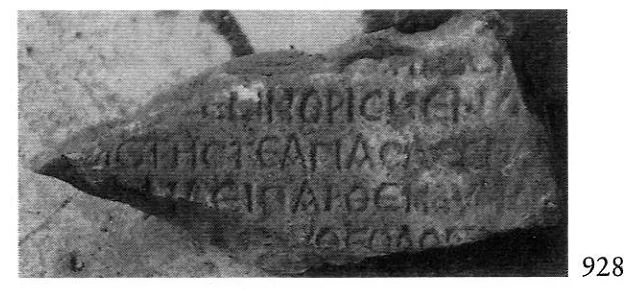
Fragment of a Greek inscription referring to *Mary (Mother of Christ, S00033) and *John the Apostle and Evangelist (S00042) as the Theologian, probably with an excerpt from an imperial letter. Found in Pythagorio (Samos, the Aegean Islands). Tentatively dated to mid 5th c., but more likely to be 6th c.
- Language
- Greek
- Date from
- 450
- Date to
- 610
- Evidence type
- Canonical and legal texts; Inscriptions
- Evidence subtype
- Formal inscriptions (stone, mosaic, etc.)
- Evidence region
- Aegean islands and Cyprus; Asia Minor
- Evidence location
- Ephesus; Nicomedia, Νικομήδεια, Nikomēdeia, Izmit, Πραίνετος, Prainetos, Nicomedia; Pythagorio; Salamis, Σαλαμίς, Salamis, Salamis, Farmagusta, Far, Κωνσταντία, Konstantia, Constantia; Samos; Salamis, Σαλαμίς, Salamis, Salamis, Farmagusta, Far, Κωνσταντία, Konstantia, Constantia
- Cult region
- Aegean islands and Cyprus; Asia Minor
- Cult location
- Ephesus; Nicomedia, Νικομήδεια, Nikomēdeia, Izmit, Πραίνετος, Prainetos, Nicomedia; Pythagorio; Salamis, Σαλαμίς, Salamis, Salamis, Farmagusta, Far, Κωνσταντία, Konstantia, Constantia; Samos; Salamis, Σαλαμίς, Salamis, Salamis, Farmagusta, Far, Κωνσταντία, Konstantia, Constantia
- Cult date from
- 450
- Cult date to
- 610
Text
]̣προσ I[
]σεσιν ὁρισμένῳ [
]̣ας τῆς τε ἁγίας δεσποί[νης ἡμῶν]
[Θεοτόκου κ]αὶ ἀειπαρθένου Μα̣ρ[ίας
το]ῦ θεολόγ[ου
1. ]̣προσ I////[ Hallof || 2. σὺν] ̣προσ̣ή[κοντι or σὺν] ̣προσ̣ή[κουσι αὐτῷ Hallof || 3. ἄλ]σεσιν Dunst || 6. καὶ τοῦ ἁγίου Ἰωάννου το]ῦ θεολόγ[ου Hallof
'[- - - with - - -] belonging [to it (?) - - - ], delimited [- - -] and of [our] holy Lady, [the God-Bearer (Theotokos)] and forever virgin Mary [- - - and of Saint John] the Theologian [- - -]'
Text: IG XII 6,2, no. 928.
Source
A marble plaque, broken and lost on all sides. Preserved dimensions: H. 0.195 m; W. 0.385 m; Th. 0.065 m; letter height 0.02-0.023 m. Found in Pythagorio (Samos) in 1964. Kept in the Museum of Pythagorio. First copied by Günter Dunst, published by Klaus Hallof.
Discussion
The inscription refers to one or two churches, dedicated to the Virgin Mary and to John the Apostle and Evangelist, here named the 'Theologian'. Lines 1-2 could contain references to its/their property. Therefore, it is not unlikely that we are dealing with the remnants of the monumental publication of an emperor's, bishop's or governor's letter, bestowing privileges upon the mentioned church(es).
Klaus Hallof supposes that the sanctuary referred to is the episcopal church, built at Pythagorio in the mid 5th c. (for the church, see: Schneider 1929, 112-119; Tölle-Kastenbein 1974, 92-105), but this is, of course, highly conjectural. As the island of Samos lies very close to Ephesos, we can speculate that the churches mentioned are rather the renowned Ephesian sanctuaries: the episcopal church of Mary (also named the Council Church), and the church of John the Apostle on the Ayasoluk hill (which is even more probable as John was venerated as 'the Theologian' in Ephesos). We know that there was a conflict between the churches of Ephesos and Smyrna (or at least a degree of competition), which provoked the personal involvement of the emperor Justinian or his successors in settling the quarrel (see: E00765, E00766, E00778). Perhaps our inscription should be added to the dossier of imperial and episcopal letters, aimed at solving the problem. The presumed letter could deal, for example, with an estate on Samos, disputed between the two sanctuaries. The stone could also have been originally displayed in Ephesos and brought to Samos at a later period, to be reused in a building.
Dating: tentatively dated to the mid 5th c. by Hallof, based on the supposition that the inscription refers to the episcopal basilica of Pythagorio, built c. 450. A later date is actually more probable, because of the possible authorship of Justinian or one of his successors.
Bibliography
Edition:
Nowakowski, P., "A new imperial letter from the Ephesian dossier, concerning the churches of John and Mary in Ephesus? A re-edition of IG XII 6,2 928", Zeitschrift für Papyrologie und Epigraphik 204 (2017), 72-78.
Inscriptiones Graecae XII 6,2, no. 928.
Further reading:
Schneider, A.M., "Samos in Frühchristlicher und Byzantinischer zeit" Athenische Mitteilungen 54 (1929), 112-119.
Tölle-Kastenbein, R., Das Kastro Tigani : die Bauten und Funde griechischer, römischer und byzantinischer Zeit (Samos 14, Berlin: Dt. Archäolog. Inst., Bonn: Habelt, 1974), 92-107.
Reference works:
Chroniques d'épigraphie byzantine, 238.
Supplementum Epigraphicum Graecum 53, 877.
Images
Associated saints
| Saint | Name in source | Certainty |
|---|---|---|
| Mary, Mother of Christ (S00033) | Μαρ[ία] | Certain |
| John, the Apostle and Evangelist (S00042) | Θεολόγ[ος] | Certain |
Cult classifications
- Cult Places
- Cult building - independent (church)
- Non Liturgical Activity
- Awarding privileges to cult centres; Seeking asylum at church/shrine
- People
- Monarchs and their family
Record author
Paweł Nowakowski
Entry date
07/03/2016
Citation
Paweł Nowakowski, Cult of Saints, E01176 — https://csla.history.ox.ac.uk/record.php?recid=E01176