
E01180
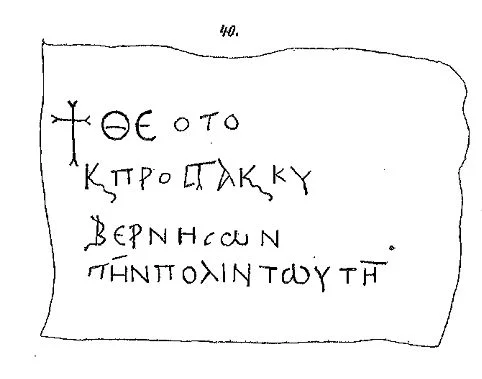
Greek invocation of *Mary (Mother of Christ, S00033), as the God-Bearer, asked to 'steer' a city. Found at Mytilene (Lesbos). Possibly late antique or later.
- Language
- Greek
- Date from
- 431
- Date to
- 1300
- Evidence type
- Inscriptions
- Evidence subtype
- Formal inscriptions (stone, mosaic, etc.)
- Evidence region
- Aegean islands and Cyprus
- Evidence location
- Lesbos; Salamis, Σαλαμίς, Salamis, Salamis, Farmagusta, Far, Κωνσταντία, Konstantia, Constantia; Mytilene; Salamis, Σαλαμίς, Salamis, Salamis, Farmagusta, Far, Κωνσταντία, Konstantia, Constantia
- Cult region
- Aegean islands and Cyprus
- Cult location
- Lesbos; Salamis, Σαλαμίς, Salamis, Salamis, Farmagusta, Far, Κωνσταντία, Konstantia, Constantia; Mytilene; Salamis, Σαλαμίς, Salamis, Salamis, Farmagusta, Far, Κωνσταντία, Konstantia, Constantia
- Cult date from
- 431
- Cult date to
- 1300
Text
+ Θεοτό-
κ(αι) πρόστα κ(αὶ) κυ-
βέρνησων
τὴν πόλιν ταύτη(ν)
1-2. Θεοτό|κ(αι) = Θεοτό|κ(ε) the word is abbreviated in the same way as κ(αὶ), so the ending -αι is expected || πρόστα = πρόστηθι Papageorgiu
'+ O God-Bearer (Theotokos), command and steer this city!'
Text: Papageorgiu 1900, no. 40.
Source
A large white plaque, found in March 1895 by Petros Papageorgiu, director of the Gymnasium of Mitilini, at the site of a house at Mytilene, next to a fragment of the epitaph for a bishop.
Discussion
The inscription is an invocation of Mary as the God-Bearer. The saint is asked to 'steer' (κυβερνάω) a city, apparently Mytilene itself. The verb κυβερνάω has obvious maritime connotations and was probably chosen because Mytilene was located on the island of Lesbos and the inhabitants were often engaged in maritime business.
The inscription certainly post-dates 431, as the title God-Bearer (Θεοτόκος) became popular only after the council of Ephesos, held in that year, but it may actually be of a much later date.
Bibliography
Edition:
Grégoire, H (ed.), Recueil des inscriptions grecques chrétiennes d'Asie Mineure, vol. 1 (Paris: Leroux, 1922), no. 151.
Papageorgiou, P., Unedierte Inschriften von Mytilene (Leipzig: B.G. Teubner, 1900), no. 40.
Further reading:
Kiourtzian, G., "Pietas insulariorum", [in:] Eupsychia: mélanges offerts à Hélène Ahrweiler, vol. 2 (Série Byzantina Sorbonensia 16, Paris: Publications de la Sorbonne, 1998), 376.
Images
Associated saints
| Saint | Name in source | Certainty |
|---|---|---|
| Mary, Mother of Christ (S00033) | Θεοτόκος | Certain |
Cult classifications
- Non Liturgical Activity
- Prayer/supplication/invocation; Saint as patron - of a community
Record author
Paweł Nowakowski
Entry date
10/03/2016
Citation
Paweł Nowakowski, Cult of Saints, E01180 — https://csla.history.ox.ac.uk/record.php?recid=E01180