
E01290
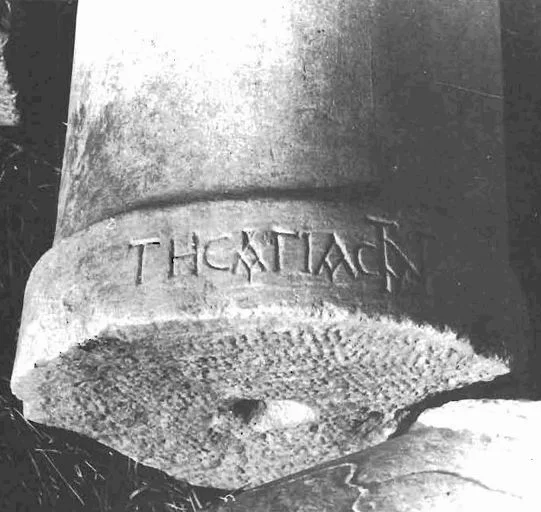
Two Greek inscriptions on columns, with the name of a certain saint *Anastasia (perhaps a local martyr, S00457). Found in the basilica at Apolakkia-Zonaras (Rhodes, the Aegean Islands). Probably 5th-7th c.
- Language
- Greek
- Date from
- 400
- Date to
- 700
- Evidence type
- Archaeological and architectural; Inscriptions
- Evidence subtype
- Cult buildings (churches, mausolea); Inscribed architectural elements
- Evidence region
- Aegean islands and Cyprus
- Evidence location
- Apolakkia; Salamis, Σαλαμίς, Salamis, Salamis, Farmagusta, Far, Κωνσταντία, Konstantia, Constantia; Rhodes (island); Salamis, Σαλαμίς, Salamis, Salamis, Farmagusta, Far, Κωνσταντία, Konstantia, Constantia
- Cult region
- Aegean islands and Cyprus
- Cult location
- Apolakkia; Salamis, Σαλαμίς, Salamis, Salamis, Farmagusta, Far, Κωνσταντία, Konstantia, Constantia; Rhodes (island); Salamis, Σαλαμίς, Salamis, Salamis, Farmagusta, Far, Κωνσταντία, Konstantia, Constantia
- Cult date from
- 400
- Cult date to
- 700
Text
Two identical inscriptions carved on two columns. The last word is written as a monogram.
τῆς ἁγίας (Ἀναστασίας)
'Of Saint (Anastasia)'
Text: Volanakis 1994, 775.
Source
The inscriptions are written on two columns from the eastern and western colonnade of the ruined basilica in Apolakkia-Zonaras. Zonaras is the name of a small hill, located c. 3 km to the south of the modern city of Apolakkia, in the south-western part of the island.
The site was first surveyed by Volanakis in 1978, but having examined the hill he found there no ruins of a church. However, the remnants of a church were unearthed, together with ancient spolia (columns, capitals, stylobates, a pre-Christian altar) in the spring of 1993, during the construction of a channel. The site was immediately reinspected by Volanakis, and two campaigns, authorised by the Archaeological Service of the Dodekanese followed. The excavations revealed remnants of a settlement, prospering from the Hellenistic to the later Roman period, destroyed in the 7th c.
On the south-western side of the hill, ruins of a three-aisled basilica were found. The basilica apparently had a wooden roof and was built over an earlier pagan shrine. Its construction was approximately dated to the 5th c. The inner size of the basilica (without the apse and the narthex) is c. 19.00 m x 14.60 m. Two rows of columns separated the nave from two aisles. The church was probably damaged by an earthquake in the 6th c., and later destroyed in a violent event in the 7th c. In the medieval period a small chapel was erected at the site.
Discussion
Ioannis Volanakis identifies the saint as *Anastasia of Rome (whose cult migrated there from Sirmium, S00602); however a local martyr, lacking an extant hagiographic tradition, is also possible. There is a church of Anastasia, excavated in Arkasa on the nearby island of Karpathos (for which see E01297), and the presence of two churches of a Saint Anastasia on adjoining islands supports the possibility that they are dedications to a local saint, otherwise unknown.
The basilica, where the inscription was found, was roughly dated by Volanakis to the 5th/7th c. The presence of a monogram in the text of the inscriptions points to the latter half of this period.
The actual purpose of these inscriptions is unknown, as they are finely carved, they are certainly not pilgrim graffiti. Perhaps they were made in the quarry, to mark the church which ordered the columns.
Bibliography
Edition:
Volanakis, I.E., "Die frühchristliche Basilika der heiligen Anastasia von Zonaras Apolakkia Rhodos", ΘΕΟΛΟΓΙΑ, τόμος 66/4, 769-791.
Volanakis, I.E., "Die frühchristliche Basilika der heiligen Anastasia von Zonaras Apolakkia Rhodos", [in:] Radovi XIII. međunarodnog Kongresa za Starokršćansku Arheologiju = Acta XIII Congressus internationalis archaeologiae christianae: Split - Poreć (25.9 - 1.10.1994.), vol. 3 (Split, Croatia: Archeološki muzej; Roma: Pontificio Istituto di Archeologia Cristiana, 1998).
Further reading:
Volanakis, I.E., "Frühchristliche Monumente auf der Insel Rhodos – ein Überblick", [in:] M. Gourdouba, L. Pietilä-Castrén, E. Tikkala (eds.), The Eastern Mediterranean in the Late Antique and Early Byzantine Periods (Helsinki: Suomen Ateenan-instituutin säätiö, 1994), 75-98.
Reference works:
Chroniques d'épigraphie byzantine, 244.
Images
Associated saints
| Saint | Name in source | Certainty |
|---|---|---|
| Anastasia, perhaps a local martyr of the Aegean region (S00457) | Ἀναστασία | Uncertain |
| Anastasia, martyr of Sirmium and Rome (S00602) | Ἀναστασία | Uncertain |
Cult classifications
- Cult Places
- Cult building - independent (church)
- Non Liturgical Activity
- Appropriation of older cult sites
Record author
Paweł Nowakowski
Entry date
19/04/2016
Citation
Paweł Nowakowski, Cult of Saints, E01290 — https://csla.history.ox.ac.uk/record.php?recid=E01290