
E01323
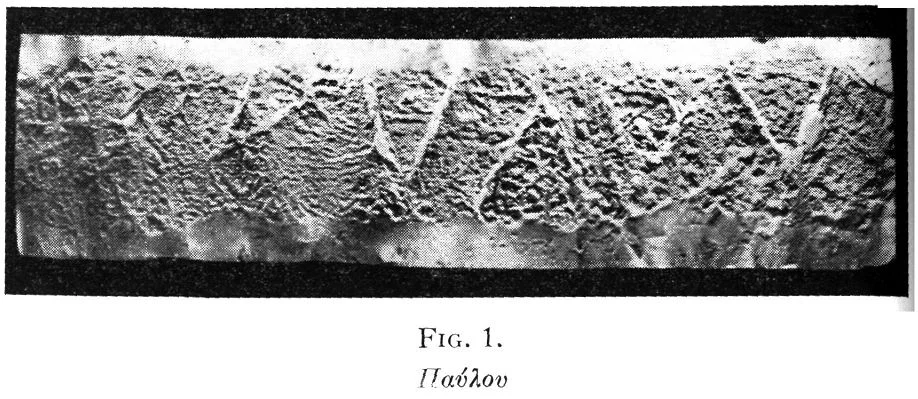
Greek inscription with the name Paulos, believed to have been on the lintel of a monastic church or chapel dedicated to *Paul the Apostle (S00008). Found near Salamis/Constantia (Cyprus). Probably late antique.
- Language
- Greek
- Date from
- 324
- Date to
- 600
- Evidence type
- Inscriptions
- Evidence subtype
- Formal inscriptions (stone, mosaic, etc.)
- Evidence region
- Aegean islands and Cyprus
- Evidence location
- Salamis; Salamis, Σαλαμίς, Salamis, Salamis, Farmagusta, Far, Κωνσταντία, Konstantia, Constantia
- Cult region
- Aegean islands and Cyprus
- Cult location
- Salamis; Salamis, Σαλαμίς, Salamis, Salamis, Farmagusta, Far, Κωνσταντία, Konstantia, Constantia
- Cult date from
- 324
- Cult date to
- 600
Text
+ Παύλου
'+ Of (the holy Apostle?) Paul'
Text: Salamine de Chypre XIII, no. 201.
Source
A complete rough sandstone block. H. 0,17 m; W. 1,07 m; Th. 0,5-0,6 m; letter height 0.08-0.11 m. Deep and neatly carved letters. Seen and copied (a squeeze) by Terence Bruce Mitford in August of 1936 in the Monastery of St. Barnabas, 1,25 miles west of Salamis/Constantia. When recorded, the block was reused as the top of three steps “leading from court to portico to the West of the monastic church”. To the right of the inscription there is a simple carving of a palm frond.
Discussion
Mitford argued that the inscribed name Paulos referred to *Paul the Apostle and that the block was originally a lintel of a monastic chapel, dedicated to the saint. He compared the object with similar inscribed lintels from Syria, from churches dedicated to *Paul and *Peter (E01873), *Sergios (E01805; E01650), and *Sergios and *Bakchos (E02234) (see: Mitford 1950, 106, note 1).
One could expect that the first missionary journey of Paul, during which he visited Cyprus together with the native Cypriote Jew *Barnabas (S00786), described in detail in Acts (13:4-13), would make him a figure likely to have been venerated on the island. But, surprisingly, we have little evidence there for the cult of Paul, and Barnabas appears to have been a much more prominent figure (see the comments in E01317). Mitford himself noted that in the earlier half of the 20th c. only one small modern chapel was consecrated to Paul near the village of Agios Dhometios, and that the church of Chrysopolitissa at Nea Paphos housed a pillar, said to be the one, to which Paul had been bound and scourged, but significantly the church itself was not dedicated to the Apostle. Therefore, the identification of Paulos mentioned in our inscription with the Apostle is highly hypothetical, as, for example a donor or the founder of the chapel could equally well be referred to in the lintel inscription.
Dating: Mitford speculated that the inscription could have been carved even in the 4th c., perhaps under Constantine I (324-337). His arguments are, however, of little value. He pointed out that the letter forms resemble 4th c. Cypriot inscriptions, and that the lack of the title of 'Apostle'/ἀπόστολος or 'saint'/ἅγιος before the name, might indicate a very early phase of the cult of saints. His other idea was that the inscription was made in the early 5th c., when Cypriot bishops were stressing the Apostolic origins of the Cypriot church in their struggle for independence from the patriarchs of Antioch. The church of Cyprus was eventually recognised as autocephalous at the Council of Ephesos 431. These suggestions are, of course, implausible, as we are not even certain if the inscription mentions the Apostle or another person, and the letter forms are not much different from those of 5th/6th c. inscriptions. The object can be only dated broadly to the Christian period (4th-6th c.).
Bibliography
Edition:
Pouilloux, J., Roesch, P., Marcillet-Jaubert J. (eds.), Salamine de Chypre XIII Testimonia Salaminia 2. Corpus épigraphique (Paris: Diffusion de Boccard, 1987), no. 201.
Mitford, T.B., "Some new inscriptions from early Christian Cyprus", Byzantion 20 (1950), no. 1.
Further reading:
Halkin, F., "L'Egypte, Chypre, la Crète et les autres îles grecques. La Grèce continentale et les pays balkaniques. L'Italie et la Sycylie", Analecta Bollandiana 70 (1952), 118 (accepted Mitford's implausible dating).
Images
Associated saints
| Saint | Name in source | Certainty |
|---|---|---|
| Paul, the Apostle (S00008) | Παῦλος | Uncertain |
Cult classifications
- Cult Places
- Cult building - dependent (chapel, baptistery, etc.); Cult building - independent (church)
- Places Names after Saint
- Monastery
Record author
Paweł Nowakowski
Entry date
01/05/2016
Citation
Paweł Nowakowski, Cult of Saints, E01323 — https://csla.history.ox.ac.uk/record.php?recid=E01323