
E01340
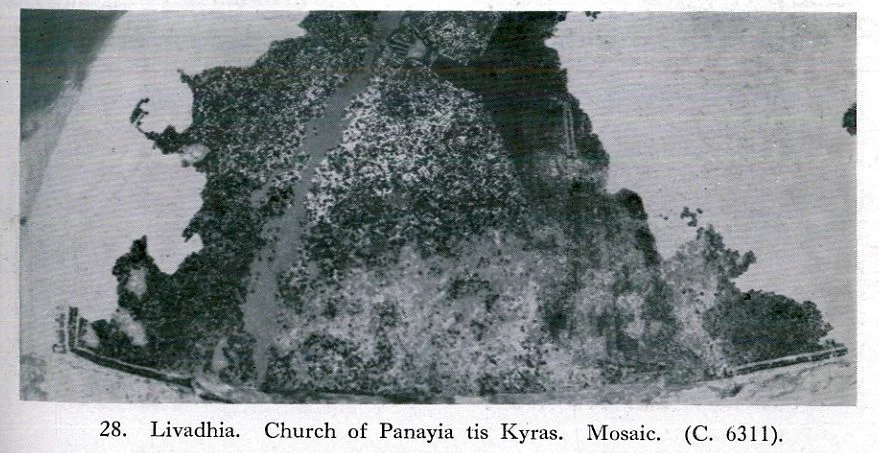
The church of Panagia tes Kyras near Livadia (eastern Cyprus) houses a mosaic with depictions of Christ, *Mary (Mother of Christ, S00033), and an unnamed *Archangel. Probably 6th c.
- Date from
- 550
- Date to
- 600
- Evidence type
- Archaeological and architectural; Images and objects
- Evidence subtype
- Cult buildings (churches, mausolea); Representative images; Wall paintings and mosaics
- Evidence region
- Aegean islands and Cyprus
- Evidence location
- Livadia; Salamis, Σαλαμίς, Salamis, Salamis, Farmagusta, Far, Κωνσταντία, Konstantia, Constantia
- Cult region
- Aegean islands and Cyprus
- Cult location
- Livadia; Salamis, Σαλαμίς, Salamis, Salamis, Farmagusta, Far, Κωνσταντία, Konstantia, Constantia
- Cult date from
- 550
- Cult date to
- 600
Text
Four Cypriot churches: Panagia Kanakaria at Lythrankomi (E01338), Panagia Angeloktistos at Kiti, Panagia tes Kyras near Livadia (E01340), and the episcopal basilica of Kourion (E01341), house pre-iconoclastic mosaics with depictions of Christ, *Mary, Mother of Christ, *Archangels, *Apostles, and *Evangelists. Arthur Megaw and Ernst Hawkins suppose that the mosaics survived iconoclasm, because Cyprus was exempted, as neutral ground, from direct Byzantine authority after the the treaty of 688 between Justin II and 'Abd al-Malik, and thus the imperial iconoclastic policy was not enforced there.
The church of the Panagia tes Kyras near Livadia lies in the eastern part of the island. The site was missed by Jakov Smirnov, Russian archaeologist and medievalist art historian, who in 1895 surveyed the churches of Panagia Kanakaria and Panagia Angeloktistos, and identified their apse mosaics as a rare pre-iconoclastic works.
Little of this mosaic is now extant, mostly due to the activity of art thieves after the division of Cyprus in 1974 (see: Michaelides 1989, 199; Van der Werff 1989, 28). The mosaic showed Mary, Mother of Christ, raising her arms toward heaven. It is supposed that she was accompanied by at least one Archangel, presumably Michael (S00181) or Gabriel (S00192).
Bibliography
Further reading:
Jeffery, G.E., “Byzantine churches in Cyprus”, Proceedings of the Society of Antiquaries of London 28 (1915-1916), 123.
Michaelides, D., Karageorghis V., Cypriot Mosaics (Nicosia: Published by the Dept. of Antiquities, Cyprus, 1987), 56-57, no. 71-70.
Michaelides, D., "The early Christian mosaics of Cyprus", The Biblical Archaeologist: From Ruins to Riches: CAARI on Cyprus 52/4 (1989), 192-202.
Megaw, A.H.S., [Short report], Annual Report of the Department of Antiquities, Cyprus (1961), 13, fig. 28.
Megaw, A.H.S., Hawkins, E.J.W., “A fragmentary mosaic of the Orant Virgin in Cyprus”, Actes du XIVe Congrès International des Etudes Byzantines, 1971, vol. 3 (Bucharest, 1976), 363-366.
Van der Werff, , Information Report of the Cultural Heritage of Cyprus Presented by the Committee on Culture and Education to the Parliamentary Assembly of the Council of Europe 6 July. Document 6079.
Images
Associated saints
| Saint | Name in source | Certainty |
|---|---|---|
| Mary, Mother of Christ (S00033) | Certain | |
| Michael, the Archangel (S00181) | Uncertain | |
| Gabriel, the Archangel (S00192) | Uncertain |
Cult classifications
- Non Liturgical Activity
- Renovation and embellishment of cult buildings
- Use of Images
- Public display of an image
Record author
Paweł Nowakowski
Entry date
03/05/2016
Citation
Paweł Nowakowski, Cult of Saints, E01340 — https://csla.history.ox.ac.uk/record.php?recid=E01340