
E01403
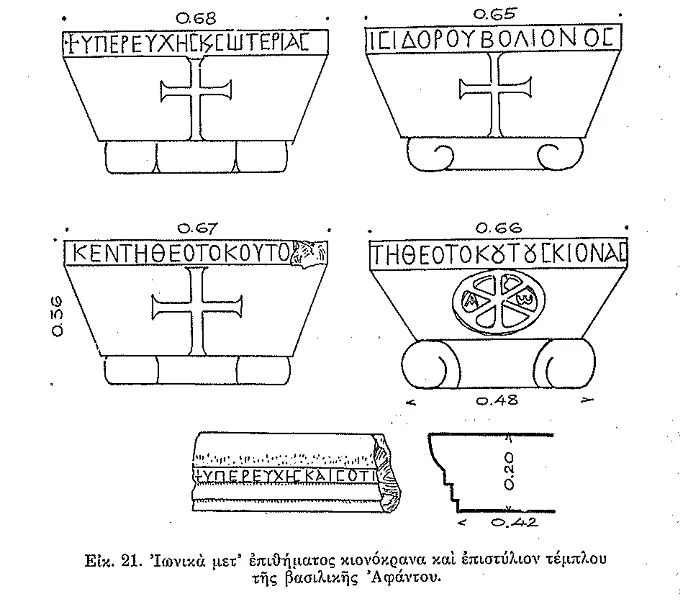
Greek dedicatory inscriptions on four capitals, commemorating the offering of columns to a church of *Mary (Mother of Christ, S00033). Found in the 17th c. church in the village of Aphantos/Afandou, near the city of Rhodes (island of Rhodes; Aegean Islands). Probably late antique.
- Language
- Greek
- Date from
- 400
- Date to
- 600
- Evidence type
- Inscriptions
- Evidence subtype
- Formal inscriptions (stone, mosaic, etc.); Inscribed architectural elements
- Evidence region
- Aegean islands and Cyprus
- Evidence location
- Afandou; Salamis, Σαλαμίς, Salamis, Salamis, Farmagusta, Far, Κωνσταντία, Konstantia, Constantia; Rhodes (island); Salamis, Σαλαμίς, Salamis, Salamis, Farmagusta, Far, Κωνσταντία, Konstantia, Constantia
- Cult region
- Aegean islands and Cyprus
- Cult location
- Afandou; Salamis, Σαλαμίς, Salamis, Salamis, Farmagusta, Far, Κωνσταντία, Konstantia, Constantia; Rhodes (island); Salamis, Σαλαμίς, Salamis, Salamis, Farmagusta, Far, Κωνσταντία, Konstantia, Constantia
- Cult date from
- 400
- Cult date to
- 600
Text
Inscription A: + ὑπὲρ εὐχῆς κ(αὶ) σωτηρίας
Inscription B: Ἰσιδόρου Βολίονος
Inscription C: ἀνέθη]κεν τῇ Θεοτόκου το[ὺς κίονας
Inscription D: τῇ Θεοτόκου τοὺς κίονας
Inscription A: '+ As a vow and for the salvation'
Inscription B: 'of Isidoros, son of Bolion'
Inscription C: 'dedicated [the columns] to the (church) of the God-Bearer'
Inscription D: 'the columns to the (church) of the God-Bearer'
Text: Orlandos 1948, 25-26.
Source
Τhe 17th c. church, dedicated to Παναγία ἡ Καθολική in the village of Afandou was examined by Anastasios Bandy before 1948. The scholar found there 5 column shafts (diameter 0.45 m), reused in the northern and southern walls of the church, which he rightly attributed to a late antique basilica. Next to the fencing of the church he found also inscribed Ionic column capitals of greyish marble, measuring on top c. W. 0.65-0.68 m; L. 0.89-0.995 m; H. 0.28 m. The capitals were decorated with carvings of crosses, and a christogram within a circle, flanked by the letters Α and Ω. Orlandos examined four of them.
The inscriptions run on a band, on top of the capitals, on the side that was almost certainly facing the nave of the church. It is probable that the text was repeated on both southern and northern sides of the name, as capitals C and D bear very similar passages.
Discussion
The inscriptions certainly belonged to the same dedicatory text, commemorating the offering of columns by a certain Isidoros, son of Bolion, to a church of Mary, venerated as the God-Bearer.
Interestingly, on capitals C and D the word 'God-Bearer'/Θεοτόκος is in the genitive form, but is preceded by the article in the dative form. Orlandos explained this confusing fact by the inconsistent grammar of late antique popular Greek and corrected the expression to either τῇ Θεοτόκῳ or τῆς Θεοτόκου. It is, however, much more probable that the article refers to the understood noun ἐκκλησία/'church'.
Bibliography
Edition:
Orlandos, A.K., "Παλαιοχριστιανικά λείψανα τῆς Ῥόδου", Ἀρχεῖον τῶν βυζαντινῶν μνημείων τῆς Ἑλλάδος 6 (1948), 25-26.
Further reading:
Kiourtzian, G., "Pietas insulariorum", [in:] Eupsychia: mélanges offerts à Hélène Ahrweiler, vol. 2 (Série Byzantina Sorbonensia 16, Paris: Publications de la Sorbonne, 1998), 377.
Reference works:
Supplementum Epigraphicum Graecum 40, 777-780.
Images
Associated saints
| Saint | Name in source | Certainty |
|---|---|---|
| Mary, Mother of Christ (S00033) | Θεοτόκος | Certain |
Cult classifications
- Cult Places
- Cult building - independent (church)
- Non Liturgical Activity
- Bequests, donations, gifts and offerings; Construction of cult buildings; Prayer/supplication/invocation; Renovation and embellishment of cult buildings; Vow
- People
- Other lay individuals/ people
Record author
Paweł Nowakowski
Entry date
27/05/2016
Citation
Paweł Nowakowski, Cult of Saints, E01403 — https://csla.history.ox.ac.uk/record.php?recid=E01403