
E01430
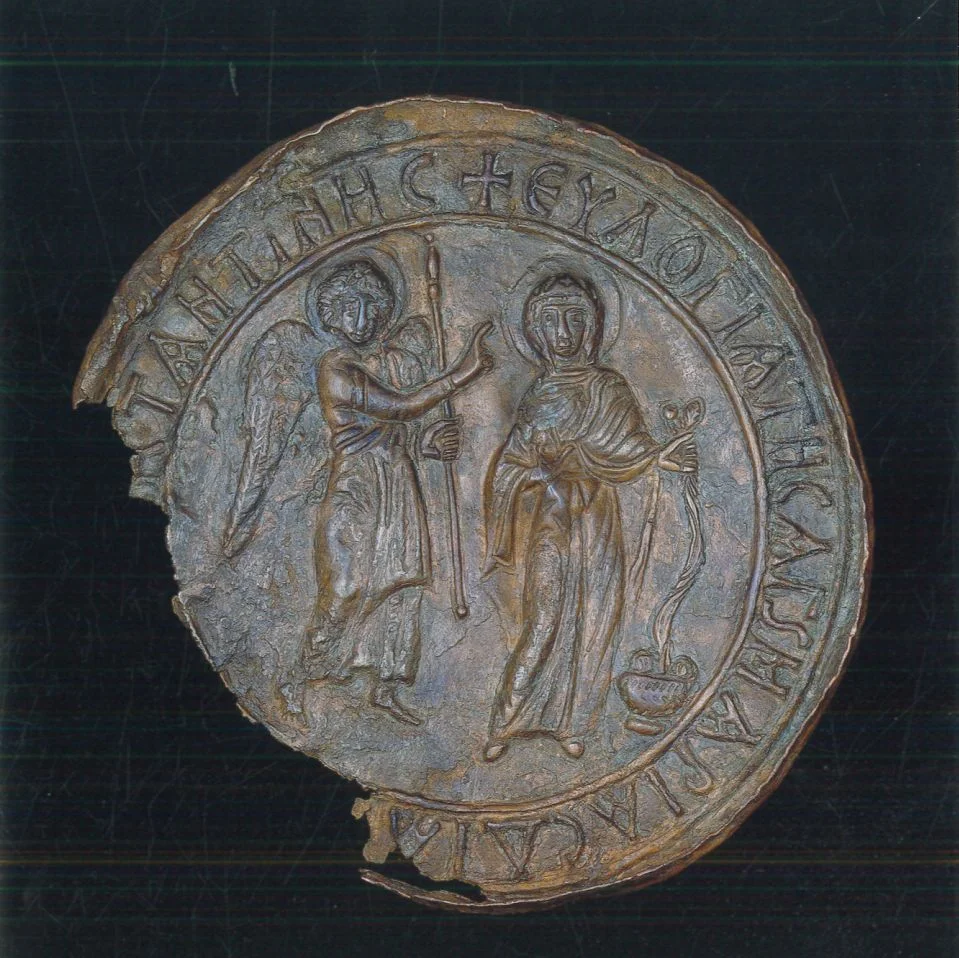
Copper disc with a depiction of *Mary (Mother of Christ, S00033) and *Gabriel (the Archangel, S00192) in the Annunciation scene. Probably from Constantina/Tella (north Mesopotamia/Osroene). Probably 6th c.
- Language
- Greek
- Date from
- 500
- Date to
- 600
- Evidence type
- Images and objects; Inscriptions
- Evidence subtype
- Inscribed objects; Lamps, ampullae and tokens; Narrative scenes
- Evidence region
- Mesopotamia
- Evidence location
- Constantina/Tella; Edessa, Edessa, Ἔδεσσα, Edessa
- Cult region
- Mesopotamia
- Cult location
- Constantina/Tella; Edessa, Edessa, Ἔδεσσα, Edessa
- Cult date from
- 500
- Cult date to
- 600
Text
Copper disc/medallion, resembling the bottom of a cup. Diameter: c. 0.14 m; Th. c. 0.01-0.015 m. Broken and lost on the lower, left-hand quarter.
The disc is now in a private collection in Munich. It probably comes from Constantina/Tella (modern Viranşehir) in north Mesopotamia.
The inner part of the disc shows the scene of the Annunciation. The Archangel Gabriel is approaching Mary from the left. He is wearing a chlamys and stretching his right arm towards the Virgin. In his left hand he is holding a staff (a spear?). Mary is facing the viewer of the object. She is wearing a maphorion, holding a spindle, and taking (purple) wool out of a basket lying next to her feet. The scene renders the story of the Annunciation, as described in the Protoevangelium of James (11,1-2). It is said there that Mary was chosen from among eight women, descendants of David, to make a new purple curtain for the Temple.
The inscription runs in a band, around the edges of the object. It reads:
+ εὐλογία τῆς ἁγ(ίας) Μαρίας δια[- - -]̣ν̣σταντίνης
The inscription is fragmentary and so far two possible completions have been suggested. Brigitte Pitarakis read the label of the objet as: + εὐλογία τῆς ἁγ(ίας) Μαρίας δια[κονία τῆς Κω]νσταντίνης (corrected to διακονίας by Christian Schmidt), which means '+ Blessing of the Holy Mary from the diakonia in Constantina'. In her opinion diakonia means here a charitable institution, run by a monastery. Pitarakis points out that some of such institutions, located near Constantina/Tella, owned copper mines and several copper liturgical vessels, found in that area, were identified as their products. The other possible reconstruction, paralleled by an inscription from a terracotta medallion that served as a souvenir of a pilgrimage/eulogia (see: $EXXXX), is: + εὐλογία τῆς ἁγ(ίας) Μαρίας δια[μονῆς τῆς Κο]νσταντίνης, i.e.: '+ Blessing of the Holy Mary from her dwelling in Constantina'. It is probable that our disc was, likewise, a souvenir that was acquired by a pilgrim, visiting a sanctuary of Mary or that it was used as a patera for serving blessed bread, distributed at the end of the Eucharistic liturgy.
Dating: Schmidt notes that the Annunciation scene with standing Mary, and Gabriel approaching her from the left, is characteristic of the 6th c.
Bibliography
Edition:
Stiegemann, Ch., Byzanz, das Licht aus dem Osten: Kult und Alltag im Byzantinischen Reich vom 4. bis 15. Jahrhundert: Katalog der Ausstellung im Erzbischöflichen Diözesanmuseum Paderborn, Paderborn 2001 (Mainz: P. von Zabern, 2001), 142-144, no. I 45 (descr. Ch. Schmidt).
Israeli Y., Mevorah, D. (eds.), Cradle of Christianity (Exhibition in Jerusalem 2000, Jerusalem: 2000), 148, 223.
Wamser, L., Zahlhaas, G. (eds.), Rom und Byzanz. Archäologische Kostbarkeiten aus Bayern (Ausstellung München, Prähistorische Staatssammlung München, 1998/1999; Munich: 1998), 28-30, no. 18 (descr. Ch. Schmidt).
Vassiliaki, M. (ed.), The Mother of God, Representations of the Virgin in Byzantine Art (Exhibition in Athens 2000, Mailand: 2000), no. 5 (descr. B. Pitarakis).
Reference works:
Chroniques d'épigraphie byzantine, 1092.
Supplementum Epigraphicum Graecum 55, 1933.
Images
Associated saints
| Saint | Name in source | Certainty |
|---|---|---|
| Mary, Mother of Christ (S00033) | Μαρία | Certain |
| Gabriel, the Archangel (S00192) | Certain |
Cult classifications
- Cult Places
- Cult building - monastic; Cult building - secondary installation (fountain, pilgrims’ hostel)
- Cult Related Objects
- Ampullae, flasks, etc.; Chalices, censers and other liturgical vessels
- Places Names after Saint
- Hospital and other charitable institutions; Monastery
- Relics
- Ampullae, eulogiai, tokens
- Use of Images
- Private ownership of an image; Public display of an image
Record author
Paweł Nowakowski
Entry date
02/06/2016
Citation
Paweł Nowakowski, Cult of Saints, E01430 — https://csla.history.ox.ac.uk/record.php?recid=E01430