
E01631
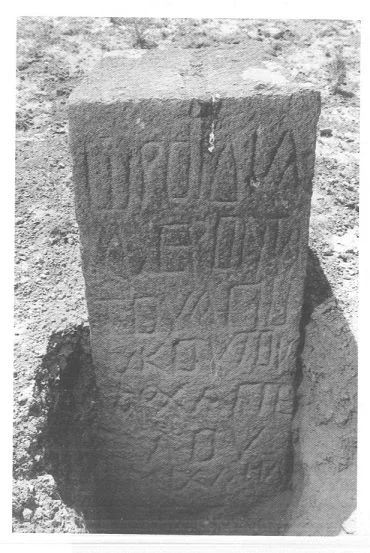
Greek inscription on a boundary stone of a church dedicated to *Michael (the Archangel, S00181). Found at Androna (modern al-Andarin), to the east of Apamea on the Orontes (central Syria). Probably 6th c.
- Language
- Greek
- Date from
- 500
- Date to
- 600
- Evidence type
- Inscriptions
- Evidence subtype
- Formal inscriptions (stone, mosaic, etc.)
- Evidence region
- Syria with Phoenicia
- Evidence location
- Androna; Antioch on the Orontes, Ἀντιόχεια, Antiocheia, Antiochia ad Orontem, Ἀντιόχεια Μεγάλη, Ἀντιόχεια ἐπὶ Ὀρόντου, Antakya
- Cult region
- Syria with Phoenicia
- Cult location
- Androna; Antioch on the Orontes, Ἀντιόχεια, Antiocheia, Antiochia ad Orontem, Ἀντιόχεια Μεγάλη, Ἀντιόχεια ἐπὶ Ὀρόντου, Antakya
- Cult date from
- 500
- Cult date to
- 600
Text
+
ὥροι δια-
φέροντα
τοῦ ἁγίου
ὔκου τοῦ
ἀρχαγγέ-
λου Μιχαήλ
+
'+ Boundaries belonging to the holy house of the Archangel Michael. +'
Text: Griesheimer 2001, no. 18.
Source
A rectangular basalt block. Its base not fully uncovered. H. (uncovered) 1.08 m; W. 0.4 m; Th. 0.4 m; letter height 0.06-0.10 m. The upper part of the carving of a cross is visible below the inscription.
Found, apparently in situ, still standing in the ground. Transcribed by Marc Griesheimer in July of 1993. First published by Griesheimer in 2001.
Discussion
The inscription marked the boundaries of a church dedicated to Michael the Archangel. It is probable that a lintel inscription from Androna, mentioning a church dedicated to Michael, comes from the same sanctuary (see: E01631).
Though this inscription does not say so explicitly, boundary stones were usually bestowed upon sanctuaries by emperors.
Dating: the phrasing resembles that of 6th c. boundary stone inscriptions, awarded to sanctuaries by the emperor Justinian and his successors.
Bibliography
Edition:
Griesheimer, M., "L'occupation byzantine sur les marges orientales du territoire d'Apamée de Syrie", [in:] B. Geyer (ed.), Conquête de la steppe et appropriation des terres sur les marges arides du Croissant fertile (Travaux de la Maison de l'Orient Méditerranéen 36, Lyon: Maison de l'Orient Méditerranéen-Jean Pouilloux, 2001), no. 18.
Further reading:
Mundell Mango, M., "Byzantine settlement expansion in north central Syria: the case of Androna/Andarin", in: A. Borrut, M. Debié, A. Papaconstantinou, D. Pieri, J.-P. Sodini (eds.), Le Proche-Orient de Justinien aux Abassides : peuplement et dynamiques spatiales : actes du colloque "Continuités de l'occupation entre les périodes byzantine et abbasside au Proche-Orient, VIIe-IXe siècles," Paris, 18-20 octobre 2007 (Bibliothèque de l'Antiquité tardive 19, Turnhout: Brepols, 2011), 93-122.
Mundell Mango, M., "Androna and the late antique cities of Oriens" in: E. Rizos (ed.), New Cities in Late Antiquity. Documents and Archaeology (Bibliothèque de l'Antiquité Tardive 35, Turnhout: Brepols, 2017), 189-204.
Reference works:
Bulletin épigraphique (2003), 563.
Supplementum Epigraphicum Graecum 51, 1948.
Images
Associated saints
| Saint | Name in source | Certainty |
|---|---|---|
| Michael, the Archangel (S00181) | Μιχαήλ | Certain |
Cult classifications
- Cult Places
- Cult building - independent (church)
- Non Liturgical Activity
- Awarding privileges to cult centres; Seeking asylum at church/shrine
Record author
Paweł Nowakowski
Entry date
15/06/2016
Citation
Paweł Nowakowski, Cult of Saints, E01631 — https://csla.history.ox.ac.uk/record.php?recid=E01631