
E01632
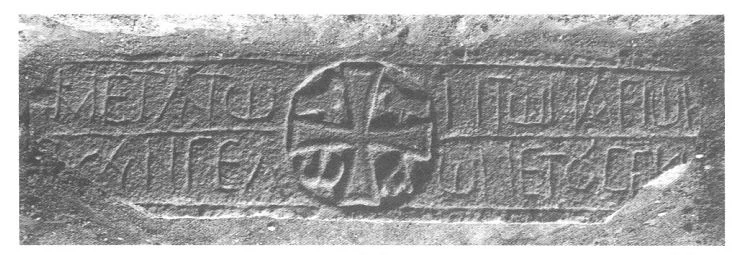
Greek building inscription for a hostel or quarters for soldiers (metaton) named after unnamed *Archangels. Found at Androna (modern al-Andarin), to the east of Apamea on the Orontes (central Syria). Dated 511/512.
- Language
- Greek
- Date from
- 511
- Date to
- 512
- Evidence type
- Inscriptions
- Evidence subtype
- Formal inscriptions (stone, mosaic, etc.)
- Evidence region
- Syria with Phoenicia
- Evidence location
- Androna; Antioch on the Orontes, Ἀντιόχεια, Antiocheia, Antiochia ad Orontem, Ἀντιόχεια Μεγάλη, Ἀντιόχεια ἐπὶ Ὀρόντου, Antakya
- Cult region
- Syria with Phoenicia
- Cult location
- Androna; Antioch on the Orontes, Ἀντιόχεια, Antiocheia, Antiochia ad Orontem, Ἀντιόχεια Μεγάλη, Ἀντιόχεια ἐπὶ Ὀρόντου, Antakya
- Cult date from
- 511
- Cult date to
- 512
Text
+ μετᾶτων τῶν ἁγίων
[ἀ]̣ρ̣χανγέλων· ἔτους γκ̣ω´
'+ Hostel of the holy Archangels. The year 823.'
Text: Griesheimer 2001, no. 17.
Source
A basalt lintel. H. 0.42 m; W. 1.65 m; Th. c. 0.28 m; letter height 0.09-0.12 m. Decorated with a carving of a large cross within a circle in its central section, and carvings of birds above, and the letters Ω and Α below the horizontal arms of the cross.
Found c. 300 m to the west of the citadel. First published by Marc Griesheimer in 2002.
Discussion
The inscription commemorates the construction (or less probably the refurbishment) of a metaton, i.e. quarters for soldiers or a hostel for pilgrims, clergy, etc. The date, year 823, is given according to the Seleucid era, which corresponds to AD 511/512. Griesheimer notes that as the citadel in Androna was built later, in AD 558/559, our metaton was probably a civil or ecclesiastical building, and not a garrison, cf. E00807; E01834.
Bibliography
Edition:
Griesheimer, M., "L'occupation byzantine sur les marges orientales du territoire d'Apamée de Syrie", [in:] B. Geyer (ed.), Conquête de la steppe et appropriation des terres sur les marges arides du Croissant fertile (Travaux de la Maison de l'Orient Méditerranéen 36, Lyon: Maison de l'Orient Méditerranéen-Jean Pouilloux, 2001), no. 17.
Further reading:
Mundell Mango, M., "Byzantine settlement expansion in north central Syria: the case of Androna/Andarin", in: A. Borrut, M. Debié, A. Papaconstantinou, D. Pieri, J.-P. Sodini (eds.), Le Proche-Orient de Justinien aux Abassides : peuplement et dynamiques spatiales : actes du colloque "Continuités de l'occupation entre les périodes byzantine et abbasside au Proche-Orient, VIIe-IXe siècles," Paris, 18-20 octobre 2007 (Bibliothèque de l'Antiquité tardive 19, Turnhout: Brepols, 2011), 93-122.
Mundell Mango, M., "Androna and the late antique cities of Oriens" in: E. Rizos (ed.), New Cities in Late Antiquity. Documents and Archaeology (Bibliothèque de l'Antiquité Tardive 35, Turnhout: Brepols, 2017), 189-204.
Reference works:
Bulletin épigraphique (2003), 563.
Supplementum Epigraphicum Graecum 51, 1941.
Images
Associated saints
| Saint | Name in source | Certainty |
|---|---|---|
| Archangels, unnamed or name lost (S00191) | [ἀ]ρχάνγελοι | Certain |
Cult classifications
- Cult Places
- Cult building - independent (church); Cult building - secondary installation (fountain, pilgrims’ hostel)
- Places Names after Saint
- Hospital and other charitable institutions; Other; Towns, villages, districts and fortresses
Record author
Paweł Nowakowski
Entry date
15/06/2016
Citation
Paweł Nowakowski, Cult of Saints, E01632 — https://csla.history.ox.ac.uk/record.php?recid=E01632