
E01633
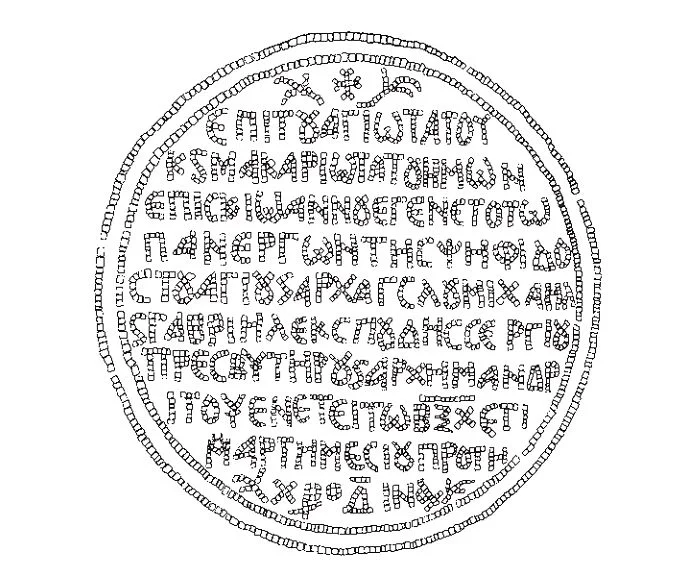
Floor-mosaic with a Greek inscription, commemorating the paving of a church dedicated to the Archangels *Michael (S00181) and *Gabriel (S00192). Found at Ras ad-Dayr, near ancient Pella/Berenike and Gerasa/Jerash (Roman province of Palaestina II). Dated 600 or 601.
- Language
- Greek
- Date from
- 598
- Date to
- 601
- Evidence type
- Archaeological and architectural; Inscriptions
- Evidence subtype
- Cult buildings (churches, mausolea); Formal inscriptions (stone, mosaic, etc.)
- Evidence region
- Arabia; Palestine with Sinai
- Evidence location
- Gerasa/Jerash; Sakkaia / Maximianopolis, Σακκαια, Sakkaia, Saccaea, Eaccaea, Maximianopolis, Shaqqa, Schaqqa, Shakka; Pella; Caesarea Maritima, Καισάρεια, Kaisareia, Caesarea, Kayseri, Turris Stratonis; Ras ad-Dayr; Caesarea Maritima, Καισάρεια, Kaisareia, Caesarea, Kayseri, Turris Stratonis
- Cult region
- Arabia; Palestine with Sinai
- Cult location
- Gerasa/Jerash; Sakkaia / Maximianopolis, Σακκαια, Sakkaia, Saccaea, Eaccaea, Maximianopolis, Shaqqa, Schaqqa, Shakka; Pella; Caesarea Maritima, Καισάρεια, Kaisareia, Caesarea, Kayseri, Turris Stratonis; Ras ad-Dayr; Caesarea Maritima, Καισάρεια, Kaisareia, Caesarea, Kayseri, Turris Stratonis
- Cult date from
- 598
- Cult date to
- 601
Text
+
ἐπὶ τοῦ ἁγιωτάτου
κ(αὶ) μακαριωτάτου ἡμῶν
ἐπισκ(όπου) Ἰωάννου ἐγένετο τὼ
πᾶν ἔργων τῆς ψηφῖδο-
ς τοῦ ἁγίου ἀρχαγ<γ>έλου Μιχαὴλ
(καὶ) Γαβριὴλ ἐκ σπουδῆς Σεργίου
πρεσβυτήρου (καὶ) ἀρχημανδρ-
ίτου ἐν ἔτει τῷ βξχ΄ ἔτι,
μη(νὶ) Ἀρτημεσίου πρότῃ
χρό(νοις) δ΄ ἰνδ(ικτιῶνος)
[4. ἔργων Gautier SEG, ἔργον Feissel || 4-5. ψηφῖδ|ος Gautier SEG, ψηφώσ(εως) Feissel || 7-8. ἀρχημανδρ|ίτου Gautier SEG, ἀρχιμανδρίτου Feissel]
'+ Under our most holy and most blessed bishop Ioannes the whole work of the floor-mosaic (of the church) of the holy Archangel Michael (and) Gabriel was completed through the efforts of the presbyter and abbot (archimandrite) Sergios. In the year 662, on the 1st day of the month of Artemisios, in the times of the 4th indiction.'
Text: SEG 56, 1903.
Translation: P. Nowakowski.
Source
Floor-mosaic with a Greek inscription within a medallion.
Found in 2005, in the north aisle of a church at Ras ad-Dayr (in the centre of its ruins), which belonged to the territory of ancient Pella or Gerasa/Jerash, excavated by the archaeological mission of the Yarmouk University (Irbid). The church has three aisles, a narthex and a squarish apse. Next to our inscription, there was another similar mosaic medallion, but it has not been published.
A photograph and an English translation (without the Greek transcription) was published by Zeidoun Al-Muheisen in 2006, and a drawing by Michele Piccirillo in 2007. Based on the photograph, Denis Feissel transcribed the text and published it in the Bulletin épigraphique. Some minor revisions of the Greek text were offered by Pierre-Louis Gatier (using additional photos) in L'Année épigraphique and by the editors of the Supplementum Epigraphicum Graecum.
Discussion
The inscription commemorates the paving of a church (or only of the aisle where it was found), dedicated to the Archangels Michael and Gabriel. As the person, who supervised and probably paid for the work, is a presbyter and archimandrite (abbot), we can suppose that the church belonged to a monastery.
Denis Feissel suggested that the inscription was dated according to the Pompeian era, which was used in both nearby major cities: Pella and Gerasa. Presupposing that the month of Artemisios, mentioned in the dating formula, is a spring month of the calendar of Arabia, he computed the date as 21st April 601. Gautier argued that the month of Artemisios was an autumn Greek month, and thus he moved the date to the autumn of the preceding year (AD 600). Michele Piccirillo, probably on account of a computional error, converted the date to AD 568. A commentary on these attempts to date the inscription is offered by Leah Di Segni in Supplementum Epigraphicum Graecum. She concludes that the supposition that the date fell in autumn is implausible. Furthermore, she points out that the era year or the indiction year may be erroneous, as they are not coherent: "Artemisios of the 4th indiction fell about April/May 601, in era year 663, while Artemisios of 662 fell in the 3rd indiction (April/May 600)".
Bibliography
Edition:
Supplementum Epigraphicum Graecum 56, 1903.
L'Année épigraphique (2006), 1617.
Bulletin épigraphique (2008), 558.
Al-Muheisen, Z., "Preliminary report on the excavations at Khirbat al-Badiyya, 1998-2005", Annual of the Department of Archaeology of Jordan 50 (2006), 83-98.
Further reading:
Piccirillo, M., "Ricerca storico-archeologica in Giordania XXVII - 2007", Liber Annuus 57 (2007), 689-692.
Images
Associated saints
| Saint | Name in source | Certainty |
|---|---|---|
| Michael, the Archangel (S00181) | Μιχαήλ | Certain |
| Gabriel, the Archangel (S00192) | Γαβριήλ | Certain |
Cult classifications
- Cult Places
- Cult building - independent (church); Cult building - monastic
- Festivals
- Anniversary of church/altar dedication
- Liturgical Activity
- Ceremony of dedication
- Non Liturgical Activity
- Bequests, donations, gifts and offerings; Renovation and embellishment of cult buildings
- People
- Ecclesiastics - abbots; Ecclesiastics - bishops; Ecclesiastics - lesser clergy
- Places Names after Saint
- Monastery
Record author
Paweł Nowakowski
Entry date
16/06/2016
Citation
Paweł Nowakowski, Cult of Saints, E01633 — https://csla.history.ox.ac.uk/record.php?recid=E01633