
E01637
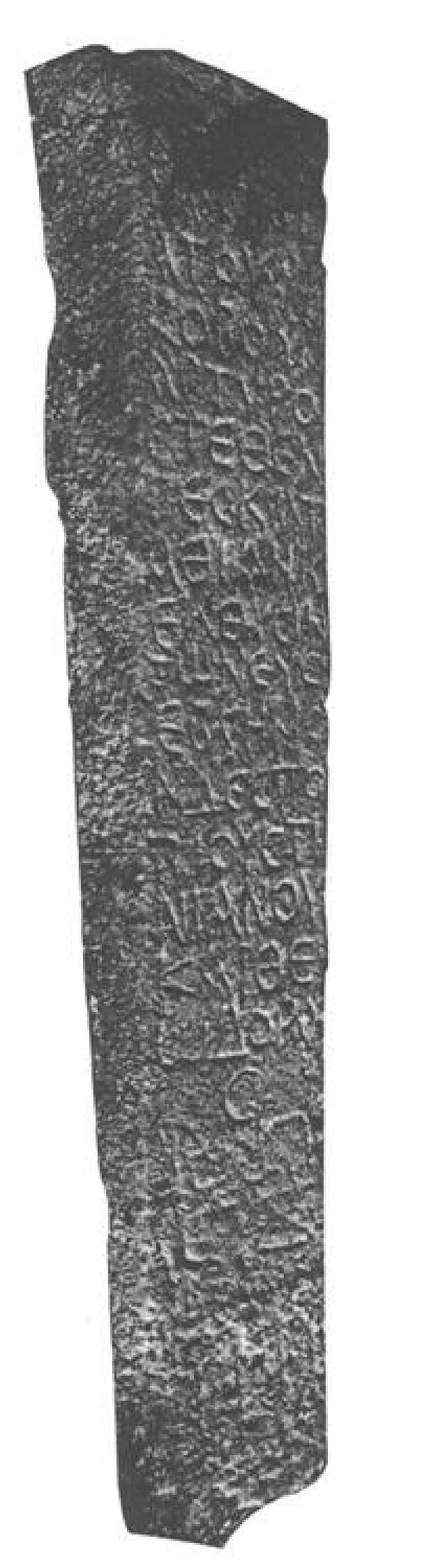
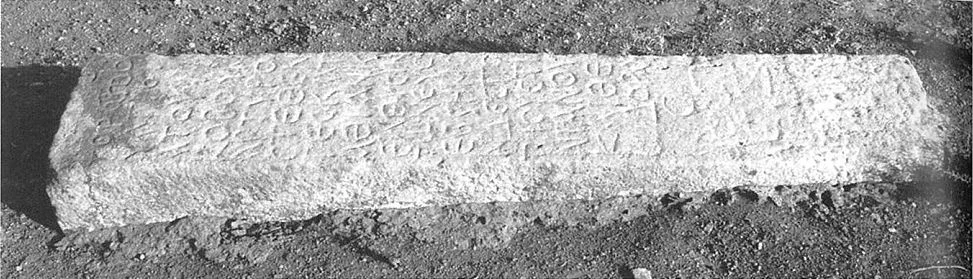
Greek inscription on a boundary stone of a church or monastery dedicated to a martyr 'Iacobos': either an otherwise unknown local martyr, or James ('brother of the Lord', S00058), or perhaps Jacob of Cyrrhestica, (monk of Syria, ob. c. 460s, S00378). Found at Umm al-Jurun near Androna (modern al-Andarin), to the east of Apamea on the Orontes (central Syria). 527/548.
- Language
- Greek
- Date from
- 527
- Date to
- 548
- Evidence type
- Archaeological and architectural; Inscriptions
- Evidence subtype
- Extant reliquaries and related fixtures; Formal inscriptions (stone, mosaic, etc.)
- Evidence region
- Syria with Phoenicia
- Evidence location
- Androna; Antioch on the Orontes, Ἀντιόχεια, Antiocheia, Antiochia ad Orontem, Ἀντιόχεια Μεγάλη, Ἀντιόχεια ἐπὶ Ὀρόντου, Antakya; Umm al-Jurun; Antioch on the Orontes, Ἀντιόχεια, Antiocheia, Antiochia ad Orontem, Ἀντιόχεια Μεγάλη, Ἀντιόχεια ἐπὶ Ὀρόντου, Antakya
- Cult region
- Syria with Phoenicia
- Cult location
- Androna; Antioch on the Orontes, Ἀντιόχεια, Antiocheia, Antiochia ad Orontem, Ἀντιόχεια Μεγάλη, Ἀντιόχεια ἐπὶ Ὀρόντου, Antakya; Umm al-Jurun; Antioch on the Orontes, Ἀντιόχεια, Antiocheia, Antiochia ad Orontem, Ἀντιόχεια Μεγάλη, Ἀντιόχεια ἐπὶ Ὀρόντου, Antakya
- Cult date from
- 527
- Cult date to
- 548
Text
+ ὅροι τ-
οῦ ἁγιο-
τάτου Ἰ-
ακώβο-
υ μάρτυ-
ρος, τεθ-
έντες
κατὰ θί-
αν κέλε-
υσιν τῶ-
ν εὐσεβ-
εστάτω-
ν ἡμõν
δεσπο-
τõν Ἰου-
στινια-
νοῦ κα-
ὶ Θε<οδ>-
ώρας
[18-19 Θερασ|ωρας stone]
'+ Boundaries (of the sanctuary) of the most holy martyr Jacob, set up following the sacred order of our most pious sovereigns Justinian and Theodora.'
Text: IGLS IV, no. 1675ter.
Translation: M. Mundell Mango, lightly modified.
Source
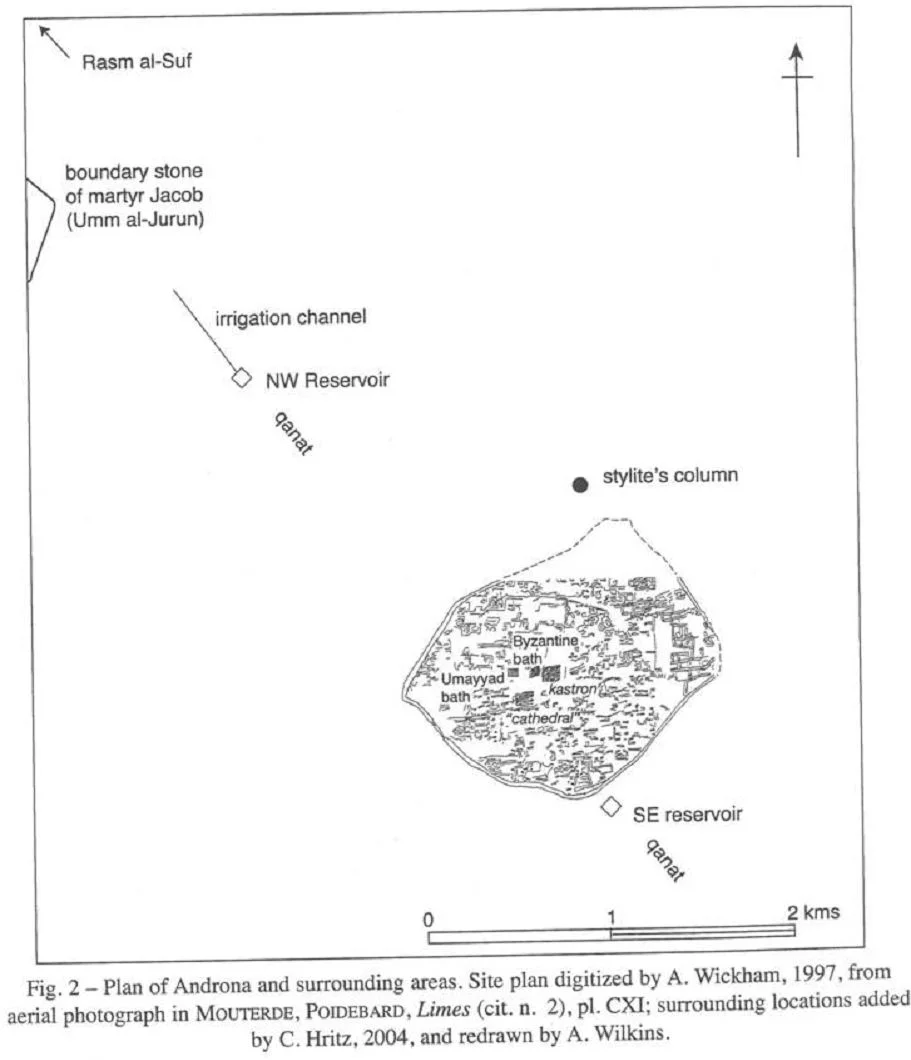
First published in 1955 in the fourth volume of Inscriptions grecques et latines de la Syrie by Louis Jalabert, René Mouterde, and Claude Mondésert, from a copy made by Jean Lauffray at the village of Umm al-Jurun, c. 2.8 km to the north-west of Androna. They did not provide any description of the object.
The stone was rediscovered and photographed by Cyril Mango in 2000. He specifies the dimensions as: H. 2.00 m; W. 0.39 m. See: Mundell Mango 2005, 335.
Discussion
The inscription marked the boundaries of a church or a monastery (or of its real estate), dedicated to a certain martyr Jacob. Interestingly, the saint is named here ἁγιώτατος/'the most holy', while normally saints are named in inscriptions just ἅγιοι/'holy'. The superlative form occurs, however, sometimes in the texts of documents issued by the imperial office, and in their excerpts reproduced as monumental publications or on boundary stones (see, for example: E00708, E00974).
The identity of this martyr Jacob is not clear. He could be, of course, a local martyr, but the editors of Inscriptions grecques et latines de la Syrie propose other possibilities. They opt either for James the Brother of the Lord, also known as James the Just, as he was reportedly killed in Jerusalem by an enraged crowd, and was considered a martyr by late antique Christians (see: Eus. HE II 23), or for Jacob of Cyrrhestica (monk and ascetic in Syria, friend of Theodoret of Cyrrhus), considered as equal to martyrs by his contemporaries (see: E00439, E00619).
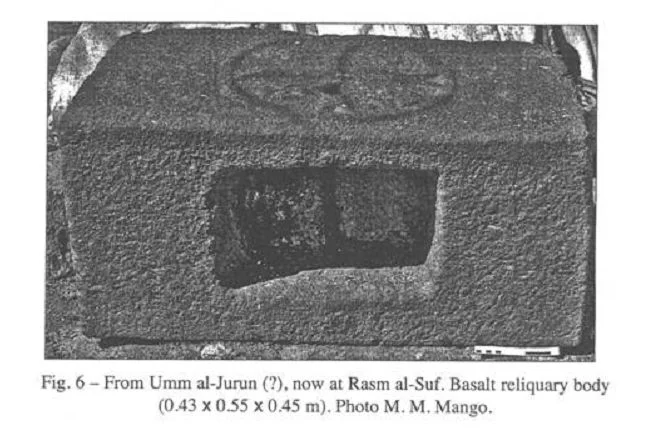
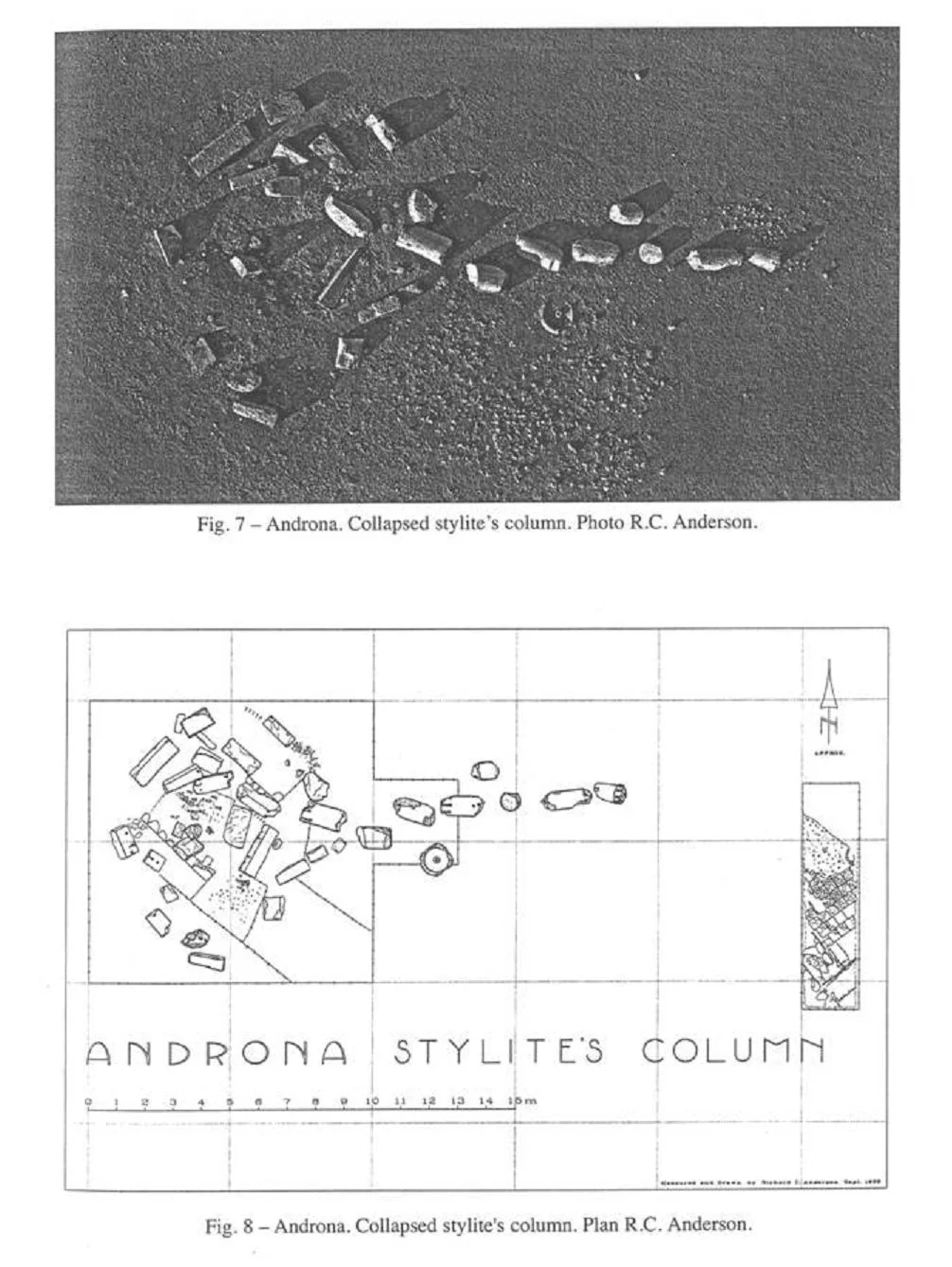
The identity of Jacob was reinvestigated by Marlia Mundell Mango in 2005. She notes that a reliquary, lacking its lid and without inscription, was found in the nearby village of Rasm al-Suf. It is believed that it was brought there from Umm al-Jurun, and, if so, it perhaps encapsulated the relics of our martyr (see: Mundell Mango 2005, 335). She also points out that a certain Jacob is invoked in a lintel inscription from Androna (IGLS IV, no. 1687), but this is certainly the Old Testament Patriarch, as the inscription is simply a quotation of Psalm 46. In her paper Mundell Mango also addresses the question of whether our Jacob could have been the stylite whose columns was found in 1998 near the walls of Androna by the joint archaeological expedition of the Syrian Department of Antiquities, the University of Heidelberg, and the University of Oxford. Mundell Mango raises the possibility that Jacob lived his life as a stylite at Androna, and was buried at Umm al-Jurun, or his relics were venerated there, or an estate, owned by his church was situated at that village (see: Mundell Mango 2005, 339; cf. Mundell Mango 2011, 121). The equation of stylite column, reliquary and boundary inscription is of course highly speculative.
Dating: The date, 527/548, is established based on the reference to the emperor Justinian and his wife Theodora, who authorised this boundary stone.
Bibliography
Edition:
Jalabert, L., Mouterde, R., Mondésert, Cl., Inscriptions grecques et latines de la Syrie, vol. 4: Laodicée, Apamène (BAH 61, Paris: Librairie orientalise Paul Geuthner, 1955), no. 1675ter.
Further reading:
S. Cosentino, "Boundary marks and space organization in early Byzantine epigraphy", in: Ch. Stavrakos (ed.), Inscriptions in the Byzantine and post-Byzantine history and history of art : proceedings of the international symposium "Inscriptions: Their Contribution to the Byzantine and Post-Byzantine History and History of Art" (Ioannina, June 26-27, 2015) (Wiesbaden: Harrassowitz Verlag in Kommission, 2016), 99.
Mundell Mango, M., “A new stylite at Androna in Syria” [in:] Mélanges Jean-Pierre Sodini. Special issue of Travaux et mémoires 15 (2005) (Paris: Association des Amis du Centre d'Histoire et Civilisation de Byzance, 2005), 335.
Mundell Mango, M., "Byzantine settlement expansion in north central Syria: the case of Androna/Andarin", in: A. Borrut, M. Debié, A. Papaconstantinou, D. Pieri, J.-P. Sodini (eds.), Le Proche-Orient de Justinien aux Abassides : peuplement et dynamiques spatiales : actes du colloque "Continuités de l'occupation entre les périodes byzantine et abbasside au Proche-Orient, VIIe-IXe siècles," Paris, 18-20 octobre 2007 (Bibliothèque de l'Antiquité tardive 19, Turnhout: Brepols, 2011), 114-115, 121.
Mundell Mango, M., "Androna and the late antique cities of Oriens" in: E. Rizos (ed.), New Cities in Late Antiquity. Documents and Archaeology (Bibliothèque de l'Antiquité Tardive 35, Turnhout: Brepols, 2017), 189-204.
Reference works:
Bulletin épigraphique (1956), 325.
Supplementum Epigraphicum Graecum 55, 1621.
Images
Associated saints
| Saint | Name in source | Certainty |
|---|---|---|
| James, 'brother of the Lord' (S00058) | Ἰάκωβος | Uncertain |
| Iakobos/Jacob of Cyrrhestica, monk of Syria, ob. c. 460s (S00378) | Ἰάκωβος | Uncertain |
| Jacob (unspecified) (S00858) | Ἰάκωβος | Certain |
Cult classifications
- Cult Places
- Cult building - independent (church); Cult building - monastic
- Non Liturgical Activity
- Awarding privileges to cult centres; Seeking asylum at church/shrine
- People
- Women
- Places Names after Saint
- Monastery
- Relics
- Reliquary – institutionally owned
Record author
Paweł Nowakowski
Entry date
17/06/2016
Citation
Paweł Nowakowski, Cult of Saints, E01637 — https://csla.history.ox.ac.uk/record.php?recid=E01637