
E01648
Pilgrim tokens (eulogiae) produced at the Monastery of *Symeon the Younger (stylite near Antioch, ob. 592, S00860), with inscriptions and depictions, all referring to Symeon, some also to *Martha (his mother, S00864), *Konon (his disciple, S00865), and *Michael (the Archangel, S00181). From Bobbio (northern Italy), and other locations (generally near-eastern). 6th-13th c.
- Language
- Greek
- Date from
- 561
- Date to
- 1400
- Evidence type
- Images and objects; Inscriptions
- Evidence subtype
- Inscribed objects; Lamps, ampullae and tokens; Narrative scenes; Rings and seals
- Evidence region
- Syria with Phoenicia
- Evidence location
- Antioch on the Orontes; Antioch on the Orontes, Ἀντιόχεια, Antiocheia, Antiochia ad Orontem, Ἀντιόχεια Μεγάλη, Ἀντιόχεια ἐπὶ Ὀρόντου, Antakya; Seleukeia Pieria; Antioch on the Orontes, Ἀντιόχεια, Antiocheia, Antiochia ad Orontem, Ἀντιόχεια Μεγάλη, Ἀντιόχεια ἐπὶ Ὀρόντου, Antakya; the Admirable Mountain; Antioch on the Orontes, Ἀντιόχεια, Antiocheia, Antiochia ad Orontem, Ἀντιόχεια Μεγάλη, Ἀντιόχεια ἐπὶ Ὀρόντου, Antakya
- Cult region
- Italy north of Rome with Corsica and Sardinia; Syria with Phoenicia
- Cult location
- Antioch on the Orontes; Antioch on the Orontes, Ἀντιόχεια, Antiocheia, Antiochia ad Orontem, Ἀντιόχεια Μεγάλη, Ἀντιόχεια ἐπὶ Ὀρόντου, Antakya; Bobbio; Sardinia, Sardinia, Sardegna, Sardinia; Seleukeia Pieria; Antioch on the Orontes, Ἀντιόχεια, Antiocheia, Antiochia ad Orontem, Ἀντιόχεια Μεγάλη, Ἀντιόχεια ἐπὶ Ὀρόντου, Antakya; the Admirable Mountain; Antioch on the Orontes, Ἀντιόχεια, Antiocheia, Antiochia ad Orontem, Ἀντιόχεια Μεγάλη, Ἀντιόχεια ἐπὶ Ὀρόντου, Antakya
- Cult date from
- 561
- Cult date to
- 1400
Text
It is not always possible to differentiate Symeon the Younger (ob. 592), with his pillar at the Wondrous Mountain near Antioch, from his elder namesake, Symeon the Elder (ob. 459), with his column at present-day Qal‘at Sim‘ān near Aleppo. However, in the case of all the pilgrim tokens below (except no. 6, for which the identification is hypothetical), Symeon the Younger is certainly the saint commemorated, since he is either referred to by his epithet 'the Wonder-Worker', or saints associated with him or the site of his column (the 'Wondrous Mountain') are mentioned.
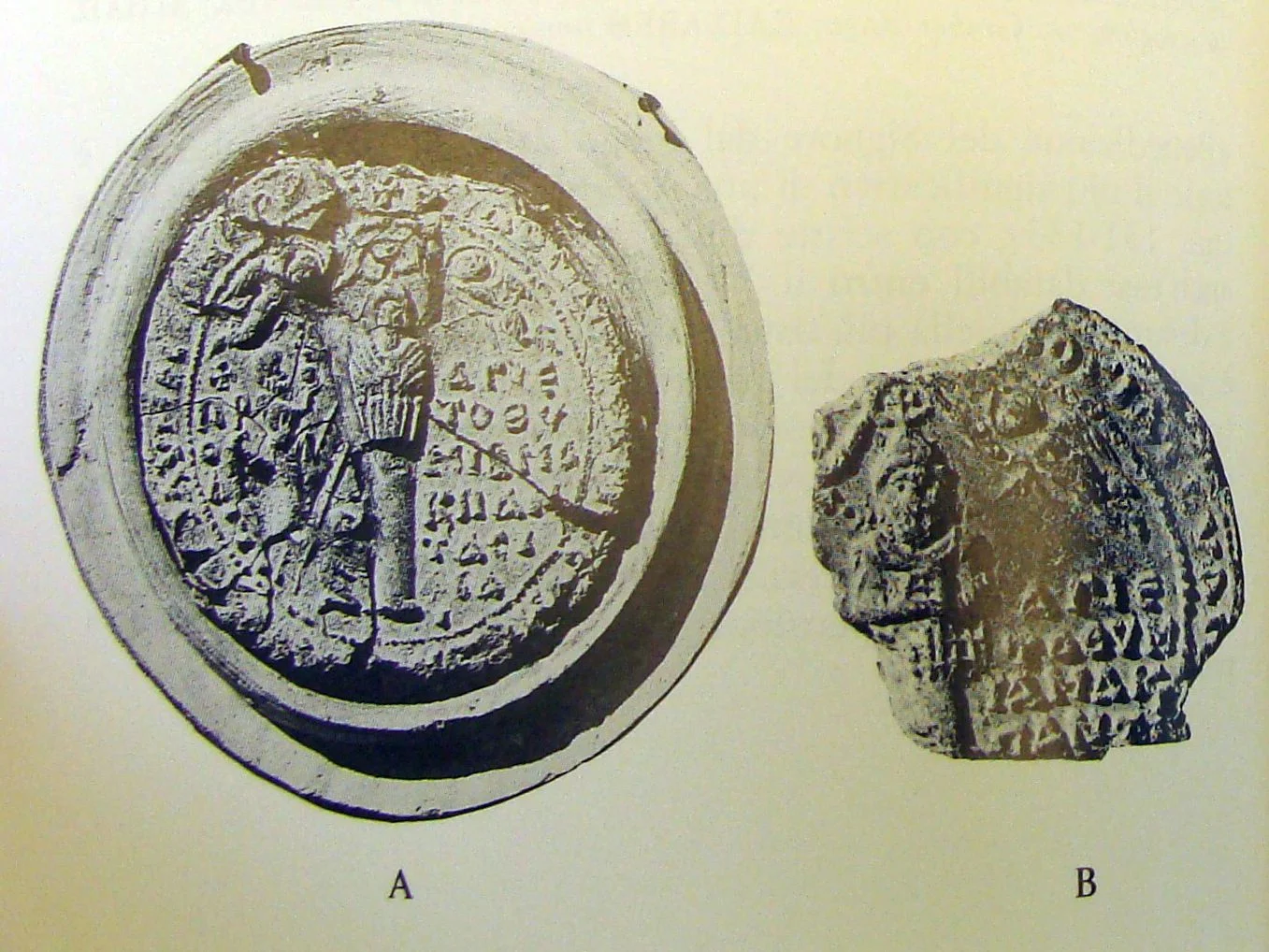
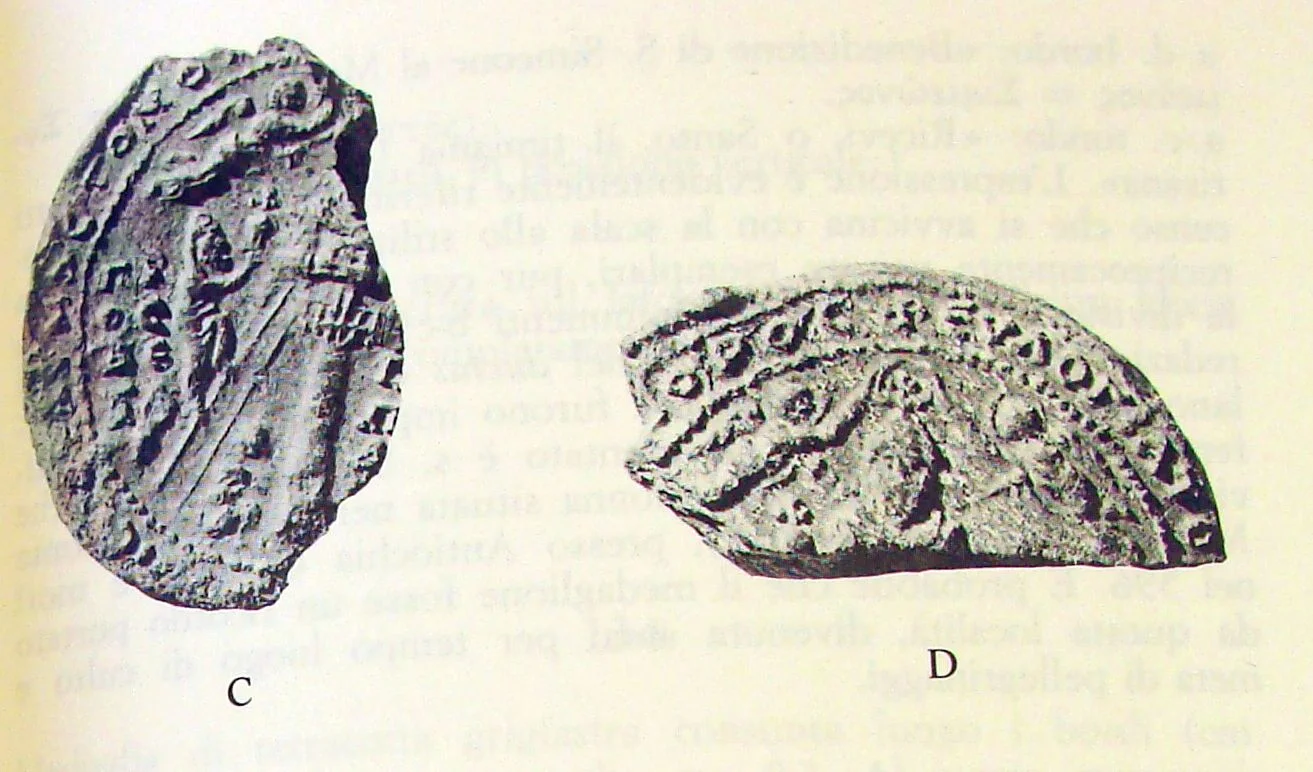
1) Four fragmentary medallions of whitish terracotta.
The medallions were found in 1910 during the examination of the bodies of the founders of the basilica of Saint Columbanus at Bobbio (north Italy). Now in the Museum of Bobbio Abbey.
Preserved dimensions:
A: H. 4.3 cm; W. 4.7 cm; Th. 0.2 cm;
B: H. 3 cm; W. 3 cm; Th. 0.1 cm;
C: H. 3.6 cm; W. 2.8 cm; Th. 0.3 cm;
D: H. 2.2 cm; W. 3.5 cm; Th. 0.3 cm.
Letter height c. 0.1-0.2 cm.
All of them bear a depiction of Symeon, bearded, and wearing monastic garments, on a column with a balustrade (Greek: βουτή) around its capital. The saint is flanked by angels who hold a small radiant cross. A supplicant (a monk?) is climbing the column, using a ladder. He is holding probably a censer, and offering it to the saint. Others are praying at its base. The image resembles the depictions of Symeon the Elder and Daniel the Stylite from the 11th c. Menologium of Basil (respectively, 11 September and 11 December).
All these medallions bear the same inscriptions.
On the margins: + εὐλογία τοῦ ἁγίου Συμεõνος [- - -] εἰς Θαυμαστὸν Ὄρος / '+The blessing (eulogia) of Saint Symeon [- - -] of the Wondrous Mountain'.
On the inner field: + πρόσδεξαι, ἅγιε, τὸ θυμίαμα κ(αὶ) πάντας ἴασαι / 'O Saint, accept the incense, a(nd) heal everyone!'
Text: Mennella 1990, no. 132 = IGLS 3/2, no. 1217.
The layout of the text and the form of the depictions are slightly different, which shows that the medallions were made with the use of different moulds.
Based on the scene depicted and on the contents of the inscriptions, it is certain that these medallions were pilgrim' tokens, distributed by the Monastery of Saint Symeon the Younger at the Wondrous Mountain, to people offering incense (which was a necessary element of the intercessory prayers performed by stylites).
Bobbio was founded in 614, so if these tokens were in the graves from the beginning, they are probably of the early 7th c. It is not clear, how these objects made their way to the West. The ampullae from Jerusalem, housed in nearby Monza, were donated by Queen Theodolinda (ob. 625; see $EXXX), and André Grabar argued that she could have acquired them from the so-called Pilgrim of Piacenza (or his family), who journeyed to the Holy Land in the 570s. Another possibility is that the objects were brought to north Italy by Leontius, a former consul, who offered some ampullae from the Holy Land to pope Gregory the Great ($EXXXX). See the comments by Leah Di Segni in the Corpus Inscriptionum Iudaeae/Palastinae 1/2, 558.
2) A lead medallion. Diameter 4.4 cm. Acquired by Henri Seyrig in Athens before 1932.
The obverse bears a depiction of the stylite, similar to those of the medallions of Bobbio. The capital of the column is decorated with three orbs. The stylite is flanked by two angels, stretching their arms towards him. At the base of the column there are two supplicants with nimbi. Behind the supplicant on the right-hand side there is a tree.
The inscription runs round the margin, letter height 0.4 cm:
+ εὐλογία τοῦ ἁγίου Συμεῶνος τοῦ θαυματουργοῦ / '+The blessing (eulogia) of Saint Symeon, the Wonder-Worker.'
Text: IGLS 3/2, no. 1218.
The reverse bears geometrical decorations: a rosette surrounded by circles with interlace decoration.
The medallion is certainly a pilgrim token from the Monastery of Symeon the Younger at the Wondrous Mountain.
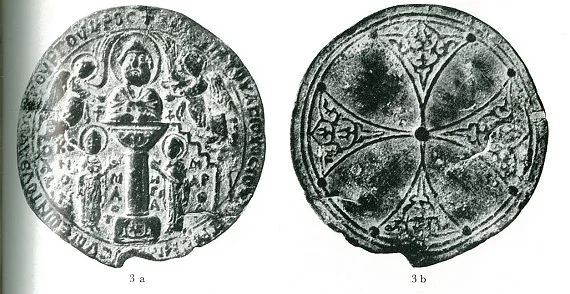
3) A bronze medallion, found at Şeyh Meğe, and acquired at Antioch by a representative of the Expedition of the University of Princeton. Probably 10th c.
The medallion shows Symeon the Younger and bears the inscription:
+ εὐλογία τοῦ ἁγίου Συμεὼν τοῦ θαυματ(ουργοῦ) ἐν τοῖς ἁγίοις αὐτοῦ. ἀμήν. / '+ The blessing (eulogia) of Saint Symeon the Wonder-(Worker) in his holy places. Amen.'
Text: IGLS 3/2, no. 1219.
4) Three lead medallions, two seen in Beirut, one in Antioch. Diameter 5.2 cm; Th. 0.5 cm.
On the obverse: Symeon the Younger, on his column, flanked by two angles. A person, dressed as a monk, with nimbus, is standing on the left hand side. He is labelled 'Konon' (almost certainly Konon, one of the disciples of Symeon). The person on the right-hand side is climbing the column.
On the obverse: a decorative cross.
Inscription on the margin:
+ εὐλογία τοῦ ἁγίου Συμεὼν τοῦ θαυματουργοῦ αἰν<ε>ῖτε <αὐ>τὸν ἐν τοῖς ἁγίοις αὐτοῦ. ἀμήν. / '+The blessing (eulogia) of Saint Symeon the Miracle-Worker. Praise him in his holy places!'
Text: IGLS 3/2, no. 1220.
5) A medallion of blackish wax or resin. Diameter 2.8 cm; Th. 0.9 cm.
The obverse bears a depiction of the bust of Symeon the Younger on his column. At the base two persons with nimbi stretch out their arms towards the saint. Remarkably, there are no angels in this scene.
Inscription on the margin:
+ ὁ ἅγ[ι]ος Συμεὸν Θαυματουργὸς καὶ Μάρθα ἡ μή(τη)ρ τ(οῦ) (= αὐτοῦ) / '+ Sa[i]nt Symeon the Wonder-Worker and Martha, his mother.'
Text: IGLS 3/2, no. 1221.
Based on the absence of the angels, Lassus, Mouterde, and Jalabert supposed that the medallion was made before the death of Symeon (592); but this cannot be demonstrated.
6) A lead seal. Kept in the Collection Rollin et Feuardent in Paris.
On the right-hand side of the obverse the bust of a monk on a small column. The left hand side is occupied by the inscription:
ὁ ἅ(γιος) Συμεὼν ὁ συλίτ(ης) Σύριος/'Saint Symeon, the Syriac stylit(e)'.
On the reverse: εὐλογία τοῦ ἁγίου Συμεών/'The blessing (eulogia) of Saint Symeon'.
Text: IGLS 3/2, no. 1223.
Date: probably 9th/10th c. According to Peeters, Mouterde, and Jalabert the saint is Symeon the Younger, as Greek was no longer spoken in that period at Qalʿat Semʿan, where Symeon the Elder was venerated.
7) Three medallions, showing Symeon the Younger, his mother, Martha, his disciple Konon, and Michael the Archangel. Provenance unknown, but almost certainly produced at the Monastery of Symeon at the Wondrous Mountain. Once kept in Brussels, in the private collection of Adolphe Stoclet, a banker and art collector. Seen by Jean Mécérian in 1948, and published based on photographs. Dated by Mécérian to the 7th or 10/11th c.
The objects bear the following inscriptions:
+ εὐλογία τοῦ ἁγίου ὁσίου πατρὸς ἡμῶν Συμεὼν τοῦ Θαυματουργοῦ Ὄρους/'+ The blessing (eulogia) of our holy and saintly father Symeon, of the Wondrous Mountain'
ὁ ἅγιος Κόνων ὁ μαθητής/'Saint Konon, the disciple'
ἡ ἁγία Μάρθα/'Saint Martha'
Μιχαήλ/'Michael'
Text: Mécérian 1962, 307.
For a stone mould for the production of eulogiae of Symeon, with a similar inscription, housed in the Louvre Museum, see: Lassus, J., “Une image de saint Syméon le Jeune sur un fragment de reliquaire syrien du Musée du Louvre”, Monuments et mémoires de la Fondation Eugène Piot 51 (1960), 149-150. Here Konon and Martha are not named ἅγιοι/'holy'.
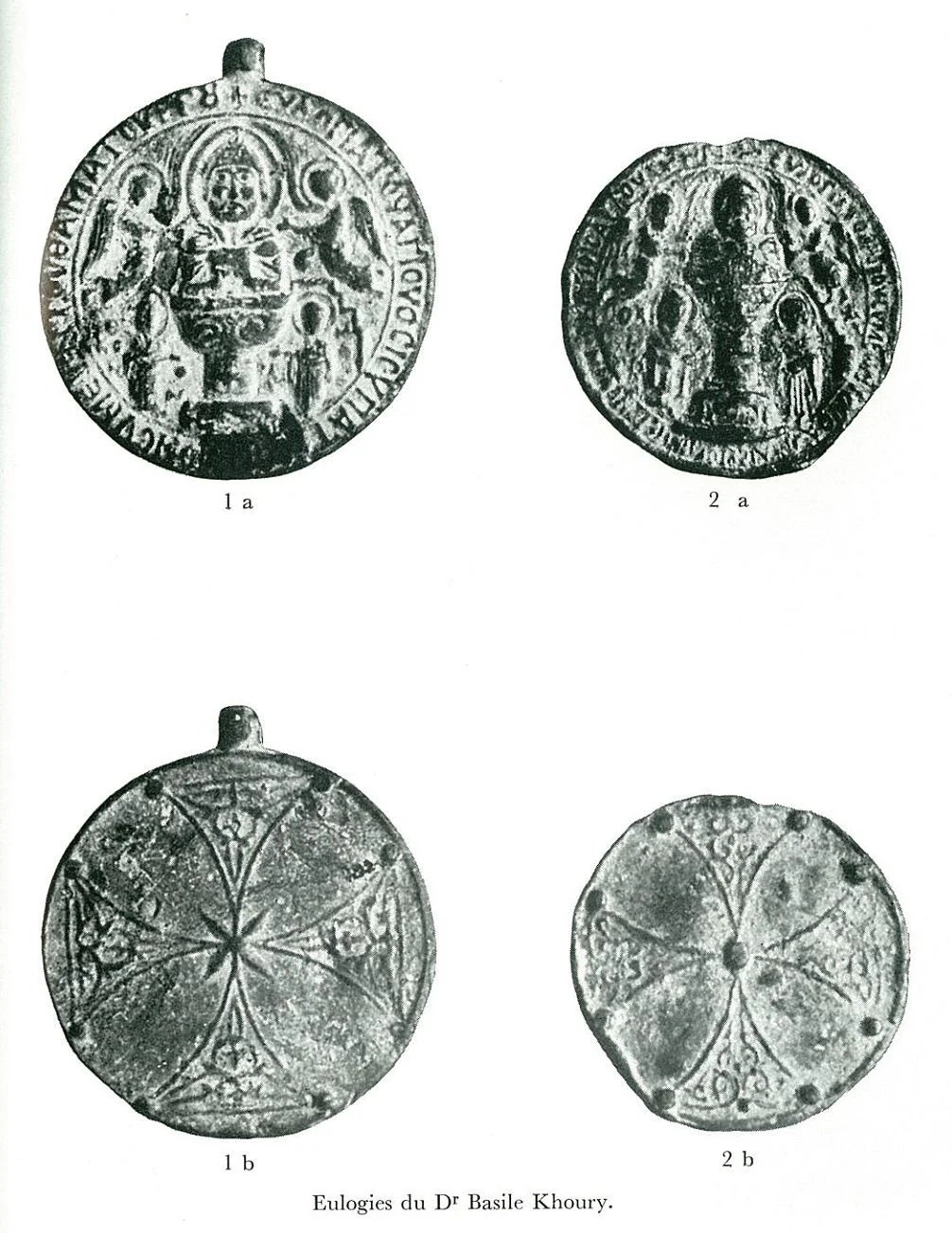
8) Two medallions (A & B), showing on the obverse: Symeon the Younger on his column, flanked by two angels, and two holy figures at the base of the column: his mother, Martha, and his disciple Konon. The reverse is decorated with a depiction of a cross.
Eulogia A: diameter 0.05 m; Th. 0.0018 m. Eulogia B: diameter 0.044 m; Th. 0.0012 m.
Provenance unknown, but almost certainly produced at the Monastery of Symeon at the Wondrous Mountain. Kept in the private collection of Basile Khoury, a dealer of antiquities in Antioch. Communicated to Mécérian.
The objects bear the following inscriptions:
Eulogia A:
+ εὐλογία τοῦ ἁγίου ὁσίου πατρὸς ἡμῶν Συμεὼν τοῦ Θαυματουργοῦ/'+ The blessing (eulogia) of our holy and saintly father Symeon of the Wondrous (Mountain)'
ὁ ἅγιος Κόνων/'Saint Konon'
ἡ ἁγία Μάρθα/'Saint Martha'
Eulogia B:
+ εὐλογία τοῦ ἁγίου Συμεὼν τοῦ Θαυματουργοῦ ἀνῖτε τὸν θ(εὸ)ν ἐν τοῖς ἁγίοις αὐτοῦ. ἀμήν/'+ The blessing (eulogia) of Saint Symeon of the Wonder-Worker. Praise God in his holy places! Amen.' (cf. the inscription in no. 4 above)
ὁ ἅγιος Κόνων/'Saint Konon'
ἡ ἁγία Μάρθα/'Saint Martha'
ἄνγελος Μιχαήλ/'the angel Michael'
Text: Mécérian 1962, 310-311.
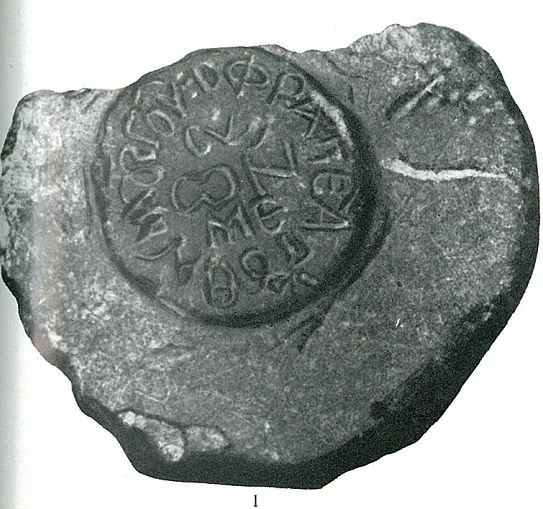
9) A basalt seal, found in the ruins of the Monastery of the Wondrous Mountain, and published by Mécérian in 1962. Diameter c. 0.1 m.
Inscription on the obverse: σφραγίς ἁγίου Θαυματουργοῦ Συμεών/'The seal (of the monastery) of the holy Wonder-Worker Symeon'
Inscription on the reverse: ΙC ΧC ΘΥ ΥC/'Jesus Christ, Son of God'
Mécérian supposes that the seal was used for stamping holy bread or vessels for holy oil or water, produced at the monastery and distributed to pilgrims. However, the inscription is not in mirror writing, as we would expect for a stamp.
Text: Mécérian 1962, 304.
Bibliography
Edition:
Menella, G., Dertona, Libarna, Forum Iulii Iriensium: regio IX (Inscriptiones christianae Italiae 7, Bari: Edipuglia, 1990), nos. 132-134.
Mécérian, J., "Les inscriptions du Mont Admirable", [in:] Mélanges offerts au Père René Mouterde pour son 80e anniversaire, vol. 2 (Mélanges Beyrouth 38, Beyrouth: Impr. Catholique, 1962), 304, 307-311.
Jalabert, L., Mouterde, R., Les inscriptions grecques et latines de la Syrie, vol. 3/2: Antioche (suite). Antiochène: nos. 989-1242 (BAH 51, Paris: P. Geuthner, 1953), nos. 1217-1223.
Further reading:
Callot, O., "À propos de quelques colonnes de stylites syriens", [in:] R. Étienne, M.-T. Le Dinahet, M. Yon, Architecture et poésie dans le monde grec. Hommages à Georges Roux (Lyon: Maison de l'Orient; Paris: Diffusion de Boccard, 1989), 108-111.
Halkin, F., "Bulletin des publications hagiographiques [Review: Jalabert, L., Mouterde, R., Les inscriptions grecques et latines de la Syrie, vol. 3/2]", Analecta Bollandiana 73 (1955), 237-239.
Reference works:
Bulletin épigraphique (1958), 500.
Chroniques d'épigraphie byzantine, 1008.
Images
Associated saints
| Saint | Name in source | Certainty |
|---|---|---|
| Symeon the Younger, stylite near Antioch, ob. 592. (S00860) | Certain | |
| Michael, the Archangel (S00181) | Certain | |
| Martha, mother of Symeon Stylites the Younger, ob. late 6th c. (S00864) | Certain | |
| Konon, disciple of Symeon the Stylite, the Younger (S00865) | Certain |
Cult classifications
- Activities
- Production and selling of eulogiai, tokens
- Cult Places
- Cult building - monastic; Other (mountain, wood, tree, pillar); Place associated with saint's life
- Cult Related Objects
- Ampullae, flasks, etc.
- Non Liturgical Activity
- Bequests, donations, gifts and offerings; Pilgrimage; Visiting graves and shrines; Visiting/veneration of living saint
- Places Names after Saint
- Monastery
- Relics
- Ampullae, eulogiai, tokens; Contact relic - other; Souvenirs of miracles; Transfer, translation and deposition of relics; Transfer/presence of relics from distant countries
- Use of Images
- Private ownership of an image
Record author
Paweł Nowakowski
Entry date
21/06/2016
Citation
Paweł Nowakowski, Cult of Saints, E01648 — https://csla.history.ox.ac.uk/record.php?recid=E01648