
E01651
Floor-mosaic showing a church, labelled 'of Saint Stephen' (certainly the First Martyr, S00030). Found in a church at Kapropera/al-Bāra/el-Bāra in the territory of Apamea on the Orontes (central Syria). Probably mid 6th c.
- Language
- Greek
- Date from
- 530
- Date to
- 580
- Evidence type
- Images and objects; Inscriptions
- Evidence subtype
- Formal inscriptions (stone, mosaic, etc.); Wall paintings and mosaics
- Evidence region
- Syria with Phoenicia
- Evidence location
- Apamea on the Orontes; Antioch on the Orontes, Ἀντιόχεια, Antiocheia, Antiochia ad Orontem, Ἀντιόχεια Μεγάλη, Ἀντιόχεια ἐπὶ Ὀρόντου, Antakya; Kapropera/El Bāra; Antioch on the Orontes, Ἀντιόχεια, Antiocheia, Antiochia ad Orontem, Ἀντιόχεια Μεγάλη, Ἀντιόχεια ἐπὶ Ὀρόντου, Antakya
- Cult region
- Syria with Phoenicia
- Cult location
- Antioch on the Orontes; Antioch on the Orontes, Ἀντιόχεια, Antiocheia, Antiochia ad Orontem, Ἀντιόχεια Μεγάλη, Ἀντιόχεια ἐπὶ Ὀρόντου, Antakya; Kapropera/El Bāra; Antioch on the Orontes, Ἀντιόχεια, Antiocheia, Antiochia ad Orontem, Ἀντιόχεια Μεγάλη, Ἀντιόχεια ἐπὶ Ὀρόντου, Antakya
- Cult date from
- 530
- Cult date to
- 580
Text
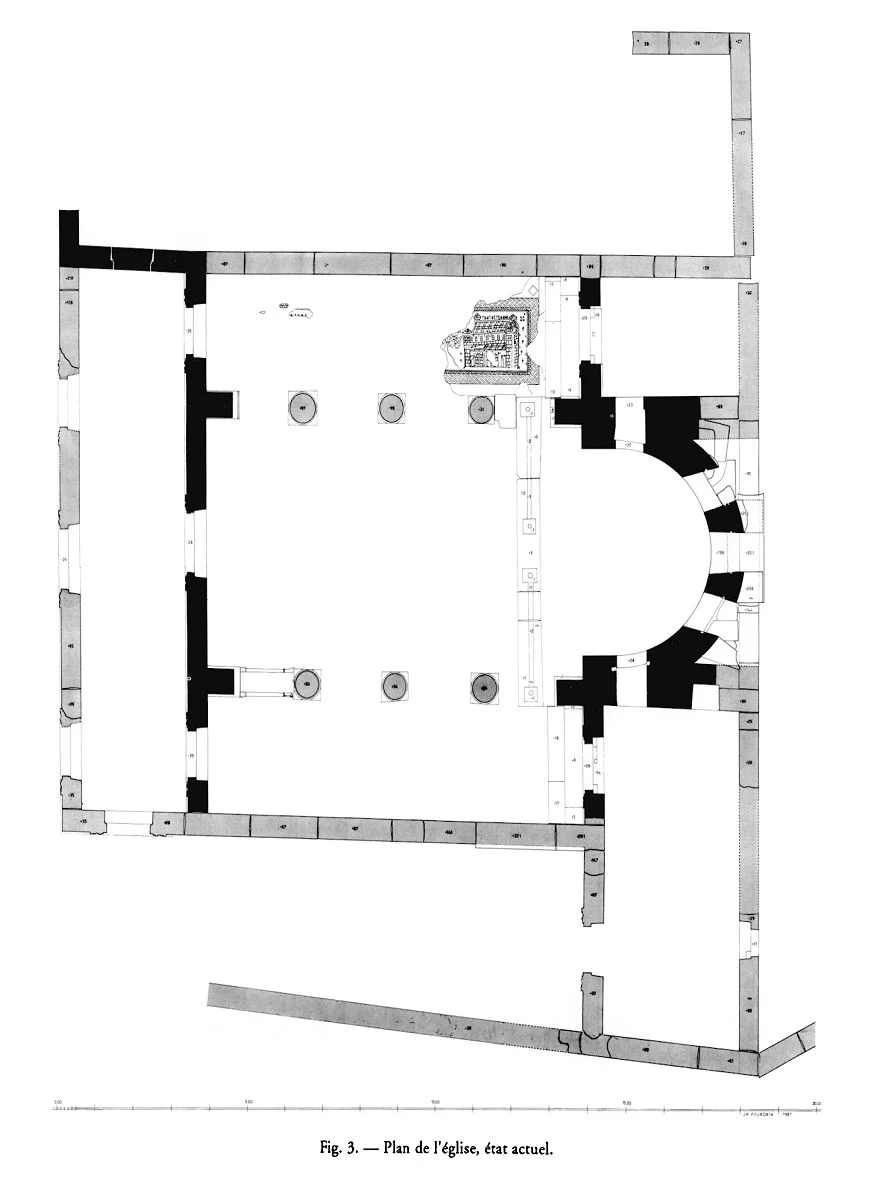
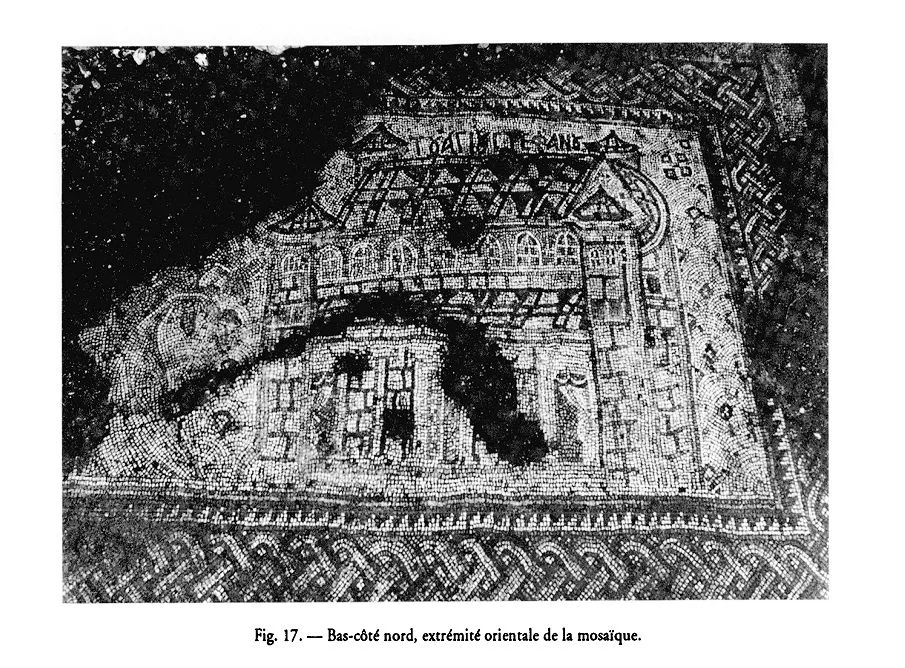
Fragmentarily preserved panel in the floor-mosaic of the north aisle of Church E.5 (or Church 4) at al-Bāra/el-Bāra - a richly decorated, three-aisled basilica, one of the latest churches built at the site in Late Antiquity (probably mid 6th c.). The mosaic is situated in front of the east entrance. Framed by a braid-like pattern.
The mosaic shows the south side of a church with apse, three aisles, including the nave with seven upper windows, and with four towers at the corners topped by conical roofs. The south wall is presented as a colonnade; between the columns there are three doors. The central door is closed; the right- and left-side doors are open, but partially covered by curtains.
The label is situated above the roof, between the two north towers:
τοῦ ἁγίου Στεφάνου
'Of Saint Stephen'
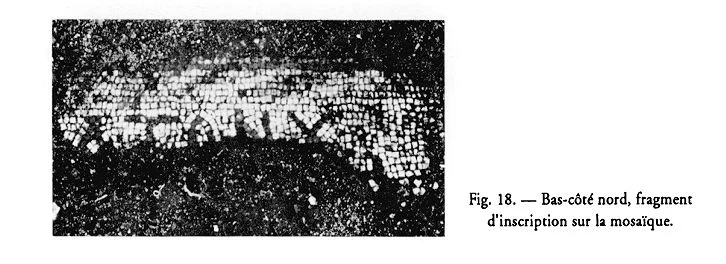
At the west end of the aisle, another preserved fragment of the mosaic bears the inscription:
ΑΤΟΝΟΥ
Text: Fourdrin 1992.
Source
First published by Jean-Pascal Fourdrin in 1992. There is no description of the dimensions of the mosaic.
Discussion
The church shown in the mosaic as dedicated to Saint *Stephen differs from Church E.5 (Church 4), where the mosaic was found, therefore it may be another, still unidentified, sanctuary. But TIB 15 opts for an identification of the two churches.
Bibliography
Edition:
Fourdrin, J.-P., “Église E.5 d'El Bāra”, Syria 69 (1992), 171-210.
Further reading:
Tchalenko, G. (ed.), Villages antiques de la Syrie du Nord: Le Massif du Bélus a l'époque romaine, vol. 2 (Paris: P. Geuthner, 1953b), Abb. XII.5.
Burns, R., Monuments of Syria: An Historical Guide (London: I.B. Tauris, 1999), 58–59.
Strube, Ch., Baudekoration im Nordsyrischen Kalksteinmassiv, vol. 2: Das 6. und frühe 7. Jahrhundert (Mainz am Rhein: P. von Zabern, 2002), 41-47.
Reference works:
Chroniques d'épigraphie byzantine, 633.
Supplementum Epigraphicum Graecum 42, 1350.
TIB 15 – Tabula Imperii Byzantini 15, p. 1364.
Images
Associated saints
| Saint | Name in source | Certainty |
|---|---|---|
| Stephen, the First Martyr (S00030) | Στέφανος | Certain |
Cult classifications
- Cult Places
- Cult building - independent (church)
- Use of Images
- Public display of an image
Record author
Paweł Nowakowski
Entry date
22/06/2016
Citation
Paweł Nowakowski, Cult of Saints, E01651 — https://csla.history.ox.ac.uk/record.php?recid=E01651