
E01672
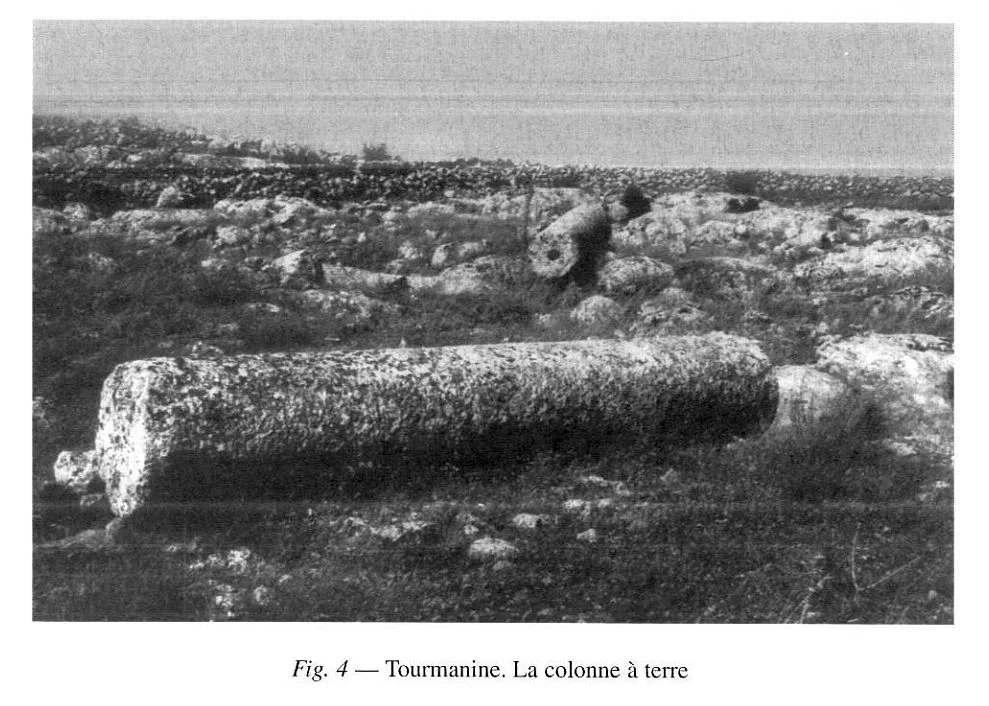
Greek inscription probably commemorating the consecration/dedication (aphierosis) of a stylite's column. Found between Turmanin and Kfeir Dart'Azze in the Limestone Massif (north Syria, between Antioch on the Orontes and Beroia/Aleppo). Probably late antique.
- Language
- Greek
- Date from
- 400
- Date to
- 800
- Evidence type
- Inscriptions
- Evidence subtype
- Formal inscriptions (stone, mosaic, etc.); Inscribed architectural elements
- Evidence region
- Syria with Phoenicia
- Evidence location
- Antioch on the Orontes; Antioch on the Orontes, Ἀντιόχεια, Antiocheia, Antiochia ad Orontem, Ἀντιόχεια Μεγάλη, Ἀντιόχεια ἐπὶ Ὀρόντου, Antakya; Kfeir Dart'Azze; Antioch on the Orontes, Ἀντιόχεια, Antiocheia, Antiochia ad Orontem, Ἀντιόχεια Μεγάλη, Ἀντιόχεια ἐπὶ Ὀρόντου, Antakya; Teleda; Antioch on the Orontes, Ἀντιόχεια, Antiocheia, Antiochia ad Orontem, Ἀντιόχεια Μεγάλη, Ἀντιόχεια ἐπὶ Ὀρόντου, Antakya; Turmanin; Antioch on the Orontes, Ἀντιόχεια, Antiocheia, Antiochia ad Orontem, Ἀντιόχεια Μεγάλη, Ἀντιόχεια ἐπὶ Ὀρόντου, Antakya
- Cult region
- Syria with Phoenicia
- Cult location
- Antioch on the Orontes; Antioch on the Orontes, Ἀντιόχεια, Antiocheia, Antiochia ad Orontem, Ἀντιόχεια Μεγάλη, Ἀντιόχεια ἐπὶ Ὀρόντου, Antakya; Kfeir Dart'Azze; Antioch on the Orontes, Ἀντιόχεια, Antiocheia, Antiochia ad Orontem, Ἀντιόχεια Μεγάλη, Ἀντιόχεια ἐπὶ Ὀρόντου, Antakya; Teleda; Antioch on the Orontes, Ἀντιόχεια, Antiocheia, Antiochia ad Orontem, Ἀντιόχεια Μεγάλη, Ἀντιόχεια ἐπὶ Ὀρόντου, Antakya; Turmanin; Antioch on the Orontes, Ἀντιόχεια, Antiocheia, Antiochia ad Orontem, Ἀντιόχεια Μεγάλη, Ἀντιόχεια ἐπὶ Ὀρόντου, Antakya
- Cult date from
- 400
- Cult date to
- 800
Text
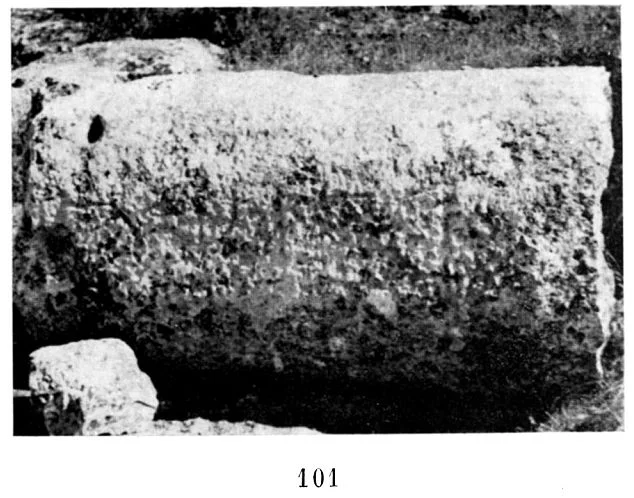
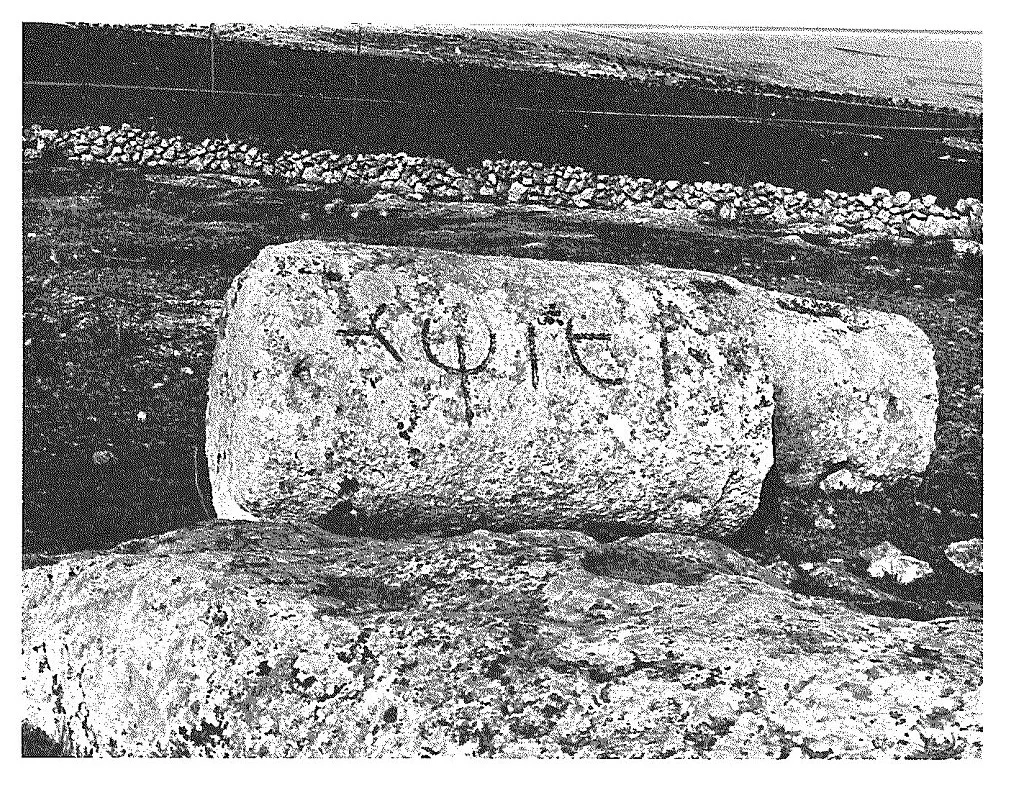
Inscription on a column:
Jarry's reading:
^ ̣ΨΙΕ +
possibly ^ ̣ΦΙΕ +
'The year 7(?)15.'
Text: Jarry 1967, no. 101.
Castellana's reading:
ἀφιερ[ῶμα]
'Consecration'
Text: Peña, Castellana & Fernandez 1975, 124.
Gatier's and Callot's reading:
ἀφιέρ[ωτε]
'It is consecrated'
Text: Callot & Gatier 2004, 578, note 28.
Source
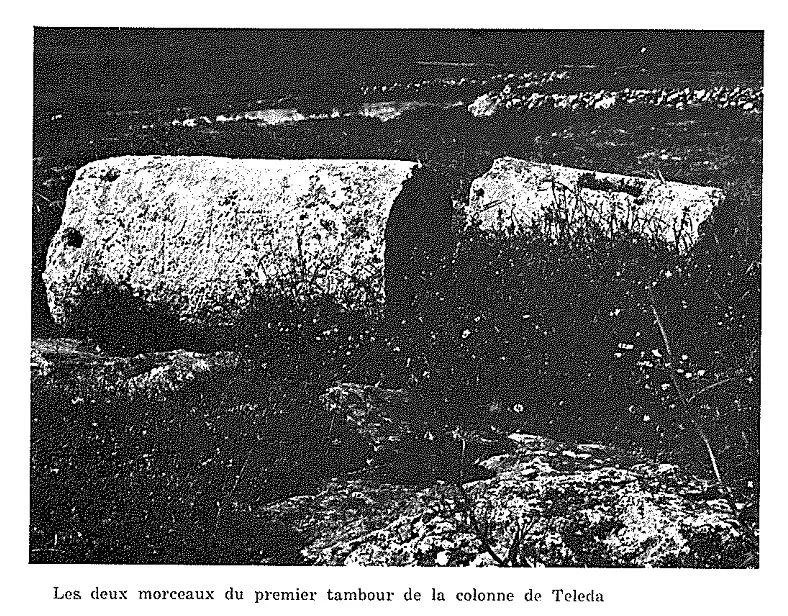
The inscription is on a collapsed column. Found by Georges Tchalenko in 1963 (copy, photograph, squeeze) near the modern road from Turmanin to Kfeir Dart'Azze. First published by Jacques Jarry in 1967, with permission of the Institut français de Beyrouth. Revisited by Pasquale Castellana before 1975 and by Pierre-Louis Gatier and Olivier Callot before 2004. The latter note that several fragments of the column were moved to a garden near the road from Tell’Adé (Teleda) to Turmanin. Other fragments are lost.
Letter height 0.3 m.
Discussion
Jacques Jarry, the first editor, read the inscription as a date, the year 715 of the era of Antioch (= the Caesarian era), which he converted to AD 666/667, or the year 515 of the same era, i.e. AD 466/467. He did commented neither on the purpose of this inscription, nor of the column on which it was carved.
In 1975 Pasquale Castellana suggested that the inscription had been erroneously read. In his opinion it was not a date, but a word abbreviated as ΑΦΙΕΡ, which he expanded as ἀφιερῶμα/'consecration' (see: Peña, Castellana & Fernandez 1975, 124). He concluded that the text commemorated the consecration of the column, almost certainly as a stylite's dwelling. Though other known stylites' columns were inscribed only in exceptional cases (see: E00566, the comments in E01638), this theory is quite plausible, as the letters of the inscription are large: they were certainly meant to commemorate an important event, and to be read from a distance. Furthermore, the isolated location of the column supports the argument.
Castellana's theory was accepted by Pierre-Louis Gatier and Olivier Callot, but they preferred to expand the inscribed word as a verb, for example: ἀφιέρωτε = ἀφιέρωται/'It is consecrated'.
Our database does not include every possible stylite column discovered; but we have included this one because of its inscription.
Bibliography
Edition:
Callot, O., Gatier, P.-L., "Les stylites de l’Antiochène", [in:] B. Cabouret, P.-L. Gatier, C. Saliou (eds.), Antioche de Syrie. Histoire, images et traces de la ville antique (Topoi, suppl. 5, Lyon: Maison de l'Orient Méditerranéen, Paris: De Boccard, 2004), 578, note 28.
Callot, O., "À propos de quelques colonnes de stylites syriens", [in:] R. Étienne, M.-T. Le Dinahet, M. Yon, Architecture et poésie dans le monde grec. Hommages à Georges Roux (Lyon: Maison de l'Orient; Paris: Diffusion de Boccard, 1989), 115, note 35.
Peña, I., Castellana, P., Fernandez, R., Les Stylites syriens (Milan: Centro propaganda e stampa, 1975), 124.
Jarry, J., "Inscriptions arabes, syriaques et grecques du massif du Bélus en Syrie du nord [avec 42 planches]", Annales islamologiques 7 (1967), no. 88.
Reference works:
Supplementum Epigraphicum Graecum 54, 1587.
Images
Associated saints
| Saint | Name in source | Certainty |
|---|---|---|
| Stylites/dendrites, unnamed or name lost (S00054) | Certain |
Cult classifications
- Cult Places
- Other (mountain, wood, tree, pillar); Place associated with saint's life
- Liturgical Activity
- Ceremony of dedication
- Non Liturgical Activity
- Visiting graves and shrines; Visiting/veneration of living saint
Record author
Paweł Nowakowski
Entry date
27/06/2016
Citation
Paweł Nowakowski, Cult of Saints, E01672 — https://csla.history.ox.ac.uk/record.php?recid=E01672