
E01679
Greek dedicatory inscription on a golden leaf, probably from a reliquary, commemorating an offering to God and 'saint Symeonios' (probably *Symeon the Younger, stylite near Antioch, ob. 592, S00860). Exact provenance unknown, probably central Syria. Probably late 6th-7th c.
- Language
- Greek
- Date from
- 592
- Date to
- 700
- Evidence type
- Archaeological and architectural; Images and objects; Inscriptions
- Evidence subtype
- Extant reliquaries and related fixtures; Inscribed objects; Other portable objects (metalwork, ivory, etc.)
- Evidence region
- Syria with Phoenicia
- Evidence location
- Ḥamāh; Antioch on the Orontes, Ἀντιόχεια, Antiocheia, Antiochia ad Orontem, Ἀντιόχεια Μεγάλη, Ἀντιόχεια ἐπὶ Ὀρόντου, Antakya
- Cult region
- Syria with Phoenicia
- Cult location
- Ḥamāh; Antioch on the Orontes, Ἀντιόχεια, Antiocheia, Antiochia ad Orontem, Ἀντιόχεια Μεγάλη, Ἀντιόχεια ἐπὶ Ὀρόντου, Antakya
- Cult date from
- 592
- Cult date to
- 700
Text
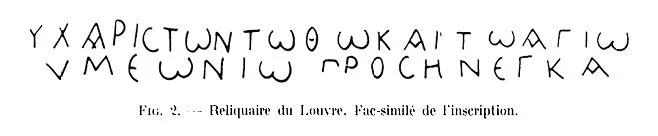
A silver or golden leaf (lamella) with edges framed by a garland. Decorated with a depiction of a stylite on a column, attacked by a serpent, and a dedicatory inscription. Now in the Louvre Museum. Probably once fixed on a side of a reliquary. H. max. 0.296 m; W. max. 0.255 m. Dimensions of the inscribed field: H. 0.04 m; W. 0.214 m; letter height 0.007 m.
First published by Jean Lassus in 1960. Provenance: central Syria. The object appeared in the antiquities market after the discovery of the so-called second Byzantine silver treasure from Ḥamāh/Amathe/Epiphaneia, see: Ross 1950, 162-163.
Inscription:
[ε]ὐχαριστῶν τῷ θ(ε)ῷ καὶ τῷ ἁγίῳ
[Σ]υμεωνίῳ προσήνεγκα
'Giving thanks to God and to Saint Symeonios I brought this offering.'
Text: Lassus 1960, 162-163.
Discussion
Jean Lassus suggests that the saint, depicted here, is Symeon Stylites the Younger. The name Symeonios, which occurs in the inscription instead of Symeon, might have been used as a diminutive, to distinguish the stylite from his earlier namesake, Symeon Stylites the Elder.
Dating: the object has been stylistically dated to the late 6th or 7th c. If it commemorates the younger Symeon, it almost certainly post-dates his death in 592.
Bibliography
Edition:
Lassus, J., “Une image de saint Syméon le Jeune sur un fragment de reliquaire syrien du Musée du Louvre”, Monuments et mémoires de la Fondation Eugène Piot 51 (1960), 129-150.
Further reading:
Ross, M.C., "A second Byzantine treasure from Hamah", Archaeology 3/3 (1950), 162-163.
Reference works:
Bulletin épigraphique (1961), 770.
Images
Captions for unavailable images
image
Associated saints
| Saint | Name in source | Certainty |
|---|---|---|
| Symeon the Younger, stylite near Antioch, ob. 592. (S00860) | Συμεώνιος | Uncertain |
Cult classifications
- Cult Related Objects
- Ex-votos; Precious material objects
- Non Liturgical Activity
- Bequests, donations, gifts and offerings; Prayer/supplication/invocation; Saint as patron - of an individual; Vow
- Relics
- Reliquary – institutionally owned
Record author
Paweł Nowakowski
Entry date
29/06/2016
Citation
Paweł Nowakowski, Cult of Saints, E01679 — https://csla.history.ox.ac.uk/record.php?recid=E01679