
E01681
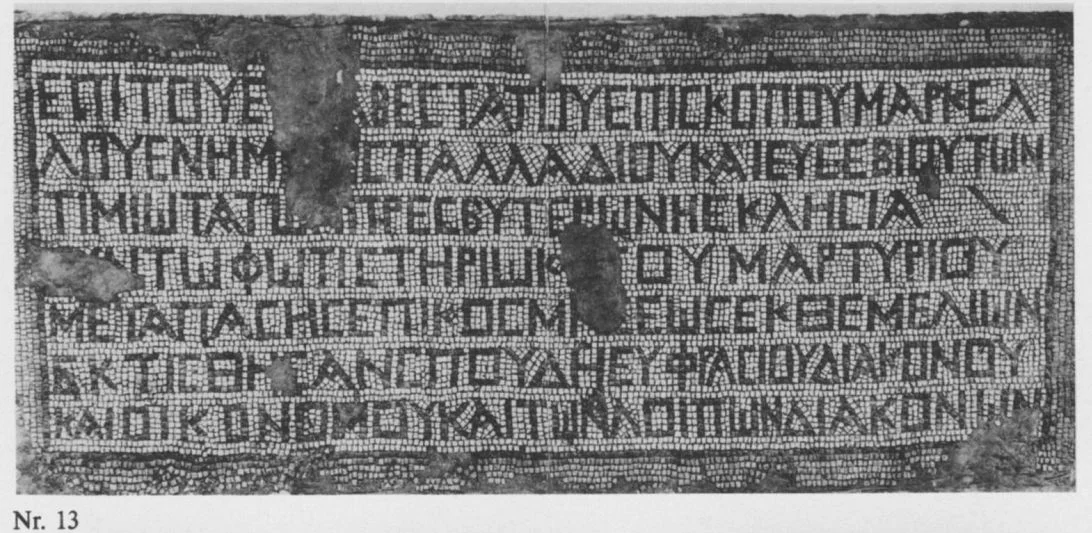
Floor-mosaic with a Greek inscription probably from north Syria, commemorating the construction of a church with a baptistery and a martyr shrine (martyrion). Exact provenance unknown. Possibly of the second half of the 4th c.
- Language
- Greek
- Date from
- 350
- Date to
- 500
- Evidence type
- Inscriptions
- Evidence subtype
- Formal inscriptions (stone, mosaic, etc.)
- Evidence region
- Syria with Phoenicia
- Evidence location
- Apamea on the Orontes; Antioch on the Orontes, Ἀντιόχεια, Antiocheia, Antiochia ad Orontem, Ἀντιόχεια Μεγάλη, Ἀντιόχεια ἐπὶ Ὀρόντου, Antakya; Tell Minis; Antioch on the Orontes, Ἀντιόχεια, Antiocheia, Antiochia ad Orontem, Ἀντιόχεια Μεγάλη, Ἀντιόχεια ἐπὶ Ὀρόντου, Antakya; Ḥūarte; Antioch on the Orontes, Ἀντιόχεια, Antiocheia, Antiochia ad Orontem, Ἀντιόχεια Μεγάλη, Ἀντιόχεια ἐπὶ Ὀρόντου, Antakya
- Cult region
- Syria with Phoenicia
- Cult location
- Apamea on the Orontes; Antioch on the Orontes, Ἀντιόχεια, Antiocheia, Antiochia ad Orontem, Ἀντιόχεια Μεγάλη, Ἀντιόχεια ἐπὶ Ὀρόντου, Antakya; Tell Minis; Antioch on the Orontes, Ἀντιόχεια, Antiocheia, Antiochia ad Orontem, Ἀντιόχεια Μεγάλη, Ἀντιόχεια ἐπὶ Ὀρόντου, Antakya; Ḥūarte; Antioch on the Orontes, Ἀντιόχεια, Antiocheia, Antiochia ad Orontem, Ἀντιόχεια Μεγάλη, Ἀντιόχεια ἐπὶ Ὀρόντου, Antakya
- Cult date from
- 350
- Cult date to
- 500
Text
ἐπὶ τοῦ ε[ὐλ]̣αβεστάτου ἐπισκόπου Μαρκέλ-
λου ἐν ἡμ[έρα]ις Παλλαδίου καὶ Εὐσεβίου τῶν
τιμιωτάτων πρεσβυτέρων ἡ ἐκλησία
[σ]̣ὺ̣ν τῷ φωτιστηρίῳ καὶ τοῦ μαρτυρίου
μετὰ πάσης ἐπικοσμήσεως ἐκ θεμελίων
ἐκτίσθησαν σπουδῇ Εὐφρασίου διακόνου
καὶ οἰκονόμου καὶ τῶν λοιπῶν διακόνων
4. καὶ τῷ φωτιστηρίῳ Rey Coquais || [σ]ὺν τῷ φωτιστηρίῳ Jarry
'Under the most pious bishop Markellos, in the days of Palladios and Eusebios, the most venerable presbyters, the church, with the baptistery, and the martyr shrine (martyrion) with all the embellishments were built from foundations by the efforts of the deacon and steward (oikonomos) Euphrasios, and the other deacons.'
Text: Jarry 1985, 113, no. 13.
Source
Floor-mosaic panel. Seen, photographed and copied by Jacques Jarry in the antiquities market before 1985. There is no published description. A photograph was republished by Pauline Donceel-Voûte in 1988 [1991].
Provenance unknown, probably north Syria. In 1987 Jean-Paul Rey-Coquais noted that the sanctuary, described in the inscription, resembles that of Ḥūarte, to the north of Apamea on the Orontes, see: E01624.
Jean Paul Rey-Coquais offered an altered restoration of the word lost at the beginning of line 4. However, having examined the shape of other letters in this inscriptions (especially Α and Κ) we see it rather implausible and retain the original restoration by Jarry.
Discussion
The inscription commemorates the construction of a church with a baptistery and a martyr shrine, probably a chapel or chamber adjacent to the apse, connected with one of the aisles. The name of the martyr, venerated there, is not specified.
In the Bulletin épigraphique Denis Feissel suggests that the bishop, mentioned in line 1, might be Markellos of Apamea, a vigorous opponent of the local pagan religions, credited with the destruction of the temple of Zeus-Belos (see: Busine 2013), and killed by the crowd in c. 389, during the attempted demolition of another pagan sanctuary. He was later himself venerated as a martyr, and praised by Theodoret of Cyrrhus in his Church history (see: EXXXXX, ch. 5.22).
Bibliography
Edition:
Donceel-Voûte, P., Les pavements des églises byzantines de Syrie et du Liban. Décor, archéologie et liturgie (Publications d’histoire de l’art et d’archéologie de l’Université catholique de Louvain 69, Louvain-La-Neuve: Département d'archéologie et d'histoire de l'art, 1988), 470, fig. 447 (photograph), cf. 171, note 17.
Jarry, J., "Nouveaux documents grecs et latins de Syrie du Nord et de Palmyrene", Zeitschrift für Papyrologie und Epigraphik 60 (1985), 113.
Further reading:
Rey-Coquais, J.-P., "Épigraphie", [in:] P. and M.T. Canivet, J. Lassus (eds.), Ḥūarte. Sanctuaire chrétien d’Apamène (IVe-VIe s.) (Paris: Librairie orientaliste Paul Geuthner, 1987), 50, note 10.
For the destruction of the temple of Zeus-Belos in Apamea, see:
Busine, A., "From stones to myth: temple destruction and civic identity in the late antique Roman East", Journal of Late Antiquity 6 (2013), 325-346.
Reference works:
Bulletin épigraphique (1987), 501.
Supplementum Epigraphicum Graecum 35, 1528; 37, 1461.
Images
Associated saints
| Saint | Name in source | Certainty |
|---|---|---|
| Martyrs, unnamed or name lost (S00060) | Certain |
Cult classifications
- Cult Places
- Cult building - dependent (chapel, baptistery, etc.); Martyr shrine (martyrion, bet sāhedwātā, etc.)
- Non Liturgical Activity
- Bequests, donations, gifts and offerings; Construction of cult buildings
- People
- Ecclesiastics - bishops; Ecclesiastics - lesser clergy
Record author
Paweł Nowakowski
Entry date
30/06/2016
Citation
Paweł Nowakowski, Cult of Saints, E01681 — https://csla.history.ox.ac.uk/record.php?recid=E01681