
E01722
Greek dedicatory inscription to *Mary (Mother of Christ, S00033). Found at the island of Chios (the Aegean Islands). Exact provenance unknown. Possibly late antique.
- Language
- Greek
- Date from
- 500
- Date to
- 1300
- Evidence type
- Inscriptions
- Evidence subtype
- Formal inscriptions (stone, mosaic, etc.)
- Evidence region
- Aegean islands and Cyprus
- Evidence location
- Chios; Salamis, Σαλαμίς, Salamis, Salamis, Farmagusta, Far, Κωνσταντία, Konstantia, Constantia
- Cult region
- Aegean islands and Cyprus
- Cult location
- Chios; Salamis, Σαλαμίς, Salamis, Salamis, Farmagusta, Far, Κωνσταντία, Konstantia, Constantia
- Cult date from
- 500
- Cult date to
- 1300
Text
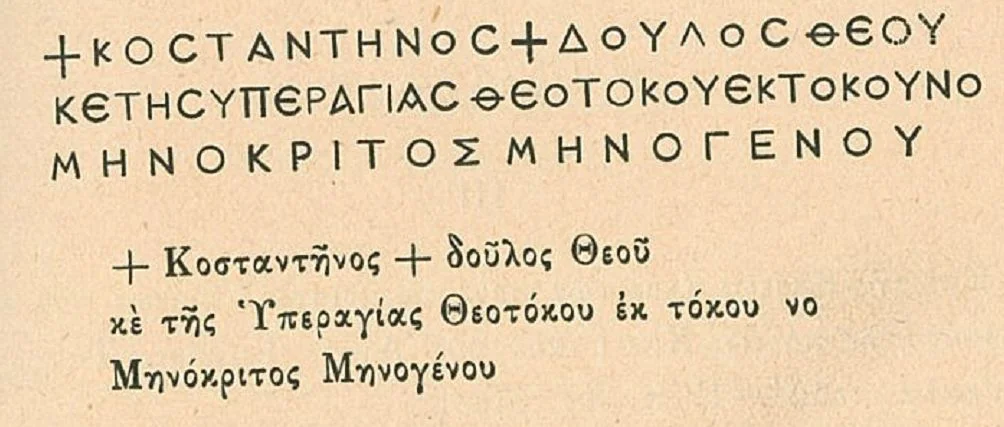
+ Κοσταντῆνος + δοῦλος θεοῦ
κὲ τῆς ὑπεραγίας Θεοτόκου εκτοκουνο[
Μηνόκριτος Μηνογένου
2. ἐκ τόκου νο[ Zolotas
'+ Konstantinos +, servant of God and of the over-holy God-Bearer (Theotokos) (?) [- - -]. Menokritos, son of Menogenes.'
Text: Zolotas 1908, 246-247, no. 79.
Source
A grey marble slab. H. 0.27 m; W. 0.59 m. Above the inscription there are carvings of two crosses and other unspecified decorations. The editor says that the third line might have been written by another hand, in an earlier period.
Seen and copied by Georgios Zolotas at the Museum of the Gymnasium in Chios after 1886. Said to have been found at a citadel (phrourion).
Discussion
The inscription was authored by a certain Konstantinos, who named himself a servant of God and of the God-Bearer. The name 'Menokritos, son of Menogenes', written on the same stone, comes probably from a different, now lost, text.
The meaning of the last word preserved in line 2, εκτοκουνο, is not clear, and the editor does not say whether the right-hand side of the stone was broken and lost when he examined it. This is, however, possible, and the line might need to be completed. The other option is that the last word in line 2 was erroneously read by the editor, or that the possibly illiterate stonecutter confused this word with the name Theotokos/'God-Bearer'.
Dating: the sophisticated epithets of Mary suggest a fairly late date for the inscription, possibly the 6th/7th c. or even later.
Bibliography
Edition:
Zolotas, G., Επιγραφαί Χίου ανέκδοτοι , Athena 20 (1908), 246-247, no. 79.
Further reading:
Kiourtzian, G., "Pietas insulariorum", [in:] Eupsychia: mélanges offerts à Hélène Ahrweiler, vol. 2 (Série Byzantina Sorbonensia 16, Paris: Publications de la Sorbonne, 1998), 375.
Images
Associated saints
| Saint | Name in source | Certainty |
|---|---|---|
| Mary, Mother of Christ (S00033) | Certain |
Cult classifications
- Non Liturgical Activity
- Prayer/supplication/invocation
- People
- Other lay individuals/ people
Record author
Paweł Nowakowski
Entry date
13/07/2016
Citation
Paweł Nowakowski, Cult of Saints, E01722 — https://csla.history.ox.ac.uk/record.php?recid=E01722