
E01752
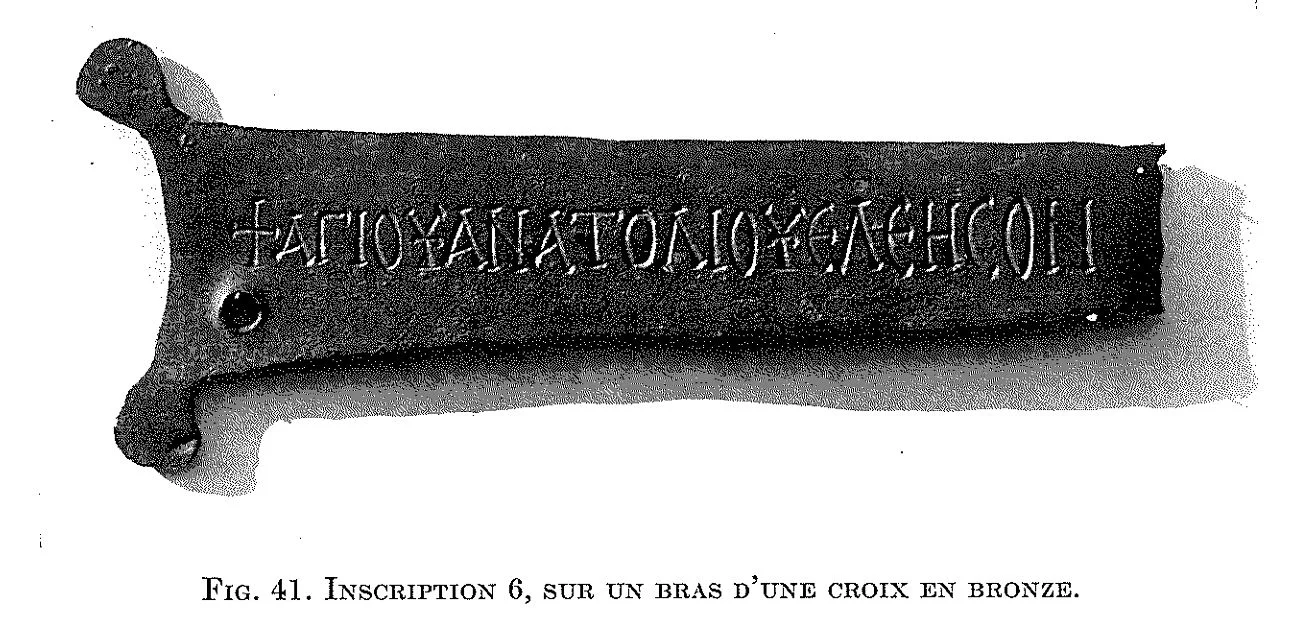
Fragmentary Greek inscription on the horizontal arm of a bronze cross, with an invocation of a certain *Anatolios. Found at Kaoussie/Qausiyeh near Antioch on the Orontes (Syria), in the so-called Cruciform Church, the presumed martyrion of *Babylas (S00061). Probably 5th-7th c.
- Language
- Greek
- Date from
- 400
- Date to
- 800
- Evidence type
- Images and objects; Inscriptions
- Evidence subtype
- Inscribed objects; Other portable objects (metalwork, ivory, etc.)
- Evidence region
- Syria with Phoenicia
- Evidence location
- Antioch on the Orontes; Antioch on the Orontes, Ἀντιόχεια, Antiocheia, Antiochia ad Orontem, Ἀντιόχεια Μεγάλη, Ἀντιόχεια ἐπὶ Ὀρόντου, Antakya; Kaoussie; Antioch on the Orontes, Ἀντιόχεια, Antiocheia, Antiochia ad Orontem, Ἀντιόχεια Μεγάλη, Ἀντιόχεια ἐπὶ Ὀρόντου, Antakya
- Cult region
- Syria with Phoenicia
- Cult location
- Antioch on the Orontes; Antioch on the Orontes, Ἀντιόχεια, Antiocheia, Antiochia ad Orontem, Ἀντιόχεια Μεγάλη, Ἀντιόχεια ἐπὶ Ὀρόντου, Antakya; Kaoussie; Antioch on the Orontes, Ἀντιόχεια, Antiocheia, Antiochia ad Orontem, Ἀντιόχεια Μεγάλη, Ἀντιόχεια ἐπὶ Ὀρόντου, Antakya
- Cult date from
- 400
- Cult date to
- 800
Text
On the one surviving part of the cross, its left-hand horizontal arm:
+ ἁγίου Ἀνατολίου ἐλέησον [- - -]
perhaps [Κύριε, ὁ θεὸς τοῦ] + ἁγίου Ἀνατολίου, ἐλέησον Lassus, [κειμήλιον (?) τοῦ] + ἁγίου Ἀνατολίου. ἐλέησον or + ἁγίου Ἀνατολίου. ἐλέησον IGLS
'[Lord, the God (?)] + of Saint Anatolios, have mercy [- - -]' (according to Lassus)
or:
'[The treasury (?)] of Saint Anatolios. Have mercy!' or '+ Of Saint Anatolios. Have mercy!' (according to the editors of the IGLS)
Text: Lassus 1938, 43, no. 6.
Source
Left-hand horizontal arm of a bronze cross, ending with two loops. Preserved dimensions: H. 0.022-0.055 m; W. 0.135 m (W. of the inscribed field: 0.113 m); letter height 0.007-0.009 m.
Found during the surveys of the Committee for the Excavation of Antioch and its Vicinity in the debris in Room 10 (annex to the baptistery) of the so-called Cruciform Church/the Church at Kaoussie, a suburb of Antioch. First published, with a photograph, by Jean Lassus in 1938.
The church was sited outside the city walls of ancient Antioch, on the right bank of Orontes. It was discovered thanks to its mosaic floors, unearthed in 1934 and 1935. The church consisted of a central squarish chamber (c. 16 m x 16 m), four perpendicular aisles (W. 11 m; L. 25 m), and extensions. A mosaic floor inscription says that the foundation of the church must pre-date 387. The construction of annexes, including the baptistery, post-dates 412. The church is normally identified as the martyr shrine of *Babylas, based on the fact that this was the only sanctuary outside the walls of Antioch, mentioned in extant sources. If so, the exact date of its construction can be established thanks to the testimony of John Chrysostom (E00095) and Sozomen (E02283), who place it in 379/380 under bishop Meletios (buried there in 381).
Discussion
The first editor, Jean Lassus, supposed that the inscription extended also on other branches of the cross, as otherwise the preserved text would be scarcely understandable. Given the genitive form of the name of the saint, followed by a request for mercy, the most reasonable reconstruction, he says, is that the God of Saint Anatolios was the addressee of the plea.
Lassus identified this Anatolios as the bishop of Laodicea in Syria, a man of born in Alexandria and trained as a mathematician, who held the episcopal see of Laodicea from 264 to 283. He was said to have died just before the beginning of the persecutions under Diocletian (not as a martyr).
According to Lassus this cross was an ex-voto offering, hung on a wall (as its reverse lacks decorations). René Mouterde, in the review of the second volume of Antioch-on-the-Orontes, published in Mélanges de l'Université Saint-Joseph in 1939, added that the room might have contained relics of the saint.
A more detailed commentary was offered by Mouterde several years later, in the third volume of Les inscriptions grecques et latines de la Syrie. He argued there that the inscription was rather a simple label, marking the ownership of the cross, as such precious objects were frequently kept in ecclesiastical treasuries (see: E00868; EXXXXXX). Therefore, he reconstructed the inscription as 'The treasury of saint Anatolios' or simply 'Of saint Anatolios'. One must, however, note that this reconstruction is not coherent with the invocation 'Have mercy!', following the name of the saint.
As for the identity of Anatolios, Mouterde considered him the bishop of Constantinople, who presided over the council of Chalcedon in 451, whose Life is summarised in the Synaxarium Ecclesiae Constantinopolitanae (3rd July).
Bibliography
Edition:
Now also: Mayer, W., Allen, P., The Churches of Syrian Antioch (300-638 CE) (Leuven - Paris - Walpole, MA: Peeters, 2012).
Jalabert, L., Mouterde, R., Les inscriptions grecques et latines de la Syrie, vol. 3/1: Région de l’Amanus, Antioche (BAH 46, Paris: P. Geuthner, 1950), no. 784.
Lassus, J., "L'Église cruciforme", [in:] R. Stillwell and others (ed.), Antioch-on-the-Orontes, vol. 2: The Excavations 1933-1936 (Princeton: Princeton Univeristy Press, London: Oxford University Press, the Hague: Martinus Nijhoff, 1938), 43, no. 6.
Further reading:
Downey, G., “The shrines of St. Babylas at Antioch and Daphne”, [in:] R. Stillwell and others (ed.), Antioch-on-the-Orontes, vol. 2: The Excavations 1933-1936 (Princeton: Princeton Univeristy Press, London: Oxford University Press, the Hague: Martinus Nijhoff, 1938), 45-48.
Downey, G., A history of Antioch in Syria: from Seleucus to the Arab conquest (Princeton : Princeton University Press, 1961), 415; 455.
Mouterde, R., “Review: Antioch-on-the-Orontes, II. The Excavations of 1933-1936 edited by R. Stilwell...”, Mélanges de l'Université Saint-Joseph (Beyrouth, Lebanon) 22 (1939), 131.
Reference works:
Bulletin épigraphique (1938), 503; (1940), 169.
Images
Associated saints
| Saint | Name in source | Certainty |
|---|---|---|
| Anatolios, bishop of Laodicea in Syria, ob. 283 (S00900) | Ἀνατόλιος | Uncertain |
| Anatolios, bishop of Constantinople, 449-458 (S00902) | Ἀνατόλιος | Uncertain |
Cult classifications
- Cult Related Objects
- Crosses; Ex-votos; Precious material objects
- Non Liturgical Activity
- Bequests, donations, gifts and offerings; Prayer/supplication/invocation; Vow
Record author
Paweł Nowakowski
Entry date
19/07/2016
Citation
Paweł Nowakowski, Cult of Saints, E01752 — https://csla.history.ox.ac.uk/record.php?recid=E01752