
E01758
Amulets from the collection of S. Ayvaz with Greek inscriptions invoking the Archangels: *Michael (S00181), *Gabriel (S00192), *Ouriel (S00770), and depictions showing *Mary (Mother of Christ, S00033), and a holy rider. Found in Syria, various locations. Probably Roman impeiral, late antique, and/or middle Byzantine. Pagan and/or Christian.
- Language
- Greek
- Date from
- 400
- Date to
- 1300
- Evidence type
- Images and objects; Inscriptions; Literary
- Evidence subtype
- Inscribed objects; Lamps, ampullae and tokens; Magical texts and amulets; Other portable objects (metalwork, ivory, etc.)
- Evidence region
- Syria with Phoenicia
- Evidence location
- Beroia; Antioch on the Orontes, Ἀντιόχεια, Antiocheia, Antiochia ad Orontem, Ἀντιόχεια Μεγάλη, Ἀντιόχεια ἐπὶ Ὀρόντου, Antakya; Berytos; Antioch on the Orontes, Ἀντιόχεια, Antiocheia, Antiochia ad Orontem, Ἀντιόχεια Μεγάλη, Ἀντιόχεια ἐπὶ Ὀρόντου, Antakya; Laodicea ad Mare; Antioch on the Orontes, Ἀντιόχεια, Antiocheia, Antiochia ad Orontem, Ἀντιόχεια Μεγάλη, Ἀντιόχεια ἐπὶ Ὀρόντου, Antakya; Ḥamāh; Antioch on the Orontes, Ἀντιόχεια, Antiocheia, Antiochia ad Orontem, Ἀντιόχεια Μεγάλη, Ἀντιόχεια ἐπὶ Ὀρόντου, Antakya
- Cult region
- Syria with Phoenicia
- Cult location
- Beroia; Antioch on the Orontes, Ἀντιόχεια, Antiocheia, Antiochia ad Orontem, Ἀντιόχεια Μεγάλη, Ἀντιόχεια ἐπὶ Ὀρόντου, Antakya; Berytos; Antioch on the Orontes, Ἀντιόχεια, Antiocheia, Antiochia ad Orontem, Ἀντιόχεια Μεγάλη, Ἀντιόχεια ἐπὶ Ὀρόντου, Antakya; Laodicea ad Mare; Antioch on the Orontes, Ἀντιόχεια, Antiocheia, Antiochia ad Orontem, Ἀντιόχεια Μεγάλη, Ἀντιόχεια ἐπὶ Ὀρόντου, Antakya; Ḥamāh; Antioch on the Orontes, Ἀντιόχεια, Antiocheia, Antiochia ad Orontem, Ἀντιόχεια Μεγάλη, Ἀντιόχεια ἐπὶ Ὀρόντου, Antakya
- Cult date from
- 400
- Cult date to
- 1300
Text
In 1942/1943 Jean Mecerian and René Mouterde published 61 magical objects from the collection of S. Ayvaz, an engineer and art collector, active in the Near East. All of the objects come form Syria and Phoenicia, mostly from the territories of Beroia/Aleppo, Ḥimṣ/Emesa, Damascus, and Beirut.
The collection includes both pagan, Jewish, and Christian charms. Below we include only those amulets which feature depictions or texts showing saints and archangels as protectors of the people wearing them. One must note, however, that not every such object necessarily belonged to a Christian. Especially those featuring depictions or names of Archangels could have been worn by Jews, or pagans.
None of these objects can be dated with any precision, and several may well be later than our cut-off date of AD 700.
The charms also show magical signs (charakteres) and images of demons, frequently occurring in pagan spells, defixiones, and magical papyri, which points to a tolerant attitude towards the old beliefs of the people wearing and producing such items.
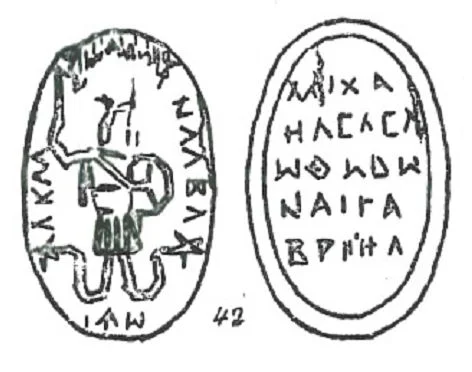
No. 42: hematite gem; Th. 0.2 cm.
provenance: Beirut
obverse: depiction of a demon with legs of a serpent, head of a rooster, wearing armour, holding a shield in his left hand and a whip in his right hand (raised); a star to the right of the demon
inscriptions: ΛΝΛΛΒΛ ΑΚΜ Ἰαω (probably derivatives of magical formulas: Αβλαναθαλβα, Αχραμμαχαμαρει)
reverse:
inscriptions: Μιχαήλ, Σαβαώθ, Ἀδωναί, Γαβριήλ / 'Michael, Sabaoth, Adonai, Gabriel'
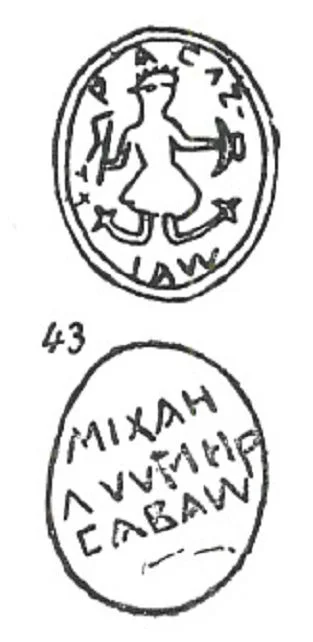
No. 43: brownish jasper gem with red veins; Th. 0.3 cm.
provenance: Beroia/Aleppo
obverse:
inscriptions: Μιχαήλ, Οὐριήλ, Σαβαώ / Michael, Ouriel, Sabaoth'
reverse: image of a demon, similar to that of no. 42
inscriptions: Ἀβρασάξ Ἰαω /'Abrasax Iao'
No. 50: bronze bracelet with four medallions. Th. 0.1 cm. The first medallion is obliterated; the second shows a holy rider with nimbus, mounted on a horse, holding a lance with a cross-like ending, and piercing a serpent-demon; the third medallion shows the seated Mary, with nimbus, holding the Child Christ on her lap, a cross and a venerator; the fourth medallion bears the inscription: ὁ κατοικõν ἐν, i.e. the beginning of Psalm 90.
provenance: Beroia/Aleppo
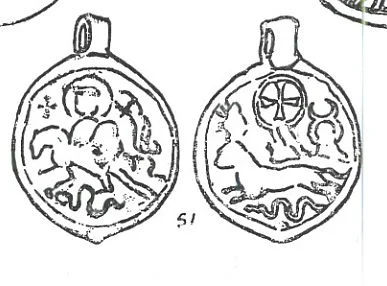
No. 51: bronze pendant. Th. 0.1 cm.
provenance: Beirut or possibly Latakia/Laodicea ad Mare
obverse: depiction of a holy rider with nimbus, wearing a chlamys; a serpent-demon under the hooves of the horse; a cross to the left of the head of the rider; possibly an angel with a cross to the right of the rider
reverse: cross within a nimbus, probably on a mountain, flanked by the Moon and the Sun; below a running lion and a serpent
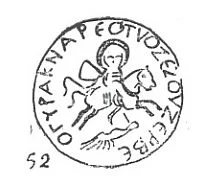
No. 52: bronze disc, possibly a medallion from a bracelet. Th. 0.1 cm.
provenance: Beirut
obverse: depiction of a holy rider with nimbus, piercing a demon
inscription: ΟΓΥΡΑΚΝΑΡΕΟΓΥΦΖΕΖΟΥΖΕΡΒΕ
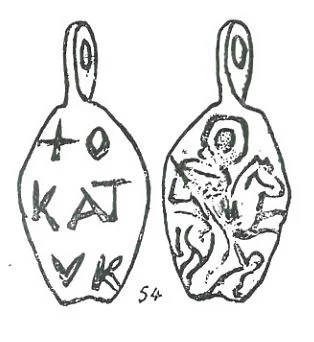
No. 54: reddish bronze pendant, with traces of paint. Th. 0.2 cm.
provenance: Beroia/Aleppo
obverse: depiction of a holy rider with nimbus, piercing a demon
inscription: + ὁ κατυκ, i.e. the beginning of Psalm 90.
For this object, see also: Feissel 1984, 576, note 159.
No. 55: bronze disc. Th. 0.1 cm.
provenance: Ḥamāh
obverse: depiction of a holy rider with nimbus, wearing a chlamys, holding a lance and flag with a cross, piercing a dog-demon; to the right of the rider an angel, stretching his hands towards the rider, standing on a bema; a star above the angel
inscription: εἷς θ(εὸ)ς ὁ νικὸν τὰ κάκα / There is One God, conquering evil'; + ὁ κατοικῶν ἐν βοηθίᾳ τοῦ Ὑψίστου ἐν σκέπῃ τοῦ θ(εο)ῦ τοῦ οὐρανοῦ αὐλισθίσεται ἐρῖ τõ Κ(υρί)ῳ, i.e. the beginning of Psalm 90.
reverse:
upper register: depiction of Christ in Majesty, with nimbus, holding a Gospel, within an oval frame (mandorla), surrounded by symbols of the Four Evangelists: the angel, the eagle, the oxen, and the lion; inscription: ἅγιος, ἅγιος, ἅγιος Κ(ύριο)ς Σαβαώθ / 'Holy, holy, holy Lord of Hosts' (the Trisagion prayer).
middle register: magical signs (charakteres) displayed over two lines
lower register: a running lion, a scorpion, below them a snake with a stroke, marked in the middle section of its body; inscription: + σφραγὶς θ(εο)ῦ ζόντος, φύλαξον ἀπὸ παντὸς κακοῦ τὸν φοροῦντα τὸ φυλακτήριον τοῦ(το) / '+ Seal of the Living God, protect the one bearing this charm (phylakterion) from every evil!' (the seal of Solomon?)
No. 56: fragmentary hematite gem. Th. 0.3 cm.
provenance: Beirut
obverse: holy rider (Solomon), piercing a demon
inscription: Σολό[μων] / 'Solo[mon]'
reverse:
inscriptions: [Σφ]ρα|[γὶ]ς θ|[ε]οῦ / 'Seal of God'; a star; probably a monogram (?): Σο<λόμο>νως/'Of Solomon'.
No. 57: blackish bronze disc. Dimensions not specified.
provenance: Beroia/Aleppo
obverse: holy rider with nimbus, piercing a demon, another holy figure with nimbus
inscription: <ε>ἷς θεὸς νικᾷ τὸ <π>ονιρό<ν> / 'There is One God, conquering evil'; + ὁ κατυ. ν...ηθίᾳ τοῦ Ὑψίστου ηυσκπι τοῦ θ(εο)ῦ τυ χραν, i.e. the beginning of Psalm 90, poorly spelt.
reverse: resembling that of no. 55
inscriptions: + ὁ [κ]ατυκὸν <ε>ἷς θ(εὸς) ὁ Κ(ύριος) CΘCΒΟΜΕΝΟCΙ CΝΟΥΒΑΔΙ ΒΩΙΑΝΙΝ, understood by the editors as: <ὁ σε>βόμενος <Κύριο>ν (οὐ) βαδί[ζ(ει) ἐν ἐρέ]βωι. ἀ<μ>ίν / 'Who venerates the Lord, will not walk in the darkness' (a phrase possibly inspired, for example, by Psalm 23, etc.)
For this object, see also: Feissel 1984, 576, note 159.
No. 58: bronze pendant. Th. 0.1 cm.
provenance: Beroia/Aleppo
obverse: holy rider with nimbus piercing a demon; a star to the right of the rider; below him the evil eye with a cross, attacked by a lion, an ibis, a serpent, a scorpion, and probably a lion
inscription: ε<ἷ>ς θ(εὸς) ὁ νικõν {ικων} <τ>ὰ / 'There is One God, the conqueror of...'
reverse: depiction of a flying demon with open mouth, wearing a crown, holding a short sword (?) and a shield
inscription: στόμαχε | ἀντιστόμαχε | Ὠσεμα ἔφαγε | Ὠσεμα ἐπὶ Ὠκε|ανοῦ τῇ κατωδώσ|η / 'O stomach, O anti-stomach, Osema devoured, Osema, as deep as the Ocean.'
No. 59: hematite gem. Th. 0.2 cm.
provenance: Beroia/Aleppo
obverse: holy rider piercing a demon; three points and a small cross of St. Andrew above the head of the saint
reverse:
inscription: Σφρα|γὶς | θε|οῦ / 'Seal of God'
No. 60: reddish bronze pendant. Th. 0.1 cm.
provenance: Beirut
obverse: holy rider with nimbus piercing a demon; a lion
inscription: [εἷς θεὸς] ὁ νικῶ[ν τὰ κακά] / '[There is One God], the conqueror [of evil]'.
reverse: the evil eye pierced by two nails, attacked by a bird, a serpent, a scorpion, a jackal (?)
inscription: [Ἰ]άω, Σα|[β]αώθ, Μι[χ|α]ήλ, βοή[θι] / 'Iao, Sabaoth, Michael, help!'
No. 61: bronze pendant. Th. 0.1 cm.
provenance: Beirut
obverse: similar to that of no. 60.
reverse: ibis eating a serpent
inscription: πινῶ / 'I am hungry!' (= πεινάω)
Bibliography
Edition:
Mecerian, J., Mouterde, R., "Objets magiques. Recueil S. Ayvaz", Mélanges de l'Université Saint-Joseph (Beyrouth, Lebanon) 25 (1942-1943), 105-128.
Further reading:
Feissel, D., "Une inscription de Salamine de Chypre et les citations du Psaume 90", Bulletin de correspondance hellénique 108 (1984), 576, note 159.
Images

Associated saints
| Saint | Name in source | Certainty |
|---|---|---|
| Michael, the Archangel (S00181) | Certain | |
| Gabriel, the Archangel (S00192) | Certain | |
| Ouriel, the Archangel (S00770) | Certain | |
| Mary, Mother of Christ (S00033) | Certain | |
| Sisinnios (unspecified) (S00608) | Uncertain | |
| Theodore, soldier and martyr of Amaseia and Euchaita (S00480) | Uncertain | |
| George, soldier and martyr, and Companions (S00259) | Uncertain | |
| Solomon, Old Testament king of Israel (S00270) | Certain | |
| Saints, unnamed (S00518) | Certain |
Cult classifications
- Cult Related Objects
- Other
- Non Liturgical Activity
- Magic; Prayer/supplication/invocation
- People
- Demons
- Recorded Miracles
- Healing diseases and disabilities; Other miracles with demons and demonic creatures
- Use of Images
- Private ownership of an image
Record author
Paweł Nowakowski
Entry date
22/07/2016
Citation
Paweł Nowakowski, Cult of Saints, E01758 — https://csla.history.ox.ac.uk/record.php?recid=E01758