
E01765
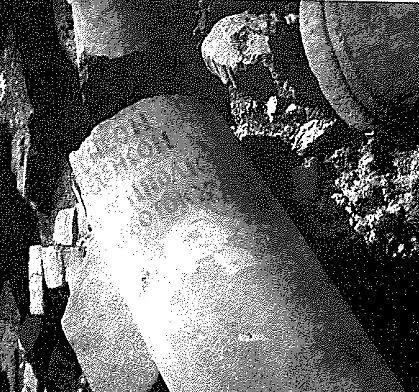
Fragmentary Greek painted inscription on a column, with an invocation of God as the Lord and an acclamation of Tyre as the city of *Mary (Mother of Christ, S00033), here named the God-Bearer. Found at Tyre (west Phoenicia). Probably 6th or 7th c.
- Language
- Greek
- Date from
- 500
- Date to
- 700
- Evidence type
- Inscriptions
- Evidence subtype
- Formal inscriptions (stone, mosaic, etc.); Graffiti; Inscribed architectural elements
- Evidence region
- Syria with Phoenicia
- Evidence location
- Tyre; Antioch on the Orontes, Ἀντιόχεια, Antiocheia, Antiochia ad Orontem, Ἀντιόχεια Μεγάλη, Ἀντιόχεια ἐπὶ Ὀρόντου, Antakya
- Cult region
- Syria with Phoenicia
- Cult location
- Tyre; Antioch on the Orontes, Ἀντιόχεια, Antiocheia, Antiochia ad Orontem, Ἀντιόχεια Μεγάλη, Ἀντιόχεια ἐπὶ Ὀρόντου, Antakya
- Cult date from
- 500
- Cult date to
- 700
Text
[- - - - - - - - - - -]
Κ(ύρι)ε σῶσον,
Κ(ύρι)ε ἐλέησον
Τύρος ἡ πόλις τῆς Θεοτόκου
1-2. less probably κὲ σῶσον, κὲ ἐλέησον Rey-Coquais
'O Lord, save (us?), O Lord have mercy! Tyre, the city (polis) of the God-Bearer.'
Text: I. Tyr 2, no. 94.
Source
Red painted inscription on a collapsed white marble column, broken on top. L. 0.40 m; letter height 0.05 m. Very fine lettering. The preserved part of the inscription is written just below the break in the column.
Found at the north-east end of the lower road (aligned south-east to north-west). First published by Jean-Paul Rey-Coquais in 2006.
Discussion
The inscription is an invocation of God as the Lord, followed by an acclamation of Tyre as the city of the God-Bearer (Theotokos). The layout of accents suggests that we may have here a piece of rhythmical prose.
The editor, Jean-Paul Rey-Coquais, notes that faint traces of the lower parts of letters were visible above the first preserved line, but he was unable to identify them. He supposes, however, that the lost fragment was short and could have contained a very common formula: Κ(ύρι)ε βοήθει/'Lord help!' This is, of course, possible but unsupported by any reliable evidence.
In his comments Rey-Coquais notes that we are dealing with an official inscription with a request for help for the city itself, echoing the peculiar devotion of its citizens to Mary. Such an idea is justified by the high quality of the lettering of the inscription, and by the fact that at least two churches in Tyre were dedicated to Mary (see: E01697).
For similar expressions, see: E00742 (a request for help for Ephesos, addressed to Mary, where the cathedral church was dedicated to her) and E01046 (Diokaisareia in Isauria named the city of Saint *Loukios).
Dating: the editor says nothing about the possible date of the inscription, but the shape of letters points to the 6th or 7th c.
Bibliography
Edition:
I. Tyr 2 – Jean-Paul Rey-Coquais (ed.), Inscriptions Grecques et Latines de Tyr, vol. 2 (BAAL: Bulletin d'Archéologie et d'Architecture Libanaises, supplement III, Beyrouth: Ministère de la Culture, Direction Générale des Antiquités, 2006), 72, no. 94.
Reference works:
Bulletin épigraphique (2007), 513.
Supplementum Epigraphicum Graecum 56, 1877.
Images
Associated saints
| Saint | Name in source | Certainty |
|---|---|---|
| Mary, Mother of Christ (S00033) | Θεοτόκος | Certain |
Cult classifications
- Non Liturgical Activity
- Prayer/supplication/invocation; Saint as patron - of a community
- Places Names after Saint
- Towns, villages, districts and fortresses
- Recorded Miracles
- Miraculous protection - of communities, towns, armies
Record author
Paweł Nowakowski
Entry date
24/07/2016
Citation
Paweł Nowakowski, Cult of Saints, E01765 — https://csla.history.ox.ac.uk/record.php?recid=E01765