
E01886
Greek inscription invoking the intercession of *Mary (Mother of Christ, S00033) to protect a gateway. Found at Qaṣr el-Mouḥarram near Apamea on the Orontes (central Syria). Probably c. 570.
- Language
- Greek
- Date from
- 560
- Date to
- 580
- Evidence type
- Inscriptions
- Evidence subtype
- Formal inscriptions (stone, mosaic, etc.)
- Evidence region
- Syria with Phoenicia
- Evidence location
- Apamea on the Orontes; Antioch on the Orontes, Ἀντιόχεια, Antiocheia, Antiochia ad Orontem, Ἀντιόχεια Μεγάλη, Ἀντιόχεια ἐπὶ Ὀρόντου, Antakya; Qaṣr el-Mouḥarram; Antioch on the Orontes, Ἀντιόχεια, Antiocheia, Antiochia ad Orontem, Ἀντιόχεια Μεγάλη, Ἀντιόχεια ἐπὶ Ὀρόντου, Antakya
- Cult region
- Syria with Phoenicia
- Cult location
- Apamea on the Orontes; Antioch on the Orontes, Ἀντιόχεια, Antiocheia, Antiochia ad Orontem, Ἀντιόχεια Μεγάλη, Ἀντιόχεια ἐπὶ Ὀρόντου, Antakya; Qaṣr el-Mouḥarram; Antioch on the Orontes, Ἀντιόχεια, Antiocheia, Antiochia ad Orontem, Ἀντιόχεια Μεγάλη, Ἀντιόχεια ἐπὶ Ὀρόντου, Antakya
- Cult date from
- 560
- Cult date to
- 580
Text
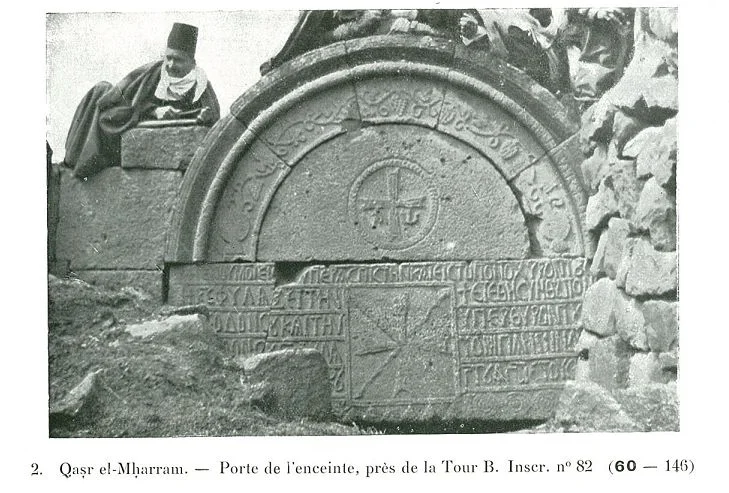
+ Κύριε βοήθι τὴν εἴσοδον καὶ τὴν ἔξοδον, εὐχῇ τῆς Θ(εο)τόκου Μαριάμ.
Θεοτόκε μραμ = Θεοτόκε Μ(α)ρ(ί)α, μ(ῆτερ θεοῦ?) Lucas, Θτοκου μρμ = Θ(εο)τόκου Μαρία(ς) Lassus, μρμ = Μ(ά)ρ(ια)μ Mouterde Littmann
'Lord, help (thy) going in and (thy) going out. Through the intercession of the God-Bearer (Theotokos) Mariam.'
Text: IGLS 4, no. 1813. The inscription is not easy to read and we do not reproduce here erroneous readings of earlier editors, which are not essential for the correct interpretation of the text. On the other hand we do present editors' rival ideas concerning the form of the name of Mary.
Source
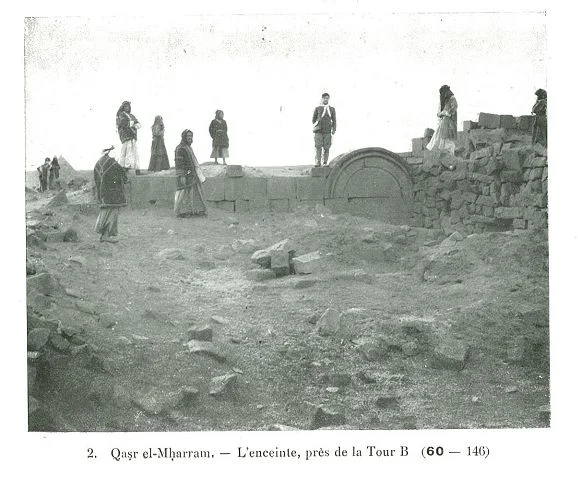
The inscription is on the arch of a gateway in the wall leading to the east side of Tower B of the fort at Qaṣr el-Mouḥarram (also named Qaṣr el-Beroūg, see: E01885). The inscription is set under an elaborately decorated arch, and arranged on either side of a combined Chi-Rho and Cross, set within a square. Good photos exist, but there is no published description with dimensions.
First published in 1905 by Hans Lucas, from a copy, squeeze, and photograph by Max von Oppenheim. Revisited and republished by Jean Lassus in the 1930s with the aid of Enno Littmann. The edition by René Mouterde (1955) follows those of earlier editors.
Discussion
As inscription E01885 on the same fortress, our inscription was carved to enhance the safety of the fort at Qaṣr el-Mouḥarram, in this case a specific gateway. Here, only the intercession of Mary is invoked, together with a set phrase frequently put above doorways in Syria, while on E01885 the intercession of 'All Saints' is also sought.
The most interesting feature of this text is the name of Mary, rendered on the stone as Μρμ. Several possible expansions of this abbreviation have been suggested (see the apparatus), but the most reasonable is the idea of Enno Littmann (accepted by René Mouterde) that we have here a Greek transcription of the Syriac name Miriam, probably in the from Μ(ά)ρ(ια)μ.
Remarkably, this is not the only case where the name of Mary is associated with towers and fortifications (cf. E01885; E01887; E01891; E01895; E01898). This interesting practice probably derives from the metaphorical description of Mary as the Tower of David and the Ivory Tower. The expressions were originally used in the Song of Solomon and were known in our region, as evidenced, for example, by an inscription from Nawa (see: IGLS 4, no. 1948).
Dating: The inscription must be more or less contemporary to the lintel situated immediately under the arch and dated AD 570 (see: IGLS 4, no. 1812).
Bibliography
Edition:
Jalabert, L., Mouterde, R., Mondésert, Cl., Inscriptions grecques et latines de la Syrie, vol. 4: Laodicée, Apamène (BAH 61, Paris: Librairie orientalise Paul Geuthner, 1955), no. 1813 (and Addendum, p. 358).
Lassus, J., Inventaire archéologique de la région au nord-est de Hama (Documents d'Études Orientales 4, Damascus: Institut français de Damas, [1935-1936?]), vol. 1: Text, 146, no. 83, fig. 149.
Lucas, H., "Griechische und lateinische Inschriften aus Syrien, Mesopotamien und Kleinasien", Byzantinische Zeitschrift 14 (1905), 35, no. 38, plate IV, 20 (from a copy, squeeze, and photograph by Max von Oppenheim).
Further reading:
Jalabert, DACL, col. 1732, no. 21.
Lucas, H., "Citat. bibl.", in: DACL, col. 1737, no. 89.
Peña, I., Lieux de pèlerinage en Syrie (Milan: Franciscan Printing Press, 2000), 14.
Images


Associated saints
| Saint | Name in source | Certainty |
|---|---|---|
| Mary, Mother of Christ (S00033) | Μάριαμ | Certain |
Cult classifications
- Non Liturgical Activity
- Prayer/supplication/invocation
- Places Names after Saint
- Gates, bridges and roads; Towns, villages, districts and fortresses
Record author
Paweł Nowakowski
Entry date
02/10/2016
Citation
Paweł Nowakowski, Cult of Saints, E01886 — https://csla.history.ox.ac.uk/record.php?recid=E01886