
E01926
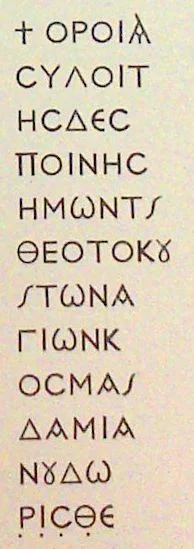
Greek inscription from a boundary stone marking the asylum of a church, or churches, dedicated to *Mary (Mother of Christ, S00033) and *Kosmas and Damianos (brothers, physician martyrs of Syria, S00385). Found at Ḥamāh/Amathe (central Syria). Probably 6th c.
- Language
- Greek
- Date from
- 500
- Date to
- 600
- Evidence type
- Inscriptions
- Evidence subtype
- Formal inscriptions (stone, mosaic, etc.)
- Evidence region
- Syria with Phoenicia
- Evidence location
- Ḥamāh; Antioch on the Orontes, Ἀντιόχεια, Antiocheia, Antiochia ad Orontem, Ἀντιόχεια Μεγάλη, Ἀντιόχεια ἐπὶ Ὀρόντου, Antakya
- Cult region
- Syria with Phoenicia
- Cult location
- Ḥamāh; Antioch on the Orontes, Ἀντιόχεια, Antiocheia, Antiochia ad Orontem, Ἀντιόχεια Μεγάλη, Ἀντιόχεια ἐπὶ Ὀρόντου, Antakya
- Cult date from
- 500
- Cult date to
- 600
Text
+ ὅροι ἄ-
συλοι τ-
ῆς δεσ-
ποίνης
ἡμῶν τ(ῆς)
Θεοτόκου
(καὶ) τῶν ἁ-
γίων Κ-
οσμᾶ (καὶ)
Δαμια-
νοῦ δω-
ρι<ε>θέ
[ντες -]
[- - -]
'+ Boundaries of the asylum of Our Lady the God-Bearer (Theotokos) and of Saints Kosmas and Damianos, bestowed [by - - -].'
Text: IGLS 5, no. 2002.
Source
Stone stele, broken and lost at top and bottom, reused in a wall in the east section of the city. H. 1.38 m; W. 0.315 m; Th. 0.12 m. Letter height 0.07-0.08 m.
Discussion
The inscription marked the boundaries of the asylum of a church, or churches, of Mary and of the physician martyrs Kosmas and Damianos. The editors suggest that only one church is meant here and that it was dedicated to all three saints, but two churches is more likely.
Dated boundary stones are usually authorised by 6th c. emperors. Our inscription is likely to be of the same date.
Bibliography
Edition:
Jalabert, L., Mouterde, R., Mondésert, C., Les inscriptions grecques et latines de la Syrie, vol. 5: Émésène (BAH 66, Paris: P. Guethner, 1959), no. 2002.
Prentice, W.K. (ed.), Greek and Latin Inscriptions (Publications of an American archaeological expedition to Syria in 1899-1900 3, New York: Century 1908), 276, no. 350.
Uspensky, F., “”, Izvestiya russkago arkheologicheskago institutα v Konstantinopole 7 (1902), 148.
Further reading:
Cosentino, S., "Boundary marks and space organization in early Byzantine epigraphy", in: Ch. Stavrakos (ed.), Inscriptions in the Byzantine and post-Byzantine history and history of art : proceedings of the international symposium "Inscriptions: Their Contribution to the Byzantine and Post-Byzantine History and History of Art" (Ioannina, June 26-27, 2015) (Wiesbaden: Harrassowitz Verlag in Kommission, 2016), 100, note 16.
Devreesse, R., Le Patriarcat d'Antioche depuis la paix de l'Église jusqu'a la conquête arabe (Paris: J. Gabalda et cie, 1945), 182, note 9.
Halkin, F., "Inscriptions grecques relatives à l'hagiographie, II, Les deux Phénicies et et les deux Syries", Analecta Bollandiana 67 (1949), 102, note 2.
Jalabert, L., Mouterde, R., Mondésert, C., Les inscriptions grecques et latines de la Syrie, vol. 5: Émésène (BAH 66, Paris: P. Guethner, 1959), 317 (addendum).
Leclercq, H., "Droit d'asile", DACL, vol. coll. 1556-1557.
Wenger, L., “Ὅροι ἀσυλίας”, Philologus 86 (1931), 431.
Images
Associated saints
| Saint | Name in source | Certainty |
|---|---|---|
| Mary, Mother of Christ (S00033) | Θεοτόκος | Certain |
| Kosmas and Damianos, brothers, physician martyrs of Syria (S00385) | Κοσμᾶς καὶ Δαμιανός | Certain |
Cult classifications
- Cult Places
- Cult building - independent (church)
- Non Liturgical Activity
- Awarding privileges to cult centres; Seeking asylum at church/shrine
Record author
Paweł Nowakowski
Entry date
17/10/2016
Citation
Paweł Nowakowski, Cult of Saints, E01926 — https://csla.history.ox.ac.uk/record.php?recid=E01926