
E01947
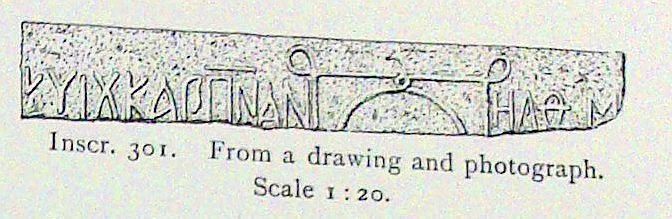
Fragmentary Greek inscription commemorating possibly the construction of a martyr shrine (martyrion). Found at Salamiye (ancient Salamias), to the north-east of Ḥimṣ/Emesa (north-west Phoenicia). Probably 5th-7th c.
- Language
- Greek
- Date from
- 450
- Date to
- 750
- Evidence type
- Inscriptions
- Evidence subtype
- Formal inscriptions (stone, mosaic, etc.)
- Evidence region
- Syria with Phoenicia
- Evidence location
- Salamias; Antioch on the Orontes, Ἀντιόχεια, Antiocheia, Antiochia ad Orontem, Ἀντιόχεια Μεγάλη, Ἀντιόχεια ἐπὶ Ὀρόντου, Antakya; Ḥimṣ/Emesa; Antioch on the Orontes, Ἀντιόχεια, Antiocheia, Antiochia ad Orontem, Ἀντιόχεια Μεγάλη, Ἀντιόχεια ἐπὶ Ὀρόντου, Antakya
- Cult region
- Syria with Phoenicia
- Cult location
- Salamias; Antioch on the Orontes, Ἀντιόχεια, Antiocheia, Antiochia ad Orontem, Ἀντιόχεια Μεγάλη, Ἀντιόχεια ἐπὶ Ὀρόντου, Antakya; Ḥimṣ/Emesa; Antioch on the Orontes, Ἀντιόχεια, Antiocheia, Antiochia ad Orontem, Ἀντιόχεια Μεγάλη, Ἀντιόχεια ἐπὶ Ὀρόντου, Antakya
- Cult date from
- 450
- Cult date to
- 750
Text
[ἐν ὀνόματι Πατρὸς] κ(αὶ) Υἱοῦ κ(αὶ) Ἁγί(ου) Πν(εύματος) ἀνῆλθ(ε) μ[αρτύριον (?) τοῦ ἁγίου (?) - - -]
1. ἀνῆλθ(ε) μ[αρτύριον (?) τοῦ ἁγίου (?) Mouterde Prentice, perhaps: ἀνῆλθ(ε) μ[ηνὶ - - -, cf. IGLS 4, no. 1423.
'[In the name of Father] and Son and Holy Spirit was erected [this martyr shrine (martyrion) of Saint - - - (?)].'
Text: IGLS 5, no. 2532. Translation: W. Prentice.
Source
Stone lintel, reused in a house at the entrance to a courtyard, in the west sector of the town. Broken and lost on bottom and at both ends. Preserved dimensions: H. 0.18 m; W. 1.40 m. Decorated with a low-relief carving of a disc framed by a square with loops at its corners. Letter height 0.12 m; letters in low-relief.
Seen and copied by Enno Littman and William Prentice, and published in 1908. Republished in 1959 by René Mouterde, after the first edition. In 2002 Jean-Claude Decourt did not find the stone during his survey of the site.
Discussion
Prentice considered the inscription as a text possibly commemorating the construction of a martyr shrine. We must note that although the cult of at least two martyrs is indeed attested in Salamias (Sergios: E01680; E01946; Kyrikos: E01945), the inscription is too fragmentary to safely judge on its contents. The word μαρτύριον, as reconstructed by the editor, based just on a single letter, lacks the article τό. Also, a survey of other Syriac inscriptions shows that the term ἀνῆλθε was quite frequently used in reference to the construction of ὑπέρθυρα/'lintels' (see: IGLS 4, nos. 1663, 1785, 1843; I. Gerasa, no. 300) rather than other structures. The verb could be also directly followed by a dating formula, see: IGLS 4, no. 1423: ἐν ὀνόματι θεοῦ καὶ Χριστο[ῦ ἀν]<ῆ>λ<θ>εν μηνὶ Ἀρτεμισίου ιʹ τοῦ ϛ<λ>ʹ/'In the name of God and Christ (the lintel) was erected/raised on the 10th (day) of the month of Artemisios, the year [-]36'. Perhaps the letter Μ in our inscription likewise belonged to the designation of a month.
Jean-Claude Decourt shares our doubts that the restoration of the term martyrion in the lacuna was incorrect.
Bibliography
Edition:
Jalabert, L., Mouterde, R., Mondésert, C., Les inscriptions grecques et latines de la Syrie, vol. 5: Émésène (BAH 66, Paris: P. Guethner, 1959), no. 2532.
Prentice, W.K. (ed.), Greek and Latin Inscriptions (Publications of an American archaeological expedition to Syria in 1899-1900 3, New York: Century 1908), 243, no. 301 (from a copy and photograph by Enno Littmann; with a drawing).
Further reading:
Decourt, J.-Cl., "Inscriptions grecques de Salamya/Salamias", in: P.-L. Gatier, B. Geyer, M.-O. Rousset (eds.), Entre nomades et sédentaires. Prospections en Syrie du Nord et en Jordanie du Sud (Travaux de la Maison de l'Orient et de la Méditerranée 55; Conquête de la steppe 3, Lyon: Maison de l'Orient et de la Méditerranée, 2010), 109-125.
Reference works:
Bulletin épigraphique (2011), 600.
Supplementum Epigraphicum Graceum 60, 1687.
Images
Associated saints
| Saint | Name in source | Certainty |
|---|---|---|
| Martyrs, unnamed or name lost (S00060) | Uncertain | |
| Sergios, soldier and martyr of Rusafa (S00023) | Uncertain | |
| Kyrikos/Cyricus and Ioulitta/Iulitta, child and his mother, martyrs of Tarsus (S00007) | Uncertain |
Cult classifications
- Cult Places
- Cult building - dependent (chapel, baptistery, etc.); Cult building - independent (church); Martyr shrine (martyrion, bet sāhedwātā, etc.)
- Non Liturgical Activity
- Construction of cult buildings
Record author
Paweł Nowakowski
Entry date
19/10/2016
Citation
Paweł Nowakowski, Cult of Saints, E01947 — https://csla.history.ox.ac.uk/record.php?recid=E01947