
E01964
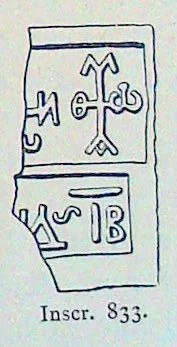
Greek inscription, just possibly naming a gateway or church after *Thomas (probably the Apostle, S00199). Found at Tamak, to the east of Apamea on the Orontes and Ḥamāh/Amathe (central Syria). Probably 6th c. or later.
- Language
- Greek
- Date from
- 500
- Date to
- 750
- Evidence type
- Inscriptions
- Evidence subtype
- Formal inscriptions (stone, mosaic, etc.)
- Evidence region
- Syria with Phoenicia
- Evidence location
- Apamea on the Orontes; Antioch on the Orontes, Ἀντιόχεια, Antiocheia, Antiochia ad Orontem, Ἀντιόχεια Μεγάλη, Ἀντιόχεια ἐπὶ Ὀρόντου, Antakya; Tamak; Antioch on the Orontes, Ἀντιόχεια, Antiocheia, Antiochia ad Orontem, Ἀντιόχεια Μεγάλη, Ἀντιόχεια ἐπὶ Ὀρόντου, Antakya; Ḥamāh; Antioch on the Orontes, Ἀντιόχεια, Antiocheia, Antiochia ad Orontem, Ἀντιόχεια Μεγάλη, Ἀντιόχεια ἐπὶ Ὀρόντου, Antakya
- Cult region
- Syria with Phoenicia
- Cult location
- Apamea on the Orontes; Antioch on the Orontes, Ἀντιόχεια, Antiocheia, Antiochia ad Orontem, Ἀντιόχεια Μεγάλη, Ἀντιόχεια ἐπὶ Ὀρόντου, Antakya; Tamak; Antioch on the Orontes, Ἀντιόχεια, Antiocheia, Antiochia ad Orontem, Ἀντιόχεια Μεγάλη, Ἀντιόχεια ἐπὶ Ὀρόντου, Antakya; Ḥamāh; Antioch on the Orontes, Ἀντιόχεια, Antiocheia, Antiochia ad Orontem, Ἀντιόχεια Μεγάλη, Ἀντιόχεια ἐπὶ Ὀρόντου, Antakya
- Cult date from
- 500
- Cult date to
- 750
Text
The inscription takes the form of two cross-shaped monograms which probably can be read as:
[- - - πυλ]ὼν Θωμᾶ.
ἰ<ν>δ(ικτιῶνος) ιβʹ
'[- - -] the gateway (?) of Thomas. 12th indiction.'
Text: IGLS 4, no. 1960.
Source
Right-hand end of a probable lintel. Preserved dimensions: H. 0.565 m; W. 0.33 m. The inscription is in low-relief.
Reused in the courtyard of a modern house. Seen and copied by Enno Littman. First published by William Prentice in 1922, after Littmann's copy. Republished by René Mouterde in 1955.
Discussion
Prentice suggests that the first, damaged, monogram can be expanded as πυλών/'gateway'. The second monogram consists of the letters Θ, Ω, Μ, Α which can stand either for the name Thomas (in the genitive case) or for the abbreviated phrase: θ(εὸς) μ(έγιστος) Α Ω/'The all-mighty God, Α and Ω'. If the first interpretation is correct, the inscription might name a church, or just a gateway, dedicated to a saint Thomas, probably the Apostle.
Dating: the dating formula of our inscription is partially lost and one cannot compute a date based only on the indiction year given in line 2. However, cross-shaped monograms are unlikely to pre-date the reign of the emperor Justin I.
Bibliography
Edition:
Jalabert, L., Mouterde, R., Mondésert, Cl., Inscriptions grecques et latines de la Syrie, vol. 4: Laodicée, Apamène (BAH 61, Paris: Librairie orientalise Paul Geuthner, 1955), no. 1960.
Prentice, W.K. (ed.), Publications of the Princeton University of archaeological Expeditions to Syria in 1904-1905 and 1909, Division III: Greek and Latin Inscriptions, Section B: Northern Syria (Leyden: E.J. Brill, 1922), 13, no. 833.
Images
Associated saints
| Saint | Name in source | Certainty |
|---|---|---|
| Thomas, the Apostle (S00199) | Θωμᾶς | Uncertain |
| Thomas (unspecified) (S00842) | Uncertain |
Cult classifications
- Cult Places
- Cult building - independent (church)
- Places Names after Saint
- Gates, bridges and roads
Record author
Paweł Nowakowski
Entry date
28/10/2016
Citation
Paweł Nowakowski, Cult of Saints, E01964 — https://csla.history.ox.ac.uk/record.php?recid=E01964