
E01971
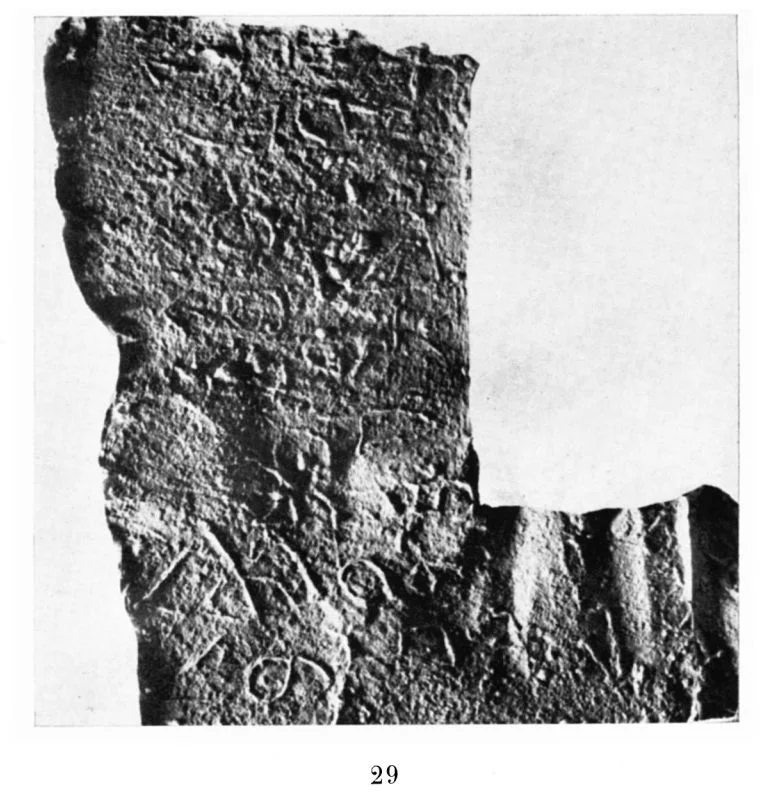
Syriac inscription on the gateway of a monastery, recording the dedication of its church to *Mary (Mother of Christ, S00033), as the God-Bearer. Found at Qaṣr ed-Deir in Jabal al-Ala to the west of Beroia/Aleppo (central Syria). Probably late antique.
- Language
- Syriac
- Date from
- 450
- Date to
- 750
- Evidence type
- Inscriptions
- Evidence subtype
- Formal inscriptions (stone, mosaic, etc.)
- Evidence region
- Syria with Phoenicia
- Evidence location
- Beroia; Antioch on the Orontes, Ἀντιόχεια, Antiocheia, Antiochia ad Orontem, Ἀντιόχεια Μεγάλη, Ἀντιόχεια ἐπὶ Ὀρόντου, Antakya; Qaṣr ed-Deir; Antioch on the Orontes, Ἀντιόχεια, Antiocheia, Antiochia ad Orontem, Ἀντιόχεια Μεγάλη, Ἀντιόχεια ἐπὶ Ὀρόντου, Antakya
- Cult region
- Syria with Phoenicia
- Cult location
- Beroia; Antioch on the Orontes, Ἀντιόχεια, Antiocheia, Antiochia ad Orontem, Ἀντιόχεια Μεγάλη, Ἀντιόχεια ἐπὶ Ὀρόντου, Antakya; Qaṣr ed-Deir; Antioch on the Orontes, Ἀντιόχεια, Antiocheia, Antiochia ad Orontem, Ἀντιόχεια Μεγάλη, Ἀντιόχεια ἐπὶ Ὀρόντου, Antakya
- Cult date from
- 450
- Cult date to
- 750
Text
ܥ]ܕܬܐ]
ܡܘܕܝܐ
ܕܝܠܕܬ
ܠܐܠܗܐ
ܐܡܬܗ
ܒܪܬܐ
ܗܕܝܪܬܐ
ܒܬܘܠܬܐ
ܩܕܝܫܬܐ
'The church confesses that she gave birth to God, his Mother, the honourable Maiden, the holy Virgin.'
Text: Jarry 1967, no. 29 (revised in Jarry 1970, 187).
Translation: S. Minov.
Original translation by J. Jarry: ‘L’église témoigne que Dieu a été engendré par sa mère la fille glorieuse la vierge sainte.’ (Jarry 1967, 156).
Revised translation by J. Jarry: ‘L’église témoigne que Dieu a été engendré par sa servante, la vierge sainte.’ (Jarry 1970, 187)
Source
A stone block from a gateway of the local monastery. H. 0.60 m; W. 0.31 m. Letter height 0.03-0.08 m.
Seen and copied (transcription, squeeze) by Jacques Jarry in 1963 (while he was a member of the 1963 expedition led by Georges Tchalenko), and published in 1967.
In 1970, Jarry offered a different translation of this text but the original one is more accurate.
Discussion
The editor does not comment on the meaning of this inscription but it almost certainly refers to the dedication of the monastic church where it was found. The circumlocutive phrase 'This church attests that God was born by his Mother' must mean that the sanctuary was named after Mary Theotokos (Θεοτόκος), i.e. the God-Bearer. It is possible that the official names of this church also included other epithets of Mary: ἁγία παρθένος/'the Holy Virgin' and ἔνδοξος/'glorious'.
Bibliography
Edition:
Jarry, J., “Inscriptions arabes, syriaques et grecques du massif du Bélus en Syrie du nord”, Annales islamologiques 7 (1967), 156, no. 29.
Further reading:
Jarry, J., "Inscriptions arabes, syriaques et grecques du massif du Bélus en Syrie du nord (suite) [avec 9 planches]", Annales islamologiques 9 (1970), 187.
Tabula Imperii Byzantini, vol. 15, p. 1614.
Images
Associated saints
| Saint | Name in source | Certainty |
|---|---|---|
| Mary, Mother of Christ (S00033) | Certain |
Cult classifications
- Cult Places
- Cult building - independent (church); Cult building - monastic
- Places Names after Saint
- Monastery
Record author
Paweł Nowakowski, Sergey Minov
Entry date
29/10/2016
Citation
Paweł Nowakowski, Sergey Minov, Cult of Saints, E01971 — https://csla.history.ox.ac.uk/record.php?recid=E01971