
E01982
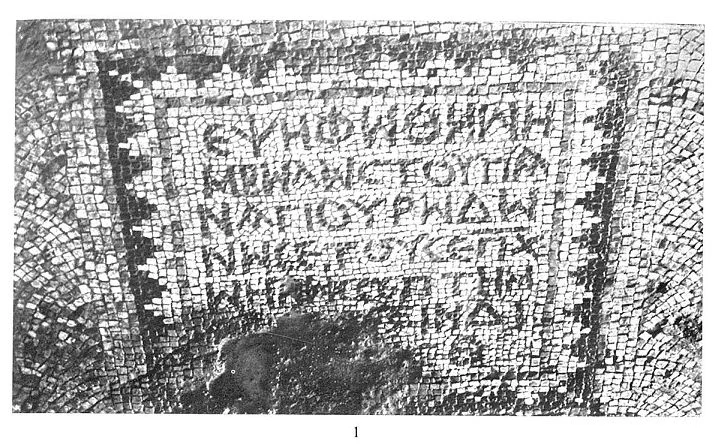
Floor-mosaic with a Greek inscription commemorating the laying of a mosaic floor in the embolos (?porch) of a church apparently dedicated to the 'all-holy *Rhodon' (?otherwise unknown saint). Found at 'Ain es-Samake to the south of Beirut (west Phoenicia/Lebanon). Dated 605.
- Language
- Greek
- Date from
- 605
- Date to
- 605
- Evidence type
- Archaeological and architectural; Inscriptions
- Evidence subtype
- Cult buildings (churches, mausolea); Formal inscriptions (stone, mosaic, etc.)
- Evidence region
- Syria with Phoenicia
- Evidence location
- 'Ain es-Samake; Antioch on the Orontes, Ἀντιόχεια, Antiocheia, Antiochia ad Orontem, Ἀντιόχεια Μεγάλη, Ἀντιόχεια ἐπὶ Ὀρόντου, Antakya; Berytos; Antioch on the Orontes, Ἀντιόχεια, Antiocheia, Antiochia ad Orontem, Ἀντιόχεια Μεγάλη, Ἀντιόχεια ἐπὶ Ὀρόντου, Antakya
- Cult region
- Syria with Phoenicia
- Cult location
- 'Ain es-Samake; Antioch on the Orontes, Ἀντιόχεια, Antiocheia, Antiochia ad Orontem, Ἀντιόχεια Μεγάλη, Ἀντιόχεια ἐπὶ Ὀρόντου, Antakya; Berytos; Antioch on the Orontes, Ἀντιόχεια, Antiocheia, Antiochia ad Orontem, Ἀντιόχεια Μεγάλη, Ἀντιόχεια ἐπὶ Ὀρόντου, Antakya
- Cult date from
- 605
- Cult date to
- 605
Text
ἐψηφώθη ὡ ἤ-
μβωλως τοῦ πα-
ναγίου Ῥώδω-
νως ἔτους
επχʹ,
μηνὼς Σεπτημ-
[βρίου .]ςʹ ἰνδι-
[κτιῶνο]ς θʹ
6-8. Σεπτημ|[βρίου .]ς΄, ἰνδι|[κτιῶνο]ς θ΄ Donceel-Voûte Seyrig || Σεπτημ|[βρ. τῆς] ε΄? ἰνδι. Mouterde
'The embolos (= porch?) of (the church of?) the all-holy Rhodon was paved with a mosaic in the year 685, on the [-]6 of the month of September, 9th [indiction].'
Text: Donceel-Voûte 1988, 329. Translation: P. Nowakowski.
Source
The existence o floor-mosaics at 'Ain es-Samake was first recorded by Virgilio Serviliano in 1959. The site was later surveyed and the mosaics secured under the supervision of Richard Lian. Some of the mosaic pavements, including two inscribed panels, were taken to the Museum in Damascus.
The surveyors concluded that the floors once belonged to a three-aisled basilica, and though the plan of the building was not entirely revealed, the structure can be quite safely considered a church. It seems that the building was at some point refurbished and extended and that the nave was flanked by a number of small chambers or porches.
Our inscription is in a framed mosaic panel, from the floor of 'Room E', one of the small chambers flanking the nave.
The inscription was first published by Maurice Chéhab. The text and dating were later corrected by Henri Seyrig in 1962, based on an examination of the photograph published by Chéhab. Pauline Donceel-Voûte follows Seyrig's corrected edition.
Discussion
This short and easy to read inscription is not entirely simple to interpret. It commemorates the paving of a space termed an embolos. According to the editors this might denote a porch, though in other Syrian inscriptions the term is sometimes used to name aisles.
In lines 2-4 we read that this embolos was of a certain all-holy (panagios) Rhodon, or probably an institution (very possibly the church itself) named after this figure. The epithet panagios was normally an element of the titulature of the Virgin Mary. Here it is apparently used in reference to a saint, very possibly the patron of our church. The identity of this Rodon is not clear, but he could be a local martyr. For a martyr Rodopianos of Aphrodisias in Caria (south-west Asia Minor), known to the Syriac Martyrology, see: E01484. It is, however, unlikely that his name was misspelt in our inscription. On balance, we believe he was probably a local martyr, otherwise unrecorded.
Dating: The date of our inscription is given in line 5 as the 685th year of the era of nearby Berytos. Together with the 9th indiction year and the month of September, we can convert this to September AD 605. The day of the completion of the paving is partially lost: it could be the 6th, 16th or 26th of the month of September. Seyrig notes that as the New Year was celebrated in Berytos on 23rd of September (which is the birthday of Augustus), our inscription could have been completed on the 26th, during the celebration of a New Year's festival. Another inscription from this church, commemorating the laying of a mosaic pavement funded by a deacon (but with no reference to the saint), is dated AD 581 (see: Donceel-Voûte 1988, 329), which implies that the sanctuary itself was built before the 7th c.
Bibliography
Edition:
Donceel-Voûte, P., Les pavements des églises byzantines de Syrie et du Liban. Décor, archéologie et liturgie (Publications d’histoire de l’art et d’archéologie de l’Université catholique de Louvain 69, Louvain-La-Neuve: Département d'archéologie et d'histoire de l'art, 1988), 326-333.
Seyrig, H., "Antiquités syriennes", Syria 39 (1962), 42-44.
René Mouterde in: M.H. Chéhab (ed.), Mosaïques du Liban (Bulletin du Musée de Beyrouth 14-15, Paris: Librairie d'Amérique et d'Orient, A. Maisonneuve, 1959), 173-178, plates CXI-CXV (with a photograph).
Reference works:
Supplementum Epigraphicum Graecum 40, 1775.
Images
Associated saints
| Saint | Name in source | Certainty |
|---|---|---|
| Rhodon (unspecified) (S01130) | Ῥώδων | Certain |
Cult classifications
- Cult Places
- Cult building - independent (church)
- Non Liturgical Activity
- Renovation and embellishment of cult buildings
Record author
Paweł Nowakowski
Entry date
02/11/2016
Citation
Paweł Nowakowski, Cult of Saints, E01982 — https://csla.history.ox.ac.uk/record.php?recid=E01982