
E02009
Greek building inscription for a church dedicated to *George (soldier and martyr, S00259), and recording the intercession of the saint for the village of Am[.]a (modern Jizeh). Found at Jizeh, midway between Bostra and Adraha (north Roman province of Arabia). Dated 538/539.
- Language
- Greek
- Date from
- 538
- Date to
- 539
- Evidence type
- Inscriptions
- Evidence subtype
- Formal inscriptions (stone, mosaic, etc.)
- Evidence region
- Arabia
- Evidence location
- Adraha; Sakkaia / Maximianopolis, Σακκαια, Sakkaia, Saccaea, Eaccaea, Maximianopolis, Shaqqa, Schaqqa, Shakka; Bosra; Sakkaia / Maximianopolis, Σακκαια, Sakkaia, Saccaea, Eaccaea, Maximianopolis, Shaqqa, Schaqqa, Shakka; Jizeh; Sakkaia / Maximianopolis, Σακκαια, Sakkaia, Saccaea, Eaccaea, Maximianopolis, Shaqqa, Schaqqa, Shakka
- Cult region
- Arabia
- Cult location
- Adraha; Sakkaia / Maximianopolis, Σακκαια, Sakkaia, Saccaea, Eaccaea, Maximianopolis, Shaqqa, Schaqqa, Shakka; Bosra; Sakkaia / Maximianopolis, Σακκαια, Sakkaia, Saccaea, Eaccaea, Maximianopolis, Shaqqa, Schaqqa, Shakka; Jizeh; Sakkaia / Maximianopolis, Σακκαια, Sakkaia, Saccaea, Eaccaea, Maximianopolis, Shaqqa, Schaqqa, Shakka
- Cult date from
- 538
- Cult date to
- 539
Text
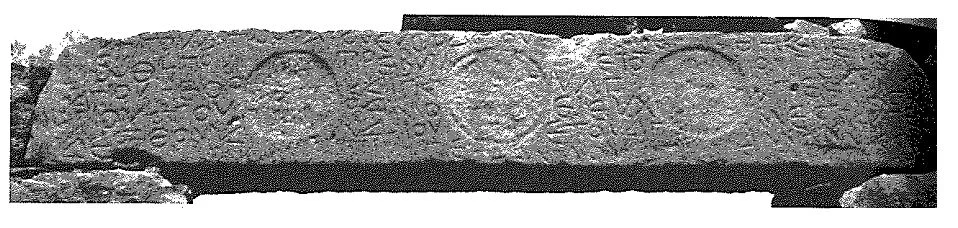
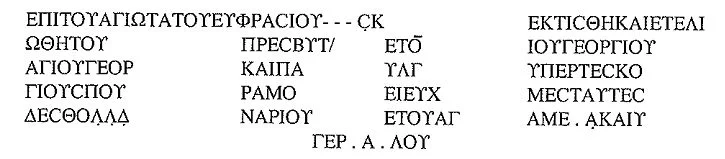
For the sake of convenience we present here a continuous text. For the layout of the inscription, written in four columns, see the attached images.
ἐπὶ τοῦ ἁγιωτάτου Εὐφρασίου [ἐπι]̣σκ(όπου) ἐκτίσθη και ἐτελιώθη <ὁ ναὸς> τοῦ ἁγίου Γεοργίου σπουδε῀ς Θο(μᾶ) πρεσβυτ(έρου) καὶ παρα̣μοναρίου, ἔτο(υς) υλγ΄, ἑ εὐχὲ τοῦ ἁγίου Γεοργίου ὑπὲρ τε῀ς κόμες ταύτες Αμε[.]α καὶ ὑ(π)ὲρ ̣Σα̣ε̣δου
[<ὁ ναὸς> Tybout in SEG, <τοῦ ναοῦ> Sartre 2000 || ε ευχε = ἐ(ν) εὐχε῀ (?) Sartre 2000]
'Under the most holy bishop Euphrasios the <church> of Saint George was founded and completed by the efforts of the presbyter and watchman (paramonarios) Thomas, in the year 433. The intercessions of Saint George for this village of Ame[.]a and for Saedos (?).'
Text: IGLS 13/2, no. 9713.
Translation: P. Nowakowski.
Source
A large stone lintel, lightly rounded at both ends. H. 0.325 m; W. 2.00 m. Letter height 0.05 m. Decorated with three carvings of crosses within circles. When recorded, the stone was reused as the lintel of a doorway in a house.
Jizeh was first surveyed by Gottlieb Schumacher in 1894. He noted the presence of numerous carved crosses, inscriptions with epitaphs and one referring to *Sergios (E02020), and remnants of a church and a monastery. The site was revisited by René Dussaud and Frédéric Macler soon after. Our inscription was, however, recorded only in 1982 by Maurice Sartre and Annie Sartre-Fauriat (copy, photograph). First published in 2000, and republished in 2011 in the thirteenth volume of Inscriptions grecques et latines de la Syrie.
Discussion
The inscription commemorates the construction of a church dedicated to George. Maurice Sartre notes that the saint was very popular in the Hauran in the 6th-8th c. and that he was frequently chosen as a patron for churches in this region (for 10 parallel dedications, see: IGLS 13/2, 173). It seems that the man behind the construction of our shrine was the presbyter and sacristan (paramonarios) Thomas. Bishop Euphrasios, appearing in the dating formula, is otherwise unattested. His see was probably Adraha, a major city to the west of Jizeh, and not Bostra (where one would expect an archbishop or a metropolitan in the 6th c.). Sartre however notes that there remains the theoretical possibility that Euphrasios resided in Bostra.
Strangely, the designation of the church itself is not specified in the text though the genitive case of the name of the saint clearly shows that it was meant to be there. The relevant passage reads: ἐκτίσθη και ἐτελιώθη <- - -> τοῦ ἁγίου Γεοργίου/'<- - -> of Saint George was built.' Sartre supposes that the word was accidentally omitted by the stone-cutter and plausibly restores it as ναός which is common in the region (but cf. L'Année épigraphique 2000, 1541 where Follet and Gatier argue that the designation of the church could be understood and never included in the text).
The inscription is the only source that preserves the ancient name of the village of Jizeh: probably Ame[l]a, Ame[r]a or Ame[d]a.
Dating: the date, the year 433, is computed according to the era of the province of Arabia and corresponds to AD 538/539.
Bibliography
Edition:
Sartre, M., Sartre-Fauriat, A. (eds.), Inscriptions grecques et latines de la Syrie, vol. 13/2: Bostra (Supplément) et la plaine de la Nuqrah (BAH 194, Beirut: Institut français du Proche-Orient, 2011), no. 9713.
Sartre-Fauriat, A., "Georges, Serge, Élie et quelques autres saints connus et inédits de la province d'Arabie", in: Fr. Prévot (ed.), Romanité et cité chrétienne. Permances et mutations. Intégration et exclusion du Ier au VIe siècle. Mélanges en l'honneur d'Yvette Duval (Paris: De Boccard, 2000), 300-301.
Sartre, M., "Évêques de Bostra et d'Adraha: une inscription de Jizeh (Syrie du Sud)", in: Fr. Prévot (ed.), Romanité et cité chrétienne. Permances et mutations. Intégration et exclusion du Ier au VIe siècle. Mélanges en l'honneur d'Yvette Duval (Paris: De Boccard, 2000), 289-292.
Reference works:
L'Année épigraphique (2000) [2003], no. 1541.
Supplementum Epigraphicum Graecum 50, 1518; 50, 1520.
Images
Associated saints
| Saint | Name in source | Certainty |
|---|---|---|
| George, soldier and martyr, and Companions (S00259) | Γεόργιος | Certain |
Cult classifications
- Cult Places
- Cult building - independent (church)
- Non Liturgical Activity
- Construction of cult buildings; Prayer/supplication/invocation; Saint as patron - of a community
- People
- Ecclesiastics - bishops; Ecclesiastics - lesser clergy; Other lay individuals/ people; Peasants
- Recorded Miracles
- Miraculous protection - of communities, towns, armies
Record author
Paweł Nowakowski
Entry date
18/11/2016
Citation
Paweł Nowakowski, Cult of Saints, E02009 — https://csla.history.ox.ac.uk/record.php?recid=E02009