
E02036
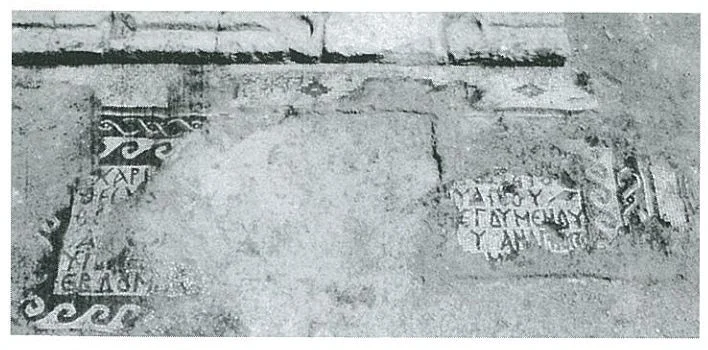
Floor-mosaic with a fragmentary Greek inscription commemorating the laying of the mosaic of 'Church 82' in Khirbet es-Samra to the south-east of Gerasa/Jerash (Jordan/the Roman province of Arabia), probably dedicated to *Theodore (soldier and martyr of Amaseia and Euchaita, S00480). Probably dated 633/634.
- Language
- Greek
- Date from
- 633
- Date to
- 634
- Evidence type
- Archaeological and architectural; Inscriptions
- Evidence subtype
- Cult buildings (churches, mausolea); Formal inscriptions (stone, mosaic, etc.)
- Evidence region
- Arabia
- Evidence location
- Gerasa/Jerash; Sakkaia / Maximianopolis, Σακκαια, Sakkaia, Saccaea, Eaccaea, Maximianopolis, Shaqqa, Schaqqa, Shakka; Khirbet es-Samra; Sakkaia / Maximianopolis, Σακκαια, Sakkaia, Saccaea, Eaccaea, Maximianopolis, Shaqqa, Schaqqa, Shakka
- Cult region
- Arabia
- Cult location
- Gerasa/Jerash; Sakkaia / Maximianopolis, Σακκαια, Sakkaia, Saccaea, Eaccaea, Maximianopolis, Shaqqa, Schaqqa, Shakka; Khirbet es-Samra; Sakkaia / Maximianopolis, Σακκαια, Sakkaia, Saccaea, Eaccaea, Maximianopolis, Shaqqa, Schaqqa, Shakka
- Cult date from
- 633
- Cult date to
- 634
Text
+ χάρι̣τ[ι θεοῦ, ἐπὶ τοῦ ὁσ]̣ι̣ωτά̣το̣υ
Θεω[δώρου ἀρχιεπ(ισκόπου) ἐψηφώθη? το]ῦ ἁγίου ❦
Θε[ωδώρου, σπουδῇ - - - -] ἑγουμένου
(καὶ) Α[- - - - - - ο]υ ἀναγνόστο-
υ Ἰ̣ω[άννου (?) - - - -ἐ]ν [χρόνοις]
ἑβδόμ̣η̣ς [ἰνδ(ικτιῶνος), τοῦ ἔτους φκ.ʹ τῆς ἐπαρχίας]
[6. probably φκ[ηʹ] or φκ[θ]ʹ]
'Through the grace [of God, under the] most pious [archbishop] Theodoros [the mosaic] (of the church?) of Saint Theodore [was completed (?). By the efforts of - - -] the abbot (higoumenos) and A[- - -], the lector Ioannes (?) [- - -] In [the times] of the seventh [indiction, the year 528 (or 529) of the province].'
Text: Gatier 1998, 388-389, no. 79.
Translation: P. Nowakowski.
Source
Fragmentarily preserved mosaic panel in the floor of the nave of Church 82, situated in front of the steps of the choir. The panel is framed by two bands: the inner one is decorated with waves and the outer one with a braid-like pattern.
The middle of the panel is lost. Original dimensions: H. 0.80 m; W. 2.70 m; letter height 0.011-0.013 m.
First published by Pierre-Louis Gatier in 1998, from a photograph by Alain Desereumaux and Jean-Baptiste Humbert, taken probably in 1982 (when Church 82 was excavated). Reprinted by Annie Sartre-Fauriat in 2000, based on the earlier edition.
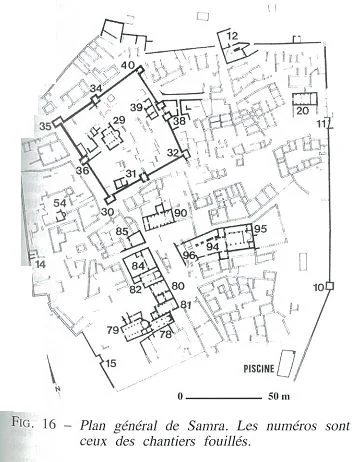
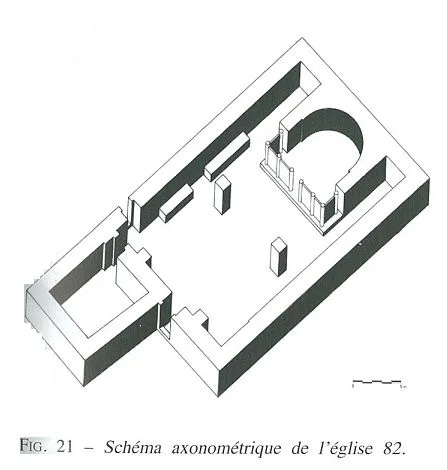
Church 82 is one of eight shrines excavated at the site by 1998. It is a small basilica (15 x 10,20 m) located in the south-west sector of the town, to the north connected to a spacious courtyard with remnants of a possible hostel.
Discussion
The inscription almost certainly commemorated the paving of the church. The date was restored by Gatier based on the supposition that Theodoros mentioned in line 2 was Theodoros, archbishop of nearby Bostra, who appears in a dated inscription from Riḥāb (529 of the province of Arabia = AD 635, see: E02044) and on the reference to the seventh indiction in line 6. The timeframe suggested by Gatier for our text corresponds to the seventh indictional year nearest to AD 635: AD 633-634.
Gatier notes that as line 3 contained a reference to an abbot, our church could have been part of a monastic establishment.
The 'Saint Th...' to whom the church was dedicated is probably Theodore the martyr of Euchaita in Pontus (north-east Asia Minor) whose cult was widespread from the 6th century onwards.
Bibliography
Edition:
Gatier, P.-L., "Les inscriptions grecques et latines de Samra et Rihab", Humbert, J.-B., Desreumaux, A., Bauzou, Th. (eds.), Fouilles de Khirbet es-Samra en Jordanie, vol. 1: La voie romaine, le cimetière, les documents épigraphiques (Turnhout: Brepols, 1998), 388-389, no. 79.
Further reading:
Desreumaux, A., Humbert, J.-B., Thébault, G., Bauzou, Th., "Des Romains, des Araméens et des Arabes dans le Balqa' jordanien : les cas de Hadeitha - Khirbet es Samra", in: A. Borrut, M. Debié, A. Papaconstantinou, D. Pieri, J.-P. Sodini (eds.), Le Proche-Orient de Justinien aux Abassides : peuplement et dynamiques spatiales : actes du colloque "Continuités de l'occupation entre les périodes byzantine et abbasside au Proche-Orient, VIIe-IXe siècles," Paris, 18-20 octobre 2007 (Bibliothèque de l'Antiquité tardive 19, Turnhout: Brepols, 2011), 285-304.
Gatier, P.-L., "Les inscriptions grecques et latines de Samra et Rihab", Humbert, J.-B., Desreumaux, A., Bauzou, Th. (eds.), Fouilles de Khirbet es-Samra en Jordanie, vol. 1: La voie romaine, le cimetière, les documents épigraphiques (Turnhout: Brepols, 1998), 51 (description of the find-spot).
Michel, A., Les églises d'époque byzantine et umayyade de Jordanie (provinces d'Arabie et de Palestine), Ve-VIIIe siècle: typologie architecturale et aménagements liturgiques (avec catalogue des monuments; préface de Noël Duval; premessa di Michele Piccirillo) (Bibliothèque de l'Antiquité tardive 2, Turnhout: Brepols, 2001), 199-201, no. 65.
Sartre-Fauriat, A., "Georges, Serge, Élie et quelques autres saints connus et inédits de la province d'Arabie", in: Fr. Prévot (ed.), Romanité et cité chrétienne. Permances et mutations. Intégration et exclusion du Ier au VIe siècle. Mélanges en l'honneur d'Yvette Duval (Paris: De Boccard, 2000), 307-308.
Reference works:
Chroniques d'épigraphie byzantine, 864.
Supplementum Epigraphicum Graecum 48, 1936; 50, 1518.
Images
Associated saints
| Saint | Name in source | Certainty |
|---|---|---|
| Theodore, soldier and martyr of Amaseia and Euchaita (S00480) | Θεώδωρος | Uncertain |
Cult classifications
- Cult Places
- Cult building - independent (church); Cult building - monastic
- Non Liturgical Activity
- Renovation and embellishment of cult buildings
- People
- Ecclesiastics - abbots; Ecclesiastics - bishops
- Places Names after Saint
- Monastery
Record author
Paweł Nowakowski
Entry date
22/11/2016
Citation
Paweł Nowakowski, Cult of Saints, E02036 — https://csla.history.ox.ac.uk/record.php?recid=E02036