
E02041
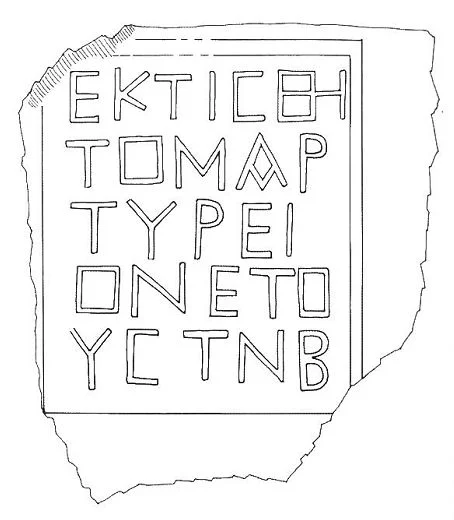
Greek inscription commemorating the construction of an unspecified martyr shrine (martyrion). Found at Riḥāb, between Bostra and Gerasa/Jerash (Jordan/the Roman province of Arabia). Dated 457/458.
- Language
- Greek
- Date from
- 457
- Date to
- 458
- Evidence type
- Inscriptions
- Evidence subtype
- Formal inscriptions (stone, mosaic, etc.)
- Evidence region
- Arabia
- Evidence location
- Bosra; Sakkaia / Maximianopolis, Σακκαια, Sakkaia, Saccaea, Eaccaea, Maximianopolis, Shaqqa, Schaqqa, Shakka; Gerasa/Jerash; Sakkaia / Maximianopolis, Σακκαια, Sakkaia, Saccaea, Eaccaea, Maximianopolis, Shaqqa, Schaqqa, Shakka; Riḥāb; Sakkaia / Maximianopolis, Σακκαια, Sakkaia, Saccaea, Eaccaea, Maximianopolis, Shaqqa, Schaqqa, Shakka
- Cult region
- Arabia
- Cult location
- Bosra; Sakkaia / Maximianopolis, Σακκαια, Sakkaia, Saccaea, Eaccaea, Maximianopolis, Shaqqa, Schaqqa, Shakka; Gerasa/Jerash; Sakkaia / Maximianopolis, Σακκαια, Sakkaia, Saccaea, Eaccaea, Maximianopolis, Shaqqa, Schaqqa, Shakka; Riḥāb; Sakkaia / Maximianopolis, Σακκαια, Sakkaia, Saccaea, Eaccaea, Maximianopolis, Shaqqa, Schaqqa, Shakka
- Cult date from
- 457
- Cult date to
- 458
Text
ἐκτίσθη
τὸ μαρ-
τύρει-
ον ἔτο-
υς τνβ΄
'The martyr shrine (martyrion) was founded in the year 352.'
Text: Gatier 1998, 394, no. 86.
Source
Limestone block. When recorded it was reused in the north enclosure wall of a mosque. H. 0.40 m; W. 0.34 m. Letter height 0.04-0.05 m.
Reportedly seen at Riḥāb. Published in 1998 by Pierre-Louis Gatier from a drawing.
Discussion
The inscription commemorates the construction of a martyr shrine where some unspecified martyrs (or a martyr) were venerated. It is not clear whether this was an independent building or just a chapel. Gatier hypothesised that this could be the martyr shrine of a martyr *Basilios, whose construction (or rather, he says, restoration) in AD 594 is attested by a mosaic (see: E02045).
The date is probably computed according to the era of the province of Arabia. If so, its year 352 corresponds to AD 457/458. Gatier notes that, given this date, we can consider our inscription as one of the earliest Christian monuments in the region.
Bibliography
Edition:
Gatier, P.-L., "Les inscriptions grecques et latines de Samra et Rihab", Humbert, J.-B., Desreumaux, A., Bauzou, Th. (eds.), Fouilles de Khirbet es-Samra en Jordanie, vol. 1: La voie romaine, le cimetière, les documents épigraphiques (Turnhout: Brepols, 1998), 390-394, no. 86.
Reference works:
Chroniques d'épigraphie byzantine, 864.
Supplementum Epigraphicum Graecum 48, 1925.
Images
Associated saints
| Saint | Name in source | Certainty |
|---|---|---|
| Martyrs, unnamed or name lost (S00060) | Certain |
Cult classifications
- Cult Places
- Cult building - dependent (chapel, baptistery, etc.); Cult building - independent (church); Cult building - unspecified; Martyr shrine (martyrion, bet sāhedwātā, etc.)
- Non Liturgical Activity
- Construction of cult buildings
Record author
Paweł Nowakowski
Entry date
23/11/2016
Citation
Paweł Nowakowski, Cult of Saints, E02041 — https://csla.history.ox.ac.uk/record.php?recid=E02041