
E02078
Greek inscription invoking the blessing for a monastery of the God of *Sergios and *Bakchos (soldiers and martyrs of Rusafa and Barbalissos, S00023; S00079). Found at Deir en-Nasrani in the south-east Jabal Druze (near Damascus, north Roman province of Arabia/south Syria). Probably late 5th or 6th c.
- Language
- Greek
- Date from
- 480
- Date to
- 700
- Evidence type
- Archaeological and architectural; Inscriptions
- Evidence subtype
- Cult buildings (churches, mausolea); Formal inscriptions (stone, mosaic, etc.)
- Evidence region
- Arabia; Syria with Phoenicia
- Evidence location
- Damascus; Antioch on the Orontes, Ἀντιόχεια, Antiocheia, Antiochia ad Orontem, Ἀντιόχεια Μεγάλη, Ἀντιόχεια ἐπὶ Ὀρόντου, Antakya; Deir en-Nasrani; Sakkaia / Maximianopolis, Σακκαια, Sakkaia, Saccaea, Eaccaea, Maximianopolis, Shaqqa, Schaqqa, Shakka
- Cult region
- Arabia; Syria with Phoenicia
- Cult location
- Damascus; Antioch on the Orontes, Ἀντιόχεια, Antiocheia, Antiochia ad Orontem, Ἀντιόχεια Μεγάλη, Ἀντιόχεια ἐπὶ Ὀρόντου, Antakya; Deir en-Nasrani; Sakkaia / Maximianopolis, Σακκαια, Sakkaia, Saccaea, Eaccaea, Maximianopolis, Shaqqa, Schaqqa, Shakka
- Cult date from
- 480
- Cult date to
- 700
Text
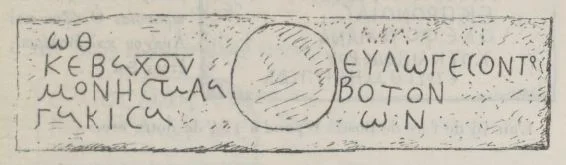
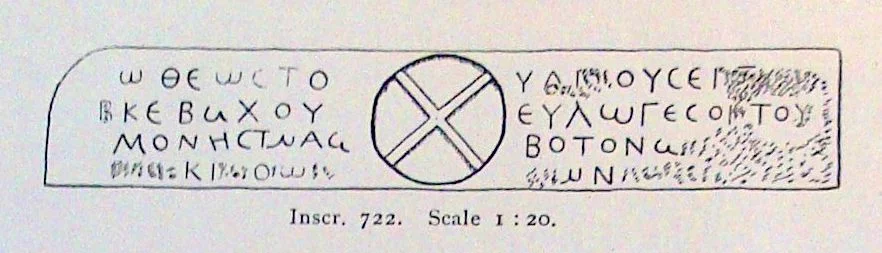
ὦ θεὼς το- ῦ ἁ̣γ[ί]ου Σε̣ργ[ίου]
κὲ Βάχου, εὐλώγεσο̣ν το̣ῦ
μονηστ(ηρίου) ̣ΛΑ- ΒΟΤΟΝΑ
///////////// ////////////
'O God of Saint Sergios and Bakchos, bless the monastery [- - -].'
Text: Littmann & Stuart 1921, no. 722.
Source
Fallen stone lintel. H. 0.35 m; W. 1.80-1.93 m. Found near the east porch of the monastery. Decorated with a carving of a cross resembling the letter Χ, within a circle (diameter 0.32 m). Letter height 0.04-0.05 m.
First seen and copied in 1901 by René Dussaud and Frédéric Macler during their survey in south Syria, and published by them in their report in 1902. Revisited by the Princeton Expedition to Syria and copied by Howard Butler. Published from Butler's copy by Enno Littmann and Duane Reed Stuart in 1921. A new edition of the inscription will be offered in the sixteenth volume of Inscriptions grecques et latines de la Syrie.
Discussion
The inscription is poorly preserved, but based on the contents of lines 1-3 we can conclude that it probably commemorated the construction of a monastery and invoked the help of the God of Saints Sergios and Bakchos. Interestingly, both saints are mentioned, while normally Saint Sergios was venerated alone in the East. Unfortunately, the name of the monastery (probably deriving from the name of its founder or of its patron saint) is lost but we can assume that it was recorded at the end of line 3.
The first editors, Dussaud and Macler, claimed that they managed to read a longer text: Κ(ύρι)ε, β(οηθοῦντος) Χ(ριστ)οῦ, εὐλώγεσον τ[ῆς] μονῆς τῶ<ν> ἁ(γίων) βοτονων (?) Γ(εωργίου) κ(α)ὶ Σ(εργίου) / 'Lord, with the help of Christ, bless the monastery of Saints [- - -] George and Sergios.' They also noted the presence of the letters ωθ in the upper left-hand corner of the inscription, which they interpreted as a date, the 808th year of the Seleucid era, i.e. AD 497. However, Littmann and Stuart, on the basis of Butler's copy, considered their readings as entirely implausible. The inscription is likely to date somewhere in the late 5th or 6th c. when the cult of Sergios was quickly spreading in the East.
Bibliography
Edition:
Inscriptions grecques et latines de la Syrie, vol. 16/2, no. 1006 (forthcoming).
Littmann, E., Stuart, D.R., (eds.), Publications of the Princeton University Archaeological Expeditions to Syria in 1904-5 and 1909, Division III: Greek and Latin Inscriptions, Section A: Southern Syria (Leiden: Brill, 1921), no. 722.
Dussaud, R., Macler, F., "Rapport sur une mission scientifique dans les régions désertiques de la Syrie moyenne", Nouvelles archives des missions scientifiques et littéraires 10 (1902), 659, no. 48.
Further reading:
Sartre-Fauriat, A., "Georges, Serge, Élie et quelques autres saints connus et inédits de la province d'Arabie", in: Fr. Prévot (ed.), Romanité et cité chrétienne. Permances et mutations. Intégration et exclusion du Ier au VIe siècle. Mélanges en l'honneur d'Yvette Duval (Paris: De Boccard, 2000), 303, note 59.
Key Fowden, E., The Barbarian Plain: St. Sergius between Rome and Iran (Berkeley, Calif.; London: University of California Press, 1999), 108.
Images
Associated saints
| Saint | Name in source | Certainty |
|---|---|---|
| Sergios, soldier and martyr of Rusafa (S00023) | Σέργιος | Certain |
| Bakchos, soldier and martyr of Barbalissos (S00079) | Βάχος | Certain |
Cult classifications
- Cult Places
- Cult building - monastic
- Non Liturgical Activity
- Construction of cult buildings; Prayer/supplication/invocation
- Places Names after Saint
- Monastery
- Recorded Miracles
- Saint aiding or preventing the construction of a cult building
Record author
Paweł Nowakowski
Entry date
06/12/2016
Citation
Paweł Nowakowski, Cult of Saints, E02078 — https://csla.history.ox.ac.uk/record.php?recid=E02078