
E02241
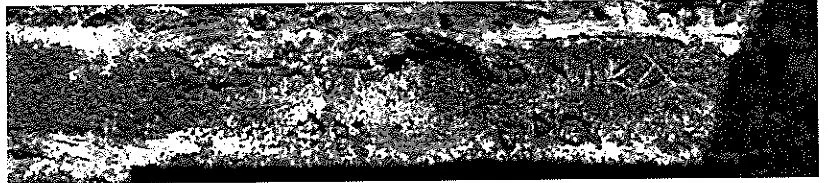
Greek inscription probably mentioning a martyr shrine (martyrion) of unnamed saints. Found at Umm al-Mayādīn to the north-west of Bostra (Roman province of Arabia). Probably 5th-6th c.
- Language
- Greek
- Date from
- 450
- Date to
- 800
- Evidence type
- Archaeological and architectural; Inscriptions
- Evidence subtype
- Cult buildings (churches, mausolea); Formal inscriptions (stone, mosaic, etc.)
- Evidence region
- Arabia
- Evidence location
- Bosra; Sakkaia / Maximianopolis, Σακκαια, Sakkaia, Saccaea, Eaccaea, Maximianopolis, Shaqqa, Schaqqa, Shakka; Umm al-Mayādīn; Sakkaia / Maximianopolis, Σακκαια, Sakkaia, Saccaea, Eaccaea, Maximianopolis, Shaqqa, Schaqqa, Shakka
- Cult region
- Arabia
- Cult location
- Bosra; Sakkaia / Maximianopolis, Σακκαια, Sakkaia, Saccaea, Eaccaea, Maximianopolis, Shaqqa, Schaqqa, Shakka; Umm al-Mayādīn; Sakkaia / Maximianopolis, Σακκαια, Sakkaia, Saccaea, Eaccaea, Maximianopolis, Shaqqa, Schaqqa, Shakka
- Cult date from
- 450
- Cult date to
- 800
Text
+ τοῦτ- ο νικᾷ
[μ]αρτ- ύρον
'+ This (sign, i.e. cross) conquers. (Church?) of martyrs.'
Text: IGLS 13/2, no. 9733.
Source
Stone lintel. H. 0.28 m; W. 1.84 m. Letter height 0.075-0.08 m. Decorated with a carving of a sunken circle in the middle of the inscribed face. The editors hypothesise that the circle may have framed a marble or metal cross which is now lost.
Seen and photographed by Maurice Sartre in 1982. The stone was set in situ, over the main doorway of an ancient church, to the west of the ancient village. First published by Maurice Sartre and Annie Sartre-Fauriat in 2011.
Discussion
The editors suppose that the building was once a sanctuary of martyrs, whose identity is not clear. They interpret the word μαρτύρον as the genitive plural form: 'of martyrs' (that should be correctly spelt μαρτύρων). However, it is also possible that we have here a corrupted word μαρτύρ<ι>ον/'martyr shrine'.
Dating: there is no reliable way to precisely date the inscription. It probably comes from the 5th or 6th c., as do other dated texts from the region.
Bibliography
Edition:
Sartre, M., Sartre-Fauriat, A. (eds.), Inscriptions grecques et latines de la Syrie, vol. 13/2: Bostra (Supplément) et la plaine de la Nuqrah (BAH 194, Beirut: Institut français du Proche-Orient, 2011), no. 9733.
Images
Associated saints
| Saint | Name in source | Certainty |
|---|---|---|
| Martyrs, unnamed or name lost (S00060) | μάρτυρες | Certain |
Cult classifications
- Cult Places
- Cult building - independent (church); Martyr shrine (martyrion, bet sāhedwātā, etc.)
Record author
Paweł Nowakowski
Entry date
11/01/2017
Citation
Paweł Nowakowski, Cult of Saints, E02241 — https://csla.history.ox.ac.uk/record.php?recid=E02241