
E02243
Greek building inscription for a church of the Archangels *Michael (S00181) and *Gabriel (S00192). Found at al-Ghāriyyeh al-Gharbiyyeh, to the north-west of Bostra (Roman province of Arabia). Dated 598/599.
- Language
- Greek
- Date from
- 598
- Date to
- 599
- Evidence type
- Inscriptions
- Evidence subtype
- Formal inscriptions (stone, mosaic, etc.)
- Evidence region
- Arabia
- Evidence location
- Bosra; Sakkaia / Maximianopolis, Σακκαια, Sakkaia, Saccaea, Eaccaea, Maximianopolis, Shaqqa, Schaqqa, Shakka; al-Ghāriyyeh al-Gharbiyyeh; Sakkaia / Maximianopolis, Σακκαια, Sakkaia, Saccaea, Eaccaea, Maximianopolis, Shaqqa, Schaqqa, Shakka
- Cult region
- Arabia
- Cult location
- Bosra; Sakkaia / Maximianopolis, Σακκαια, Sakkaia, Saccaea, Eaccaea, Maximianopolis, Shaqqa, Schaqqa, Shakka; al-Ghāriyyeh al-Gharbiyyeh; Sakkaia / Maximianopolis, Σακκαια, Sakkaia, Saccaea, Eaccaea, Maximianopolis, Shaqqa, Schaqqa, Shakka
- Cult date from
- 598
- Cult date to
- 599
Text
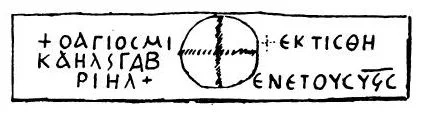
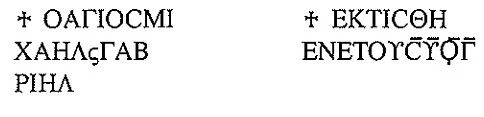
+ ὁ ἅγιος Μι- + ἐκτίσθη
χαὴλ (καὶ) Γαβ- ἐν ἔτους υϙγ΄
ριήλ
[1-2. Μι|χαὴλ Sartre, Μι|[κ]αὴλ Dussaud || 2. υϙγ΄ Sartre, ΥϘC stone, corrected to υϙ[ε]΄by Dussaud]
'+ Saint Michael and Gabriel. + (It) was built in the year 493.'
Text: IGLS 13/2, no. 9740.
Source
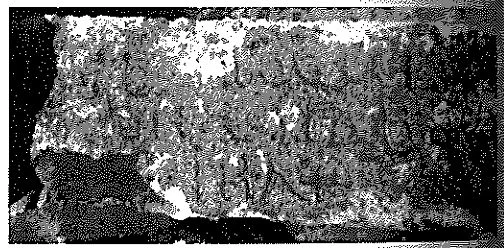
Stone lintel. H. 0.32 m; W. 1.65 m; Th. 0.50 m. Letter height 0.085 m. Broken and lost in the lower left-hand corner. Decorated with a carving of a large circle containing a cross in the middle of the inscribed face.
Seen and copied by René Dussaud and Frédéric Macler during their survey in south Syria, and published by them in 1901 with a drawing. The surveyors probably saw the stone still in situ, over a doorway. The stone was revisited and photographed by Maurice Sartre in 1982, and republished by Maurice Sartre and Annie Sartre-Fauriat in 2011. By the time of Sartre's visit the stone was reused in a wall, to the west of the village. The building (probably a church) where it was originally displayed, was destroyed only recently, during the construction of a road.
Discussion
The inscription commemorates the construction of a church dedicated to the Archangels Michael and Gabriel. The Sartres stress the fact that attestations of the cult of archangels are not frequent in the Hauran (see E02614).
Dating: the inscription is dated according to the era of the province of Arabia. Its year 493 corresponds to AD 598/599. Dussaud read the date incorrectly (as the year 495), and hence dated the inscription to AD 600.
Bibliography
Edition:
Sartre, M., Sartre-Fauriat, A. (eds.), Inscriptions grecques et latines de la Syrie, vol. 13/2: Bostra (Supplément) et la plaine de la Nuqrah (BAH 194, Beirut: Institut français du Proche-Orient, 2011), no. 9740.
Dussaud, R., Macler, F., Voyage archéologique au Safâ et dans le Djebel-ed-Drûz (Paris: , 1901), 206, no. 99.
Images
Associated saints
| Saint | Name in source | Certainty |
|---|---|---|
| Gabriel, the Archangel (S00192) | Μιχαήλ | Certain |
| Michael, the Archangel (S00181) | Γαβριήλ | Certain |
Cult classifications
- Cult Places
- Cult building - independent (church)
- Non Liturgical Activity
- Construction of cult buildings
Record author
Paweł Nowakowski
Entry date
11/01/2017
Citation
Paweł Nowakowski, Cult of Saints, E02243 — https://csla.history.ox.ac.uk/record.php?recid=E02243