
E02244
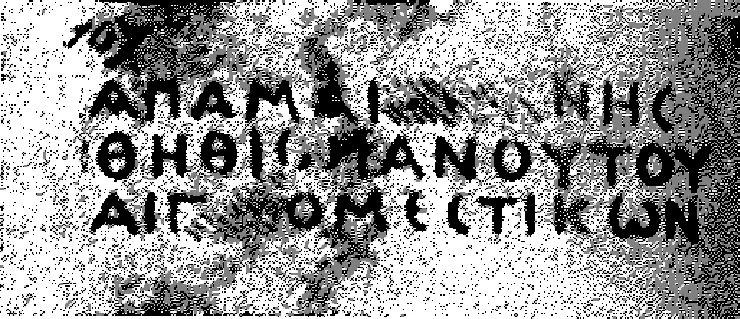
Greek inscription with an invocation of *Mary (Mother of Christ, S00033). Found at Ta'leh, to the north of Bostra (Roman province of Arabia). Probably late antique.
- Language
- Greek
- Date from
- 450
- Date to
- 800
- Evidence type
- Inscriptions
- Evidence subtype
- Formal inscriptions (stone, mosaic, etc.)
- Evidence region
- Arabia
- Evidence location
- Bosra; Sakkaia / Maximianopolis, Σακκαια, Sakkaia, Saccaea, Eaccaea, Maximianopolis, Shaqqa, Schaqqa, Shakka; Ta'leh; Sakkaia / Maximianopolis, Σακκαια, Sakkaia, Saccaea, Eaccaea, Maximianopolis, Shaqqa, Schaqqa, Shakka
- Cult region
- Arabia
- Cult location
- Bosra; Sakkaia / Maximianopolis, Σακκαια, Sakkaia, Saccaea, Eaccaea, Maximianopolis, Shaqqa, Schaqqa, Shakka; Ta'leh; Sakkaia / Maximianopolis, Σακκαια, Sakkaia, Saccaea, Eaccaea, Maximianopolis, Shaqqa, Schaqqa, Shakka
- Cult date from
- 450
- Cult date to
- 800
Text
ἁγία Μαρ[ία μ]νήσ-
θηθι Ομανου τοῦ
ἀπ[ὸ δ]ομεστίκων
[1-2. μ]νήσ|θηθι Bankes' copy, μ]νήσ|θητι Sartre]
'O Holy Mary, remember Omanos, former domestikos!'
Text: IGLS 13/2, no. 9826.
Source
Probably a lintel, apparently complete at both ends but possibly broken on top and bottom. Dimensions unknown. Now lost.
The inscription was seen and copied by William John Bankes, during his journeys in the Mediterranean between 1815 and 1820 (for his work in the Near East, see the comments in E02194). The copy remained unpublished until 2011, when it was edited by Maurice Sartre and Annie Sartre-Fauriat.
Discussion
The inscription is a simple invocation of Mary, Mother of Christ (here named the Holy Mary and not Theotokos/the God-Bearer).
The supplicant is called 'domestikos'. The Sartres note that this epithet was characteristic of high-ranking officials, e.g. prefects, magistri militum, magistri officiorum, but also of provincial governors and members of the imperial guard. Consequently, they suggest that our supplicant could have been a governor of the province of Arabia, possibly of Arab origin as he bears a quite distinctive name, or a soldier in a military unit of domestici.
Bibliography
Edition:
Sartre, M., Sartre-Fauriat, A. (eds.), Inscriptions grecques et latines de la Syrie, vol. 13/2: Bostra (Supplément) et la plaine de la Nuqrah (BAH 194, Beirut: Institut français du Proche-Orient, 2011), no. 9826.
Images
Associated saints
| Saint | Name in source | Certainty |
|---|---|---|
| Mary, Mother of Christ (S00033) | Μαρία | Certain |
Cult classifications
- Non Liturgical Activity
- Prayer/supplication/invocation
- People
- Officials; Soldiers
Record author
Paweł Nowakowski
Entry date
12/01/2017
Citation
Paweł Nowakowski, Cult of Saints, E02244 — https://csla.history.ox.ac.uk/record.php?recid=E02244