
E02379
Two Greek inscriptions (one in mosaic, one carved) from the 'church of bishop Genesios' in Gerasa/Jerash (Roman province of Arabia). One of them is dated probably 611, the other addresses *Theodore (almost certainly the soldier and martyr of Amaseia and Euchaita, S00480).
- Language
- Greek
- Date from
- 610
- Date to
- 800
- Evidence type
- Archaeological and architectural; Inscriptions
- Evidence subtype
- Cult buildings (churches, mausolea); Formal inscriptions (stone, mosaic, etc.)
- Evidence region
- Arabia
- Evidence location
- Gerasa/Jerash; Sakkaia / Maximianopolis, Σακκαια, Sakkaia, Saccaea, Eaccaea, Maximianopolis, Shaqqa, Schaqqa, Shakka
- Cult region
- Arabia
- Cult location
- Gerasa/Jerash; Sakkaia / Maximianopolis, Σακκαια, Sakkaia, Saccaea, Eaccaea, Maximianopolis, Shaqqa, Schaqqa, Shakka
- Cult date from
- 610
- Cult date to
- 800
Text
Inscription 1:
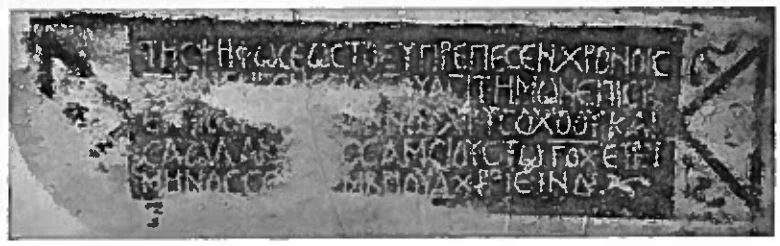
Mosaic panel framed by a tabula ansata. H. 0.68 m; W. 1.93 m. Set in the floor of the north aisle, at its east end, in front of the chancel screen. Letter height 0.09 m.
τῆς ψηφώσεως τὸ εὐπρεπὲς ἐν χρόνοις
̣γ̣έ̣γ̣ο̣ν̣ε̣ν ̣Γ̣ε̣ν̣ε̣σίου τοῦ ἁγί(ω)τ(άτου) ἡμῶν ἐπισκ(όπου)
ἐκ προσ̣φ̣ο̣ρ̣ᾶ[ς Ἰ]̣ω̣άννου χρυσοχόου καὶ
Σαώλα Κο[.]ησσαμσιοῦς τῷ γοχ΄ ἔτει,
μηνὸς Σε̣π[τ]̣εμβρίου α΄, χρό(νων) ιε΄ ἰνδ(ικτιῶνος).
'The nice appearance of the mosaic was done in the time of our most holy bishop Genesios, from the offering of Ioannes the goldsmith, and Saola, [- - -] in the year 673, on the 1st (day) of the month of September, in the time of the 15th indiction.'
Text: I. Gerasa, no. 335.
Translation: P. Nowakowski.
Inscription 2:
Carved on a rectangular stone block, within a raised tabula ansata. H. 0.33 m; W. 0.25 m (0.47 m with ansae). Letter height 0.03 m. The text overlaps ansae. Line 1 has a couple of gaps.
ἅγηι Θεώδ ̣ω[ρ]ε πρόσδεξ[ε] τὴν προσφορὰν
τ̣ο̣ῦ δούλου σ̣ο̣υ Θεω[δ]̣ώρου κ[αὶ . . . .]Π. . .
'O Saint Theodore, accept the offering of your servant Theodoros and [- - -]!'
Text: I. Gerasa, no. 336.
Translation: P. Nowakowski.
Source
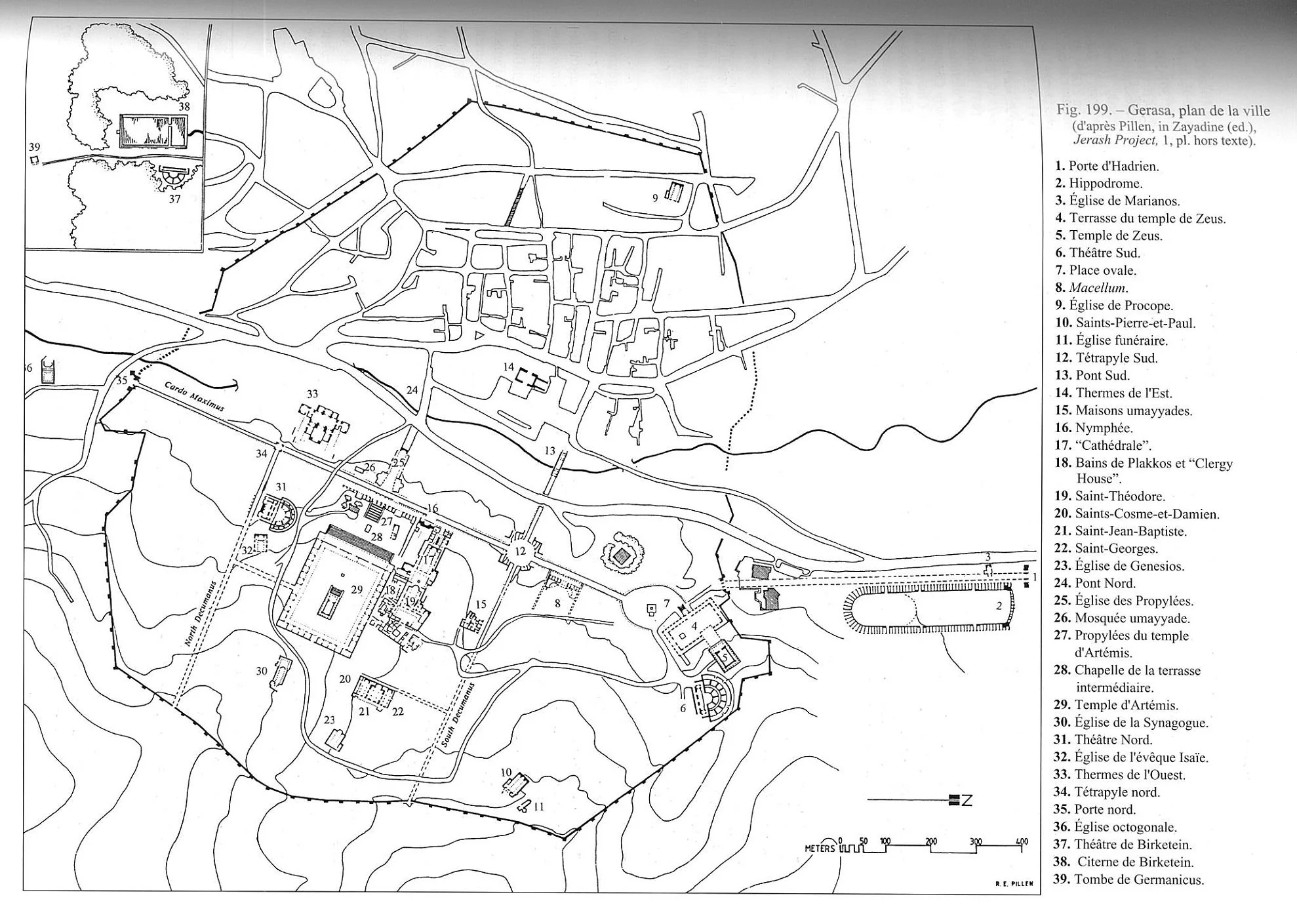
The church built under bishop Genesios, whose dedication is unknown, lies to the south-east of the temple of Artemis, to the west of the so-called 'complex of John the Baptist' (see E02367).
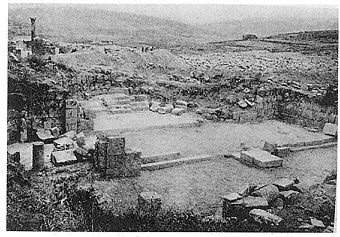
The church was partially excavated in 1929 by the expedition of the British School of Archaeology in Jerusalem. Only the foundations of the church and single stone blocks were preserved.
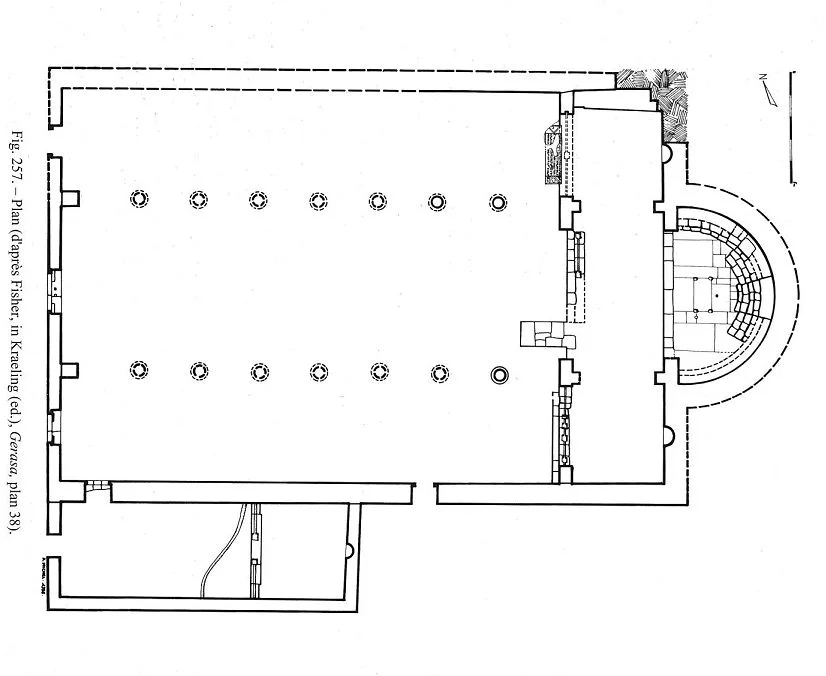
The church appears to have been a three-aisled basilica (33.60 m x 19.60 m) with an apse, an atrium (not excavated and not marked on the plan), and an annex at the west end of the south aisle.
The apse had a synthronon, and four altar sockets in its floor. A stone beneath the altar had a small niche, presumably a loculus for a reliquary. The apse was not flanked by chambers, but a rectangular field at the east end of the nave and aisles was delimited by a chancel screen and small rounded niches were present in the east wall, on both sides of the apse. The east wall of the annexed room had a similar niche and was also guarded by a chancel screen.
The floor of the church was decorated with mosaics but as the nave was not properly excavated, we do not know their actual layout.
The inscriptions were recorded in 1929 and first published in 1938 by Charles Welles, from a copy by A.H.M. Jones.
Discussion
Inscription 1 commemorates the paving of the north aisle, funded by a certain goldsmith Ioannes. This undertaking is dated to September of the 673rd year of the Gerasene Era (which is basically an era of Pompey), which corresponds to September AD 610. Anne Michel prudently notes that this date does not match the 15th indiction year, which fell in AD 611/612. Hence, Jones and Welles placed the inscription in 611. This is one of the latest dated dedicatory texts in Jerash. The content of line 3 is not clear: perhaps the name of another donor is mentioned there.
Inscription 2 was found in the same church, but its detailed location is unknown. It commemorates an offering to Saint Theodore (almost certainly the soldier and martyr of Amaseia and Euchaita) by a homonymous donor, but to the best of our knowledge, so far nobody has used it to suggest that the church might have been dedicated to the saint. Theodore was also venerated in Jerash in the 'episcopal complex' (E02342). Jones broadly dated this inscription to the 7th c., based on the contents of Inscription 1. There is no published image of this inscription.
Bibliography
Edition:
Welles, C.B., 'The inscriptions', in: Kraeling, C.H. (ed.), Gerasa, city of the Decapolis (New Haven: American School of Oriental Research, 1938), nos. 335-336 and Pl. LXXIVd.
Further reading:
Crowfoot, J.W., Churches at Jerash. A Preliminary Report of the Joint Yale-British Expeditions to Jerash, 1928-1930 (Supplementary papers (British School of Archaeology in Jerusalem) 3, London: Council of the British School of Archaeology in Jerusalem, 1931), 27.
Kraeling, C.H. (ed.), Gerasa, city of the Decapolis (New Haven: American School of Oriental Research, 1938), 333.
Michel, A., Les églises d'époque byzantine et umayyade de Jordanie (provinces d'Arabie et de Palestine), Ve-VIIIe siècle: typologie architecturale et aménagements liturgiques (avec catalogue des monuments; préface de Noël Duval; premessa di Michele Piccirillo) (Bibliothèque de l'Antiquité tardive 2, Turnhout: Brepols, 2001), 269-272, no. 95.
Images
Associated saints
| Saint | Name in source | Certainty |
|---|---|---|
| Theodore, soldier and martyr of Amaseia and Euchaita (S00480) | Θεώδωρος | Certain |
Cult classifications
- Cult Places
- Cult building - dependent (chapel, baptistery, etc.); Cult building - independent (church)
- Festivals
- Anniversary of church/altar dedication
- Liturgical Activity
- Ceremony of dedication
- Non Liturgical Activity
- Bequests, donations, gifts and offerings; Explicit naming a child, or oneself, after a saint; Prayer/supplication/invocation; Renovation and embellishment of cult buildings
- People
- Ecclesiastics - bishops; Merchants and artisans; Other lay individuals/ people
Record author
Paweł Nowakowski
Citation
Paweł Nowakowski, Cult of Saints, E02379 — https://csla.history.ox.ac.uk/record.php?recid=E02379