
E02537
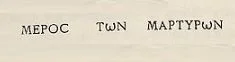
Fragmentary Greek inscription from an architrave or altar (?), referring to martyrs whose names are lost. Found at Madaba (Roman province of Arabia). Probably 6th c.
- Language
- Greek
- Date from
- 500
- Date to
- 750
- Evidence type
- Archaeological and architectural; Inscriptions
- Evidence subtype
- Altars with relics; Formal inscriptions (stone, mosaic, etc.); Inscribed architectural elements
- Evidence region
- Arabia
- Evidence location
- Madaba; Sakkaia / Maximianopolis, Σακκαια, Sakkaia, Saccaea, Eaccaea, Maximianopolis, Shaqqa, Schaqqa, Shakka
- Cult region
- Arabia
- Cult location
- Madaba; Sakkaia / Maximianopolis, Σακκαια, Sakkaia, Saccaea, Eaccaea, Maximianopolis, Shaqqa, Schaqqa, Shakka
- Cult date from
- 500
- Cult date to
- 750
Text
μέρος τῶν μαρτύρων [- - -]
'District of the martyrs [- - -].'
Text: I. Jordanie 2, no. 151.
Source
Fragment of an architrave, reused in a modern house. The stone is said by its editors to have once formed a part of an altar. There is no published description.
First published in 1897 by Kleofas Koikylides. Re-published from his edition by Henry Stevenson and R. Kraetzchmar in 1897. Revisited by Giuseppe Manfredi and re-edited by him in 1899, based on his own copy. Pierre-Louis Gatier did not examine the object for his edition in I. Jordanie 2. The stone is now probably lost.
Discussion
The inscription probably records a district named after martyrs. See: E04324, E04326, and E04314.
The late 19th c. editors dealing with this text suggested that it referred to a place where relics of martyrs were deposited. Gatier points out that the term μέρος is sometimes used in Syria as a designation of a tomb (e.g. in IGLS 5, no. 2400). He concludes that the author of the inscription might have meant a sarcophagus, but does not say clearly whether it would be an original burial place of martyrs or a reliquary shaped in the form of a sarcophagus.
Bibliography
Edition:
Gatier, P.-L., Inscriptions de la Jordanie, vol. 2: Région centrale (Amman, Hesban, Madaba, Main, Dhiban) (Paris: Librairie orientaliste Paul Geuthner, 1986), no. 151.
Manfredi, G., "Piano generale delle antichità di Madaba", Nuovo Bulletino di Archeologia Cristiana 5 (1899), 166.
Kraetzschmar, R., "", Mitteilungen und Nachrichten des deutschen Palästina-Vereins (1897), 54.
Stevenson, H., "Di un insigne pavimento in musaico esprimente la geografia dei luoghi santi scoperto in una basilica cristiana di Madaba in nella Palestina", Nuovo Bulletino di Archeologia Cristiana 3 (1897), 101.
Koikylides, K., Ὁ ἐν Μαδηβᾳ μοσαϊκός (Jerusalem, 1897), 24.
Images
Associated saints
| Saint | Name in source | Certainty |
|---|---|---|
| Martyrs, unnamed or name lost (S00060) | Certain |
Cult classifications
- Cult Places
- Altar; Burial site of a saint - sarcophagus/coffin; Burial site of a saint - unspecified; Cult building - unspecified
- Places Names after Saint
- Towns, villages, districts and fortresses
Record author
Paweł Nowakowski
Entry date
09/03/2017
Citation
Paweł Nowakowski, Cult of Saints, E02537 — https://csla.history.ox.ac.uk/record.php?recid=E02537