
E02652
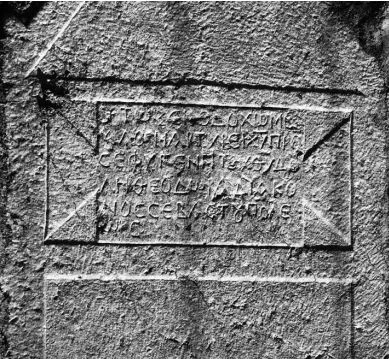
Greek epitaph for the deaconess Theodora who sought refuge at 'a great martyr' (certainly *Theodore, soldier and martyr of Amaseia and Euchaita, S00480). Found at Çorum in the territory of Amaseia, close to Euchaita (Helenopontus, north-eastern Asia Minor). Late antique.
- Language
- Greek
- Date from
- 400
- Date to
- 700
- Evidence type
- Inscriptions
- Evidence subtype
- Funerary inscriptions
- Evidence region
- Asia Minor
- Evidence location
- Amasea; Nicomedia, Νικομήδεια, Nikomēdeia, Izmit, Πραίνετος, Prainetos, Nicomedia; Euchaita; Nicomedia, Νικομήδεια, Nikomēdeia, Izmit, Πραίνετος, Prainetos, Nicomedia; Çorum; Nicomedia, Νικομήδεια, Nikomēdeia, Izmit, Πραίνετος, Prainetos, Nicomedia
- Cult region
- Asia Minor
- Cult location
- Amasea; Nicomedia, Νικομήδεια, Nikomēdeia, Izmit, Πραίνετος, Prainetos, Nicomedia; Euchaita; Nicomedia, Νικομήδεια, Nikomēdeia, Izmit, Πραίνετος, Prainetos, Nicomedia; Çorum; Nicomedia, Νικομήδεια, Nikomēdeia, Izmit, Πραίνετος, Prainetos, Nicomedia
- Cult date from
- 400
- Cult date to
- 700
Text
+ τῷ ξενοδόχῳ με[γ]-
άλῳ μαρτύρει Χ(ριστο)ῦ προ-
σέφυγεν ἡ τοῦ θ(εο)ῦ δού-
λη Θεοδώρα δυάκο-
νος Σεβαστουπόλε-
ως
'+ At the receiver of strangers, the great martyr of Christ, sought refuge the servant of God Theodora, deacon (of the city) of Sebastopolis.'
Text: Marek & Adak 2016, no. 99.
Source
A large stone stele topped by a gable with small acroteria. The inscription is framed by a tabula ansata. Dimensions not specified. First published by Christian Marek and Mustafa Adak in 2015 (with a photograph).
Discussion
The epitaph commemorates a woman who held the function of a deaconess in Sebastopolis (modern Sulusaray), sited c. 100 km to the south-east of the find-spot of the inscription. It says that Theodora sought refuge (προσέφυγεν) at a great martyr of Christ. Marek and Adak rightly point out that this must be Theodore whose magnificent sanctuary was located to the east of Çorum, in Euchaita. As a parallel they quote a boundary stone of a shrine of Michael the Archangel from Çiftlik, near Ancyra in Galatia (see E00996), and two inscriptions from the Near East with regulations on the zone protected by the privilege of asylum (E04405: El Bassah/Betzet in Palestine and E01764: from the territory of Tyre), where derivatives of that verb are used to denote people seeking the protection of asylum. However, we suggest that as the inscription is an epitaph, and not a legal text, it is more likely to refer to the spiritual protection expected from the saint, and may actually commemorate a burial ad sanctos. For similar phrasing, see: nos. E00979; E01009; E01017.
In line 1 the saint is described by a peculiar epithet, ξενοδόχος. Normally the word means 'the receiver of strangers', and this makes sense also in our case, as the shrine of Theodore in Euchaita was a major pilgrimage destination. It is possible that Theodora, a native of Sebastopolis, died during her pilgrimage to Euchaita, and that is the reason why the hospitality of Theodore is stressed here (he offered her an 'eternal' stay at his shrine and in Heaven). On the other hand, Hesychios notes that the term ξενοδόχος was actually a synonym of the word 'martyr': ξεινοδόκος· ὑποδεχόμενος ξένους καὶ μάρτυς/'xeinodokos: the one who receives strangers, and martyr'. A request for help for strangers (ξένοι), addressed to Saint John the Baptist, is recorded on a pilgrim ampulla found at Sardis (see SEG 55, 1301: ἅγηιε Ἰοάννη Βα(πτιστᾶ) | βοείθε τ(ο)ὺς ξέν(ο)υς).
Bibliography
Edition:
Marek, Ch., Adak, M., Epigraphische Forschungen in Bithynien, Paphlagonien, Galatien und Pontos (Philia Supplements 2, Istanbul: Kabalcı Yayınevi, 2016), no. 99.
Images
Associated saints
| Saint | Name in source | Certainty |
|---|---|---|
| Theodore, soldier and martyr of Amaseia and Euchaita (S00480) | Certain | |
| Martyrs, unnamed or name lost (S00060) | Certain |
Cult classifications
- Non Liturgical Activity
- Burial ad sanctos; Consecrating a child, or oneself, to a saint; Pilgrimage; Prayer/supplication/invocation; Saint as patron - of an individual; Seeking asylum at church/shrine; Visiting graves and shrines
- People
- Ecclesiastics - lesser clergy; Foreigners (including Barbarians); Women
Record author
Paweł Nowakowski
Entry date
01/04/2017
Citation
Paweł Nowakowski, Cult of Saints, E02652 — https://csla.history.ox.ac.uk/record.php?recid=E02652