
E02653
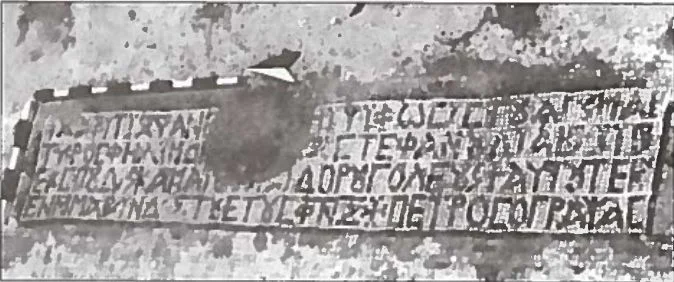
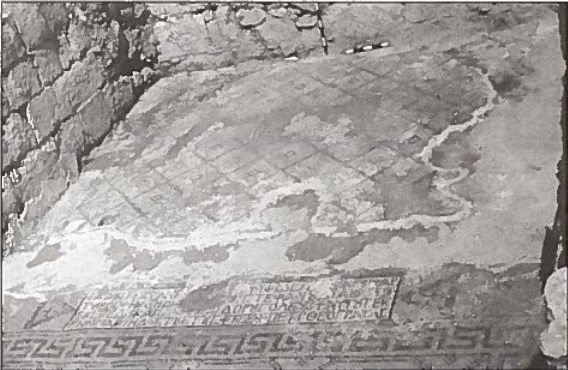
Floor-mosaic with a Greek inscription commemorating the restoration of the pavement in a church or chapel dedicated to *Philemon (possibly the martyr of Antinoopolis, Egypt, S00386). Found at Riḥāb, between Bostra and Gerasa/Jerash (Roman province of Arabia). Dated 663.
- Language
- Greek
- Date from
- 663
- Date to
- 663
- Evidence type
- Archaeological and architectural; Inscriptions
- Evidence subtype
- Cult buildings (churches, mausolea); Formal inscriptions (stone, mosaic, etc.)
- Evidence region
- Arabia
- Evidence location
- Bosra; Sakkaia / Maximianopolis, Σακκαια, Sakkaia, Saccaea, Eaccaea, Maximianopolis, Shaqqa, Schaqqa, Shakka; Gerasa/Jerash; Sakkaia / Maximianopolis, Σακκαια, Sakkaia, Saccaea, Eaccaea, Maximianopolis, Shaqqa, Schaqqa, Shakka; Riḥāb; Sakkaia / Maximianopolis, Σακκαια, Sakkaia, Saccaea, Eaccaea, Maximianopolis, Shaqqa, Schaqqa, Shakka
- Cult region
- Arabia
- Cult location
- Bosra; Sakkaia / Maximianopolis, Σακκαια, Sakkaia, Saccaea, Eaccaea, Maximianopolis, Shaqqa, Schaqqa, Shakka; Gerasa/Jerash; Sakkaia / Maximianopolis, Σακκαια, Sakkaia, Saccaea, Eaccaea, Maximianopolis, Shaqqa, Schaqqa, Shakka; Riḥāb; Sakkaia / Maximianopolis, Σακκαια, Sakkaia, Saccaea, Eaccaea, Maximianopolis, Shaqqa, Schaqqa, Shakka
- Cult date from
- 663
- Cult date to
- 663
Text
+ χάριτι Χ(ριστο)ῦ ἀνε[νεώθ]η ἱ ψίφωσις τοῦ ἁγ(ίου) μάρ-
τυρος Φηλίμο̣ν[ος ἐπὶ] Στεφάνου διακ(όνου) (καὶ) ἱγου(μένου),
ἐκ σπουδ(ῆς) (καὶ) καμάτο[υ] Θιωδόρου Γολέου (καὶ) τ(ῶν) αὐτοῦ τέκν(ων)·
ἐν μη(vὶ) Μαρ(τίῳ), ἰνδ(ικτιῶνι) ς΄ τοῦ ἔτους φνζ΄· + Πέτρος ὁ γράψας
[2. Φήλιμο̣ς SEG || ἐπὶ τοῦ ἁγ(ίου)] Στεφάνου SEG || 3. καμάτου, [Θι]ωδόρου, (καὶ) Γολέου αὐτοῦ τέκν(ων) SEG || 4. Μαρ(τίου) SEG || ἰνδ(ικτιῶνος) SEG || <Πέ>τρος SEG]
'+ Through the grace of Christ was restored the mosaic pavement of the holy martyr Philemon (?) [under] the deacon and abbot (higoumenos) Stephanos, by the zeal and toil of Theodoros, son of Goleos (?), and his children. In the month of March, 6th indiction, the year 557. + Petros wrote (it).'
Text: BE (2005), 544, ed. by D. Feissel and P.-L. Gatier.
Translation: P. Nowakowski.
Source
Mosaic panel framed by a tabula ansata, from an unspecified church in Riḥāb. There is no published description. Adjacent to the border of a carpet mosaic decorated with lozenges.
The mosaic was published as a photograph, together with a number of other new epigraphic finds from Riḥāb, with little or no descriptions, by Abdel-kader Al-Hissan in the Annual of the Department of Antiquities of Jordan in 2001 and again in 2002. Based on the photographs, preliminary comments were offered by Denis Feissel in the Bulletin épigraphique and a very faulty transcription by the editors of the Supplementum Epigraphicum Graecum 51, 2043. In 2005 Pierre-Louis Gatier and Denis Feissel published a corrected transcription which was accepted in Supplementum Epigraphicum Graecum 53, 1885.
Discussion
The inscription commemorates the paving of an unspecified church or chapel dedicated to a certain martyr Philemon. The completion of this undertaking is dated to the month of March of the 557th year of the era of the province of Arabia, which corresponds to March AD 663, that is two year after the paving of the church of *Sergios in the same town (E02647), in the Umayyad period. As the supervisor of the work is an abbot, we can presume that the shrine belonged to a monastic establishment.
The name of the saint was originally read by the editors of the SEG as Philimos or Phelimos, but Feissel and Gatier rightly correct it to Philemon whom, however, they did not attempt to identify. As the figure is styled 'martyr', it is unlikely that he was Philemon, the addressee of the Epistle to Philemon. Possibly our Philemon is the Egyptian martyr of Antinoopolis, venerated in Thessalonike in the month of March (as documented by an inscribed mosaic from the Rotunda, see E00597). The only basis for this identification is, however, the date of his commemoration in Thessalonike, which coincides with that of the restoration of our shrine, and the fact that the cults of some Egyptian martyrs were present in the region (e.g. *Menas in Riḥāb: E02044; *Varos in Philadelphia/Amman: E02382; *Viktor near Gaza and the *Three Egyptian Martyrs near Ashkelon: E02524, etc.).
Bibliography
Edition:
Supplementum Epigraphicum Graecum 51, 2043, read anew in Bulletin épigraphique (2005), 544 and accepted in SEG 53, 1885.
Al-Hissan, A., "The new archaeological discoveries of the al-Fudayn and Rahāb - al-Mafraq excavation projects", Annual of the Department of Antiquities of Jordan 46 (2002), 84 (Arabic Section).
Al-Hissan, A., "", Annual of the Department of Antiquities of Jordan 45 (2001), 12 (Arabic Section).
Further reading:
Gatier, P.-L., "Inscriptions grecques, mosaïques et églises des débuts de l'époque islamique au Proche-Orient (VIIe-VIIIe) siècles", in: A. Borrut, M. Debié, A. Papaconstantinou, D. Pieri, J.-P. Sodini (eds.), Le Proche-Orient de Justinien aux Abassides : peuplement et dynamiques spatiales : actes du colloque "Continuités de l'occupation entre les périodes byzantine et abbasside au Proche-Orient, VIIe-IXe siècles," Paris, 18-20 octobre 2007 (Bibliothèque de l'Antiquité tardive 19, Turnhout: Brepols, 2011), 10.
Piccirillo, M., L'Arabie chrétienne (Paris: Editions Mengès, 2002), 74, 229.
Piccirillo, M., "Aggiornamento delle liste episcopali delle diocesi in territoria transgiordanico", Liber Annuus 55 (2005), 387 (implausibly associated with bishop Polyeuktos, before 634).
Reference works:
Bulletin épigraphique (2002), 481.
Images
Associated saints
| Saint | Name in source | Certainty |
|---|---|---|
| Philemon, Apollonios and companions, martyrs of Antinoopolis (S00386) | Φηλίμων | Uncertain |
Cult classifications
- Cult Places
- Cult building - dependent (chapel, baptistery, etc.); Cult building - independent (church); Cult building - monastic
- Non Liturgical Activity
- Bequests, donations, gifts and offerings; Renovation and embellishment of cult buildings
- People
- Children; Ecclesiastics - abbots; Ecclesiastics - lesser clergy; Merchants and artisans; Other lay individuals/ people
- Places Names after Saint
- Monastery
Record author
Paweł Nowakowski
Entry date
03/04/2017
Citation
Paweł Nowakowski, Cult of Saints, E02653 — https://csla.history.ox.ac.uk/record.php?recid=E02653