
E02655
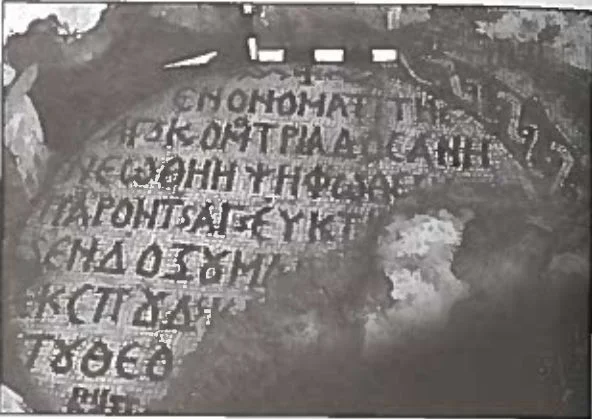
Floor-mosaic with a fragmentary Greek inscription commemorating the restoration of the pavement of an oratory (eukterion) of a martyr whose name is lost. Found at Riḥāb, between Bostra and Gerasa/Jerash (Jordan/the Roman province of Arabia). Probably 6th or 7th c.
- Language
- Greek
- Date from
- 500
- Date to
- 700
- Evidence type
- Archaeological and architectural; Inscriptions
- Evidence subtype
- Cult buildings (churches, mausolea); Formal inscriptions (stone, mosaic, etc.)
- Evidence region
- Arabia
- Evidence location
- Bosra; Sakkaia / Maximianopolis, Σακκαια, Sakkaia, Saccaea, Eaccaea, Maximianopolis, Shaqqa, Schaqqa, Shakka; Gerasa/Jerash; Sakkaia / Maximianopolis, Σακκαια, Sakkaia, Saccaea, Eaccaea, Maximianopolis, Shaqqa, Schaqqa, Shakka; Riḥāb; Sakkaia / Maximianopolis, Σακκαια, Sakkaia, Saccaea, Eaccaea, Maximianopolis, Shaqqa, Schaqqa, Shakka
- Cult region
- Arabia
- Cult location
- Bosra; Sakkaia / Maximianopolis, Σακκαια, Sakkaia, Saccaea, Eaccaea, Maximianopolis, Shaqqa, Schaqqa, Shakka; Gerasa/Jerash; Sakkaia / Maximianopolis, Σακκαια, Sakkaia, Saccaea, Eaccaea, Maximianopolis, Shaqqa, Schaqqa, Shakka; Riḥāb; Sakkaia / Maximianopolis, Σακκαια, Sakkaia, Saccaea, Eaccaea, Maximianopolis, Shaqqa, Schaqqa, Shakka
- Cult date from
- 500
- Cult date to
- 700
Text
branch + branch
ἐν ὀνόματι τῆς
ἁγ(ίας) κ(αὶ) ὁμο(ουσίου) Τριάδος ἀνη-
νεώθη ἡ ψηφωθε̣σ̣ί[α τοῦ]
παρόντ(ος) ἁγ(ίου) εὐκτ̣η[ρίου τοῦ ἁγ(ίου)]
(καὶ) ἐνδόξου μάρ[τυρος - - -]
ἐκ σπουδ(ῆς) ̣Κ[- - -]
τοῦ ΘΕΟ[- - -]
μη(νὶ) Π[- - -]
[5. εὐκτ̣η[ρίου - - -] SEG]
'+ In the name of the Holy and Consubstantial Trinity was resorted the mosaic pavement of [the] present holy oratory (eukterion) [of the holy] and glorious martyr [- - -] by the zeal of K[- - -] of the [- - -] in the month of P[- - -].'
Text: SEG 51, 2046, lightly modified.
Translation: P. Nowakowski.
Source
Fragmentary medallion from an unspecified church in Riḥāb. There is no published description. The lower right quarter is lost.
The medallion was published as a photograph, together with a number of other new epigraphic finds from Riḥāb, with little or no descriptions, by Abdel-kader Al-Hissan in the Annual of the Department of Antiquities of Jordan in 2002. A preliminary transcription was offered by the editors of the Supplementum Epigraphicum Graecum 51, 2046.
Discussion
The inscription commemorates the paving of a church or chapel dedicated to a martyr whose name is lost. The month mentioned in the last line is either Panemos or Peritios.
The panel is probably contemporary to other dated mosaic inscriptions from Riḥāb, which come from the 6th and 7th centuries.
Bibliography
Edition:
Supplementum Epigraphicum Graecum 51, 2046.
Al-Hissan, A., "The new archaeological discoveries of the al-Fudayn and Rahāb - al-Mafraq excavation projects", Annual of the Department of Antiquities of Jordan 46 (2002), 85 (Arabic Section).
Reference works:
Bulletin épigraphique (2005), 544.
Images
Associated saints
| Saint | Name in source | Certainty |
|---|---|---|
| Martyrs, unnamed or name lost (S00060) | Certain |
Cult classifications
- Cult Places
- Cult building - dependent (chapel, baptistery, etc.); Cult building - independent (church)
- Non Liturgical Activity
- Bequests, donations, gifts and offerings; Renovation and embellishment of cult buildings
- Religious Grouping
- Explicitly Nicene
Record author
Paweł Nowakowski
Entry date
03/04/2017
Citation
Paweł Nowakowski, Cult of Saints, E02655 — https://csla.history.ox.ac.uk/record.php?recid=E02655