
E02665
Greek inscriptions on stone. Found in the sanctuary (hagios topos) of *Lot (Old Testament patriarch, S01234) at Deir 'Ain 'Abata near Zoara/modern Ghor es-Safi on the south-east shore of the Dead Sea (Jordan/Roman province of Palaestina III). Probably 6th-7th c.
- Language
- Greek
- Date from
- 500
- Date to
- 700
- Evidence type
- Inscriptions
- Evidence subtype
- Formal inscriptions (stone, mosaic, etc.)
- Evidence region
- Palestine with Sinai
- Evidence location
- Deir 'Ain Abata; Caesarea Maritima, Καισάρεια, Kaisareia, Caesarea, Kayseri, Turris Stratonis; Zoara; Caesarea Maritima, Καισάρεια, Kaisareia, Caesarea, Kayseri, Turris Stratonis
- Cult region
- Palestine with Sinai
- Cult location
- Deir 'Ain Abata; Caesarea Maritima, Καισάρεια, Kaisareia, Caesarea, Kayseri, Turris Stratonis; Zoara; Caesarea Maritima, Καισάρεια, Kaisareia, Caesarea, Kayseri, Turris Stratonis
- Cult date from
- 500
- Cult date to
- 700
Text
Inscription 1:
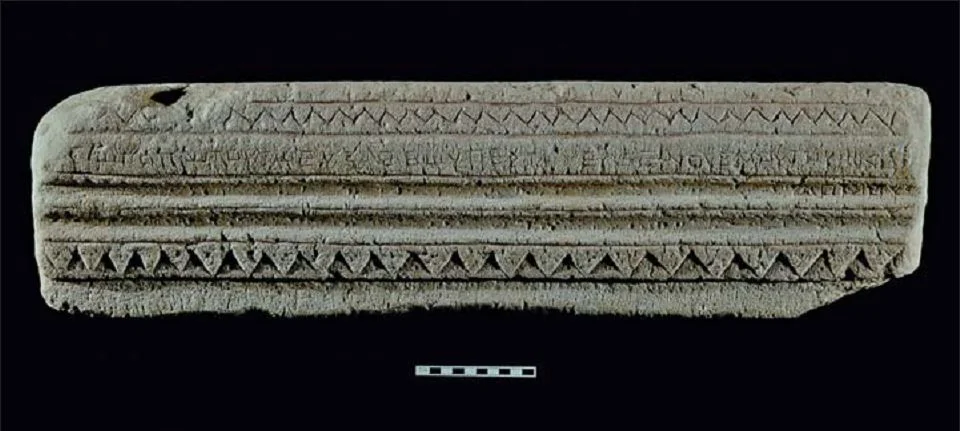
White sandstone lintel. Decorated with mouldings. Weathered face. Broken and lost in the upper left-hand corner. H. 0.225 m; W. 0.78 m; Th. 0.20 m. Letter height 0.009-0.02 m. Reportedly found in the apse in the south aisle of the church.
[ὁ εἰσιὼν (?) ἐν τῷ] ̣ἁγίῳ τόπῳ τούτῳ, εὐξάσθω ὑπὲρ το̣ῦ ἐλεεινοῦ ἐμοῦ, τοῦ οἰκο-
δόμου
'[Let him who enters] this holy place, pray for me, the humble mason!'
Text: Politis 2012, 410-411, no. 8 [ed. and translation Y. Meimaris & K.I. Kritikakou-Nikolaropoulou].
The editors suppose that the architect (oikodomos) mentioned in this request, was the constructor of the church of Lot or another building at the site of the monastery. They add that the structure could be seen as a gift to the saint by the architect.
Inscription 2:
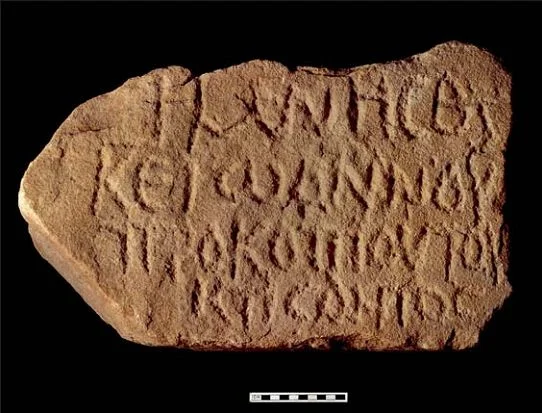
Sandstone slab with a very rough surface. Found to the north of the church, in a courtyard of the monastery (sometimes described as the site of the pilgrims' hostel). H. 0.29 m; W. 0.48 m; Th. 0.08 m. Letter height 0.035-0.075 m.
+ μνήσθ(ητι),
Κ(ύρι)ε, Ἰωάννου
Προκοπίου τοῦ
κτίσαντος
'+ O Lord, remember Ioannes, son of Prokopios, the founder!'
Text: Politis 2012, 409-410, no. 6 [ed. and translation Y. Meimaris & K.I. Kritikakou-Nikolaropoulou].
The editors suppose that Ioannes, son of Prokopios, here described as a donor or founder was probably responsible for the construction of the pilgrims' hostel.
Inscription 3:
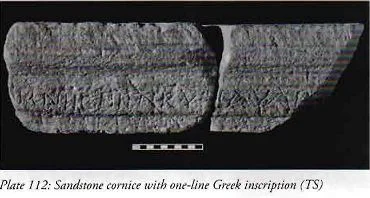
Two conjoining fragments of a white-pinkish sandstone cornice. Found in the pilgrims' hostel. Fragment A: H. 0.175 m; W. 0.32 m; Th. 0.245 m. Fragment B: H. 0.175 m; W. 0.17 m; Th. 0.245 m. Letter height 0.02-0.04 m. The engraved letters were painted red.
+ μνήσθητι, Κύ(ριε), ̣Παύλ̣ο[υ - - -]
'+ O Lord, remember Paulos [- - -]!'
Text: Politis 2012, 410, no. 7 [ed. and translation Y. Meimaris & K.I. Kritikakou-Nikolaropoulou].
Meimaris and Kritikakou-Nikolaropoulou mention four more fragmentary stones with scarcely legible inscriptions, that were found at the sanctuary. As they are not relevant for the present study, we do not reproduce them here. For the text, see Politis 2012, 411-412, nos. 9-12.
Source
For a description of the site, see: E02664.
For graffiti from the site, see: E02666.
For the painted inscriptions (dipinti), invoking 'saint Lot', that confirm the identification of this site as the sanctuary and monastery of Lot, which is also known from the Madaba mosaic map (E02524 no.2), see E02782.
Bibliography
Edition:
Politis. K.D. (ed.), Sanctuary of Lot at Deir 'Ain 'Abata: Excavations 1988-2003 (Amman: Jordan Distribution Agency, 2012), 393-416 (Greek inscriptions).
We are very grateful to Konstantinos Politis for generously providing a copy of this publication, and to Alan Walmsley and Carol Palmer, the director of the British Institute in Amman (CBRL), for additional help.
Further reading:
Politis, K.D., "Excavations at the Monastery of Saint Lot at Deir ‘Ain ‘Abata", Liber Annuus 41 (1991), 517-518.
Politis, K.D. "The Sanctuary of Agios Lot, the City of Zoara and the Zared River", in: M. Piccirillo, E. Alliata (eds.), The Madaba Map Centenary 1897–1997: Travelling Through the Byzantine Umayyad Period. Proceedings of the International Conference Held in Amman, 7.–9. April 1997 (Jerusalem: Franciscan Printing Press, 1999), 225-227.
Politis, K.D., "The Monastery of Aghios Lot at Deir 'Ain 'Abata in Jordan”, in: Daim, F., Drauschke, J. (eds.), Byzanz – Das Römerreich im Mittelalter (Mainz: Römisch-Germanisches Zentralmuseum, 2010), 155-180.
Politis, K.D., "The sanctuary of Lot at 'Ain 'Abata in Jordan", in: L.D. Chrupcała (ed.), Christ is here! Studies in Biblical and Christian Archaeology in Memory of Michele Piccirillo, ofm (SBF Collectio Maior 52, Milan: Edizioni Terra Santa, 2012), 355-382.
See also:
http://www.christusrex.org/www1/ofm/mad/articles/PolitisLot.html
Reference works:
Bulletin épigraphique (2015), 721.
Supplementum Epigraphicum Graecum 58, 1779; 42, 1483; 62, 1698-1716.
Images
Associated saints
| Saint | Name in source | Certainty |
|---|---|---|
| Lot, Old Testament patriarch and nephew of Abraham (S01234) | Λώτ | Certain |
Cult classifications
- Cult Places
- Cult building - independent (church); Cult building - monastic; Holy cave; Place associated with saint's life
- Non Liturgical Activity
- Construction of cult buildings; Prayer/supplication/invocation; Renovation and embellishment of cult buildings
- People
- Ecclesiastics - monks/nuns/hermits; Merchants and artisans; Other lay individuals/ people
- Places Names after Saint
- Hospital and other charitable institutions; Monastery
Record author
Paweł Nowakowski
Entry date
06/04/2017
Citation
Paweł Nowakowski, Cult of Saints, E02665 — https://csla.history.ox.ac.uk/record.php?recid=E02665