
E02701
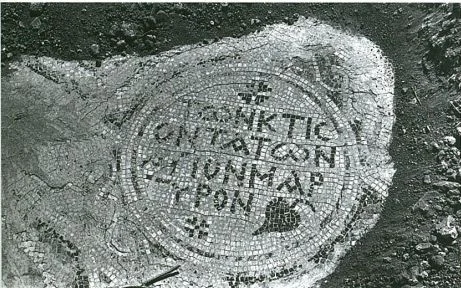
Floor mosaic with a Greek inscription commemorating the construction of a church of unnamed martyrs. Found at Khirbat Majed near Shajarah, Irbid, and Kapitolias/Beit Ras, to the south-east of the Sea of Galilee (Roman province of Palaestina II or Roman province of Arabia). Probably 6th-7th c.
- Language
- Greek
- Date from
- 500
- Date to
- 700
- Evidence type
- Archaeological and architectural; Inscriptions
- Evidence subtype
- Cult buildings (churches, mausolea); Formal inscriptions (stone, mosaic, etc.)
- Evidence region
- Arabia; Palestine with Sinai
- Evidence location
- Arbela; Sakkaia / Maximianopolis, Σακκαια, Sakkaia, Saccaea, Eaccaea, Maximianopolis, Shaqqa, Schaqqa, Shakka; Kapitolias; Caesarea Maritima, Καισάρεια, Kaisareia, Caesarea, Kayseri, Turris Stratonis; Khirbat Majed; Caesarea Maritima, Καισάρεια, Kaisareia, Caesarea, Kayseri, Turris Stratonis; Shajarah; Caesarea Maritima, Καισάρεια, Kaisareia, Caesarea, Kayseri, Turris Stratonis; Skythopolis; Caesarea Maritima, Καισάρεια, Kaisareia, Caesarea, Kayseri, Turris Stratonis
- Cult region
- Arabia; Palestine with Sinai
- Cult location
- Arbela; Sakkaia / Maximianopolis, Σακκαια, Sakkaia, Saccaea, Eaccaea, Maximianopolis, Shaqqa, Schaqqa, Shakka; Kapitolias; Caesarea Maritima, Καισάρεια, Kaisareia, Caesarea, Kayseri, Turris Stratonis; Khirbat Majed; Caesarea Maritima, Καισάρεια, Kaisareia, Caesarea, Kayseri, Turris Stratonis; Shajarah; Caesarea Maritima, Καισάρεια, Kaisareia, Caesarea, Kayseri, Turris Stratonis; Skythopolis; Caesarea Maritima, Καισάρεια, Kaisareia, Caesarea, Kayseri, Turris Stratonis
- Cult date from
- 500
- Cult date to
- 700
Text
In 1992 Michele Piccirillo published a short note on a small church excavated at the village of Khirbat Majed to the north of Wadi Shalleh in 1987, which he believed was attached to a monastery. The excavators found there floor mosaics with inscriptions reportedly mentioning Sobbeon, son of Domintios, of Silona, and his brother Domentis as founders. A mosaic panel, published by Piccirillo as a photograph together with the note, contains a reference to 'Holy Martyrs', which became the basis for the identification of the church as dedicated to unnamed martyrs.
In 2001 Anne Michel offered an imperfect transcription of the panel, read from the published photograph: τῶν κ(αὶ) τις | οντα τῶν | ἁγίον μαρτύρον/'(? ... des saints martyrs)'. We suggest that the inscription reads τὼν κτίσ|οντα τῶν | ἁγίον μαρ|τύρων/'(e.g. Protect) the founder (of the shrine) of the Holy Martyrs!' or, alternatively, τὼν κτίσ|οντα τὼν | ἅγιον μαρ|τύρ<ι>ων/'(e.g. Protect) the founder of the holy martyrion!', and that it is the end of an invocation which began in another, adjacent medallion.
Michel points out that the church must have belonged to the bishopric of Adraha or Kapitolias (that is to the metropolitan see of Bostra in the province of Arabia) or to the bishopric of Skythopolis, the metropolitan see of the province of Palaestina II.
As far as we know the mosaics from this church are still unpublished.
Bibliography
Edition:
Piccirillo, M., The Mosaics of Jordan (Amman, Jordan: American Center of Oriental Research, 1992 [2008, 3rd ed.]), 341, no. 751.
Michel, A., Les églises d'époque byzantine et umayyade de Jordanie (provinces d'Arabie et de Palestine), Ve-VIIIe siècle: typologie architecturale et aménagements liturgiques (avec catalogue des monuments; préface de Noël Duval; premessa di Michele Piccirillo) (Bibliothèque de l'Antiquité tardive 2, Turnhout: Brepols, 2001), 419.
Images
Associated saints
| Saint | Name in source | Certainty |
|---|---|---|
| Martyrs, unnamed or name lost (S00060) | ἅγιοι μάρτυρες | Certain |
Cult classifications
- Cult Places
- Cult building - independent (church); Cult building - monastic; Martyr shrine (martyrion, bet sāhedwātā, etc.)
- Non Liturgical Activity
- Bequests, donations, gifts and offerings; Construction of cult buildings
- People
- Other lay individuals/ people
- Places Names after Saint
- Monastery
Record author
Paweł Nowakowski
Entry date
13/04/2017
Citation
Paweł Nowakowski, Cult of Saints, E02701 — https://csla.history.ox.ac.uk/record.php?recid=E02701