
E02703
Scarcely legible Greek inscription with an invocation, just possibly of the God of unnamed martyrs. Found at Khirbat al-Khalidi near modern 'Aqaba, at the north end of the Gulf of 'Aqaba (Jordan/Roman province of Palaestina III). Probably 6th-8th c. or later.
- Language
- Greek
- Date from
- 500
- Date to
- 800
- Evidence type
- Inscriptions
- Evidence subtype
- Formal inscriptions (stone, mosaic, etc.)
- Evidence region
- Palestine with Sinai
- Evidence location
- 'Aila/'Aqaba; Caesarea Maritima, Καισάρεια, Kaisareia, Caesarea, Kayseri, Turris Stratonis; Khirbat al-Khalidi; Caesarea Maritima, Καισάρεια, Kaisareia, Caesarea, Kayseri, Turris Stratonis
- Cult region
- Palestine with Sinai
- Cult location
- 'Aila/'Aqaba; Caesarea Maritima, Καισάρεια, Kaisareia, Caesarea, Kayseri, Turris Stratonis; Khirbat al-Khalidi; Caesarea Maritima, Καισάρεια, Kaisareia, Caesarea, Kayseri, Turris Stratonis
- Cult date from
- 500
- Cult date to
- 800
Text
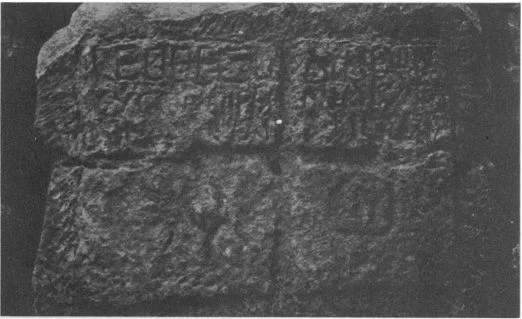
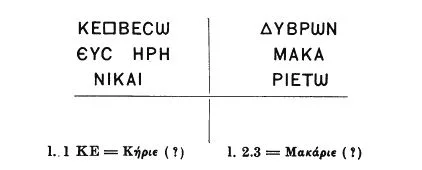
In 1939 Nelson Glueck published a poor photograph of a scarcely legible inscription carved to the right and to the left of an inscribed cross on a reused building block which he had seen at Khirbat al-Khalid, among the ruins of an unidentified large Byzantine structure (possibly a church). With the aid of John Henry Iliffe he tentatively dated the block to the 6th or 7th c. and offered an imperfect transcription:
ΚΕΟΒΕCΩ ΔΥΒΡΩΝ
ΕΥC ΗΡΗ ΜΑΚΑ
ΝΙΚΑΙ ΡΙΕΤΩ
The transcription was re-examined by James Oliver who in 1941 suggested another interpretation, arguing that line 2 contains the phrase εὐστάθει εἰρήνῃ allegedly corresponding to the Latin expression requiescat in pace and that the word ΔΥΒΡΩΝ in line 1 is a personal name (Dybron or Thybron). He also noted the presence of two large letters Α and Ω below the horizontal bars of the cross:
Κ(ύρι)ε ̣ἐ̣λ̣έησ̣ο Δύβρων
εὐσ[τάθ]ι ἰρή- μακα-
νι καὶ ριέτω
Α Ω
'O Lord, have mercy, he rests in peace, and may Dyrbon be blessed!'
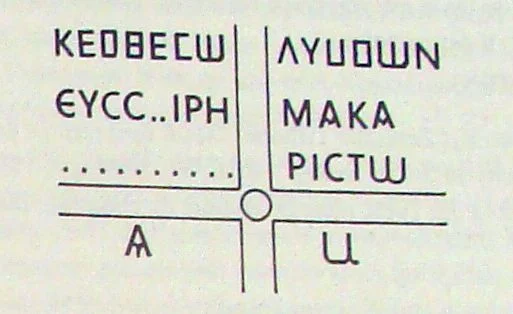
In 1954 Albrecht Alt read the phrase Κ(ύρι)ε ὁ θε(ὸ)ς τῶ[ν] δυναμέων /'O Lord, God of the Powers!' in line 1 and the name Εύσέβιος in line 2. His reading was, however, rejected by Maurice Sartre who in the fourth volume of Inscriptions de la Jordanie offers yet another transcription (still based on Glueck's photograph as the stone is now lost):
ΚΕΟΘΕCΩ ΛΥUΟΩΝ
ΕΥCC..ΙΡΗ ΜΑΚΑ
............. ΡΙCΤΩ
Α Ω
Sartre reached the following interpretation: Κ(ύρι)ε ὁ θε(ός) σῶ(σον) Δύβρων. Εὐσ[τάθι] ἰρή[νι καὶ μακαρι[ζ]έτω. Α Ω/'O Lord, God, save Dybron. He securely rests in peace and may he be blessed! Α Ω'
In our opinion this reading is not convincing. The name Dybron is otherwise not attested (already Denis Feissel suggested to Sartre that here one should probably read a different word, e.g. Αυορων, a toponym) and the phrase εὐστάθει εἰρήνῃ is also unparalleled. We hypothetically suggest that line 1 might contain an invocation of the God of the Martyrs: Κ(ύρι)ε ὁ θ(εό)ς τῶν μαρτύρων. Sadly, the photograph is of very poor quality and the rest of the text is even less clear.
Bibliography
Edition:
Sartre, M., Inscriptions de la Jordanie, vol. 4: Pétra et la Nabatène méridionale du Wadi al-Hasa au golfe de 'Aqaba (Paris: Librairie orientaliste Paul Geuthner, 1993), no. 137.
Alt, A., "Eine Inschrift aus dem Limeskastell chirbet el chalde", Zeitschrift des deutschen Palästina-Vereins 70 (1954), 85-87.
Oliver, J.H., "Notes on Documents of the Roman East", American Journal of Archaeology 45 (1941), 542-543.
Glueck, N., "Explorations in Eastern Palestine, III", Annual of the American School of Oriental Research 18-19 (1937-1939), 18 and fig. 10.
Further reading:
Michel, A., Les églises d'époque byzantine et umayyade de Jordanie (provinces d'Arabie et de Palestine), Ve-VIIIe siècle: typologie architecturale et aménagements liturgiques (avec catalogue des monuments; préface de Noël Duval; premessa di Michele Piccirillo) (Bibliothèque de l'Antiquité tardive 2, Turnhout: Brepols, 2001), 421 (with no reference to Sartre's discussion).
Saller, S.J., Bagatti, B., The Town of Nebo (Khirbet El-Mekhayyat): with a brief survey of other Christian monuments in Transjordan (Jerusalem: Franciscan Press, 1949), 233, no. 134.
Images
Associated saints
| Saint | Name in source | Certainty |
|---|---|---|
| Martyrs, unnamed or name lost (S00060) | μάρτυρες | Uncertain |
Cult classifications
- Non Liturgical Activity
- Prayer/supplication/invocation
Record author
Paweł Nowakowski
Entry date
13/04/2017
Citation
Paweł Nowakowski, Cult of Saints, E02703 — https://csla.history.ox.ac.uk/record.php?recid=E02703