
E02723
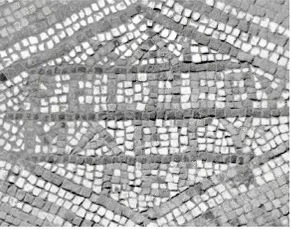
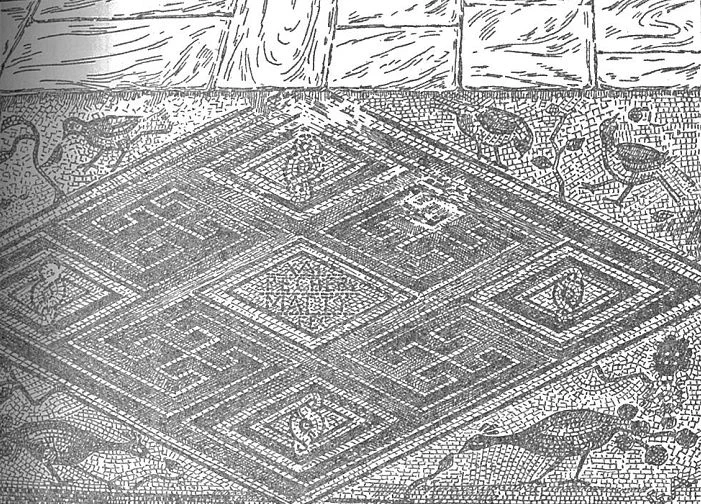
Floor-mosaic with a Greek inscription containing an acclamation of unnamed martyrs. Found at 'Ein Kerem, south-west outskirts of Jerusalem (Roman province of Palaestina I), at the cave traditionally identified as the birthplace of John the Baptist. Probably 5th-7th c.
- Language
- Greek
- Date from
- 450
- Date to
- 700
- Evidence type
- Archaeological and architectural; Inscriptions
- Evidence subtype
- Formal inscriptions (stone, mosaic, etc.); Internal cult fixtures (crypts, ciboria, etc.)
- Evidence region
- Palestine with Sinai
- Evidence location
- 'Ein Kerem; Caesarea Maritima, Καισάρεια, Kaisareia, Caesarea, Kayseri, Turris Stratonis; Jerusalem; Caesarea Maritima, Καισάρεια, Kaisareia, Caesarea, Kayseri, Turris Stratonis
- Cult region
- Palestine with Sinai
- Cult location
- 'Ein Kerem; Caesarea Maritima, Καισάρεια, Kaisareia, Caesarea, Kayseri, Turris Stratonis; Jerusalem; Caesarea Maritima, Καισάρεια, Kaisareia, Caesarea, Kayseri, Turris Stratonis
- Cult date from
- 450
- Cult date to
- 700
Text
χαί-
ρεσθε θ(εο)ῦ
μάρτυ-
ρες
'Hail, martyrs of God!'
Text: CIIP 1/2, no. 849.
Translation: L. Di Segni.
Source
Mosaic panel shaped as a lozenge (1.99 m x 1.04 m). Black letters on a white background, black border, red lines inside the inscribed field. Set in the middle of a carpet mosaic, also in the form of a lozenge, decorated with images of birds and flowers in the corners, and geometric patterns, in the floor of what was probably the choir (bema) of a chapel (the so-called 'north chapel'). The chapel lies in front of a rock-cut tomb, under the portico of the present Church of John the Baptist. The church has been known to European travellers since at least the mid 17th c., but the subterranean chapel was discovered only in 1885, and excavated by Sylvester Saller between 1941 and 1942, with permission of the Studium Biblicum Franciscanum. The cave has been considered to be the place of birth of John the Baptist.
The panel was first recorded in 1885 and published by Joseph Germer-Durand in 1893. Later republished by a number of editors with no changes, as the readings are clear. The two most notable editions are in the corpus of mosaic pavements from Israel by Ruth and Asher Ovadiah (1987), and in the Corpus Inscriptionum Iudaeae/Palaestinae (2012) by Leah Di Segni.
Discussion
The inscription contains an acclamation of unnamed 'martyrs of God'. There is no evidence that would suggest who those martyrs were and whether their relics were venerated in the chapel. Di Segni rightly notes that several completely unjustified identifications of those martyrs have been suggested, for example as the Innocents, the victims of Herod I (Mt 2,16), Sabaite monks murdered during the Samaritan uprising in 529/530 or during the Arab invasion, or even John the Baptist and Zechariah, his father, as the upper church was dedicated to the former and the village was believed by early Christians to have been the place of his birth. We support Di Segni's doubts that the vague reference to 'martyrs of God' is insufficient to identify the chapel with a place of cult of John the Baptist and his father, even in spite of the said tradition.
Dating: the date, based on the style of the floor mosaic and the shape of letters, was likewise differently established by different editors. The first editor, Germer Durand, argued that the panel was laid in the 7th c., Bagatti and Saller opted for the later 5th or 6th c., Avi-Yonah for the 6th c. Leah Di Segni, based on the shape of letters, dates the mosaic to the 5th c.
Bibliography
Edition:
Cotton, H.M., Di Segni, L., Eck, W., Isaac, B., Kushnir-Stein, A., Misgav, H., Price, J.J., Yardeni, A. and others (eds.), Corpus inscriptionum Iudaeae/Palaestinae: A Multi-Lingual Corpus of the Inscriptions from Alexander to Muhammad, vol. 1, part 2: Jerusalem, nos. 705-1120 (Berlin, Boston: De Gruyter, 2012), no. 849 (with further bibliography).
Ovadiah, R. & A., Hellenistic, Roman and Early Byzantine Mosaic Pavements in Israel (Rome: "L'Erma" di Bretschneider, 1987), 79, no. 116.
Bagatti, B., "Il mosaico dei martiri ad Ain Karem (Palestina)", Rivista di archeologia cristiana 17 (1940), 279-292.
Avi-Yoanh, M., "Mosaic pavements in Palestine", Quarterly of the Department of Antiquities in Palestine 2 (1933), 157-158, no. 71.
Germer-Durand, J., "Epigraphie chrétienne de Palestine", La Revue biblique 2 (1893), 212.
Further reading:
Halkin, F., "Inscriptions grecques relatives à l'hagiographie. IV La Palestine", Analecta Bollandiana 69 (1951), 70-71.
Leclercq, H., "", DACL 13/1, col. 854.
Madden A.M., Corpus of Byzantine Church Mosaic Pavements in Israel and the Palestinian Territories (Leuven - Walpole, MA: Peeters, 2014), 35, no. 36.
Meimaris, Y., Sacred names, saints, martyrs and church officials in the Greek inscriptions and papyri pertaining to the Christian Church of Palestine (Athens: National Hellenic Research Foundation, Center for Greek and Roman Antiquity, 1986), no. 615.
Saller, S.J., Bagatti, B., The Town of Nebo (Khirbet El-Mekhayyat): with a brief survey of other Christian monuments in Transjordan (Jerusalem: Franciscan Press, 1949), 89 (photograph).
Reference works:
Bulletin épigraphique (1952), 173.
Supplementum Epigraphicum Garecum 8, 229.
Images
Associated saints
| Saint | Name in source | Certainty |
|---|---|---|
| Martyrs, unnamed or name lost (S00060) | Certain | |
| John the Baptist (S00020) | Uncertain |
Cult classifications
- Cult Places
- Burial site of a saint - crypt/ crypt with relics; Cult building - dependent (chapel, baptistery, etc.); Cult building - independent (church); Holy cave; Place associated with saint's life
- Non Liturgical Activity
- Prayer/supplication/invocation
Record author
Paweł Nowakowski
Entry date
20/04/2017
Citation
Paweł Nowakowski, Cult of Saints, E02723 — https://csla.history.ox.ac.uk/record.php?recid=E02723