
E02735
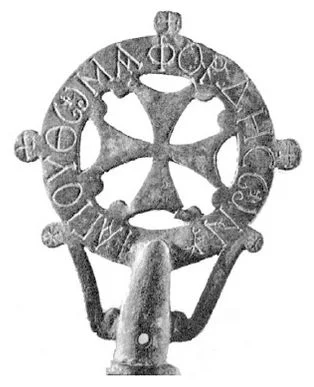
Bronze cross inscribed 'of Thomas in Phordison', probably from a church of Thomas the Apostle (S00199). Found at Jerusalem (Roman province of Palaestina I). Probably 6th c.
- Language
- Greek
- Date from
- 500
- Date to
- 600
- Evidence type
- Images and objects; Inscriptions
- Evidence subtype
- Inscribed objects; Other portable objects (metalwork, ivory, etc.)
- Evidence region
- Palestine with Sinai
- Evidence location
- 'Ein Kerem; Caesarea Maritima, Καισάρεια, Kaisareia, Caesarea, Kayseri, Turris Stratonis; Jerusalem; Caesarea Maritima, Καισάρεια, Kaisareia, Caesarea, Kayseri, Turris Stratonis
- Cult region
- Palestine with Sinai
- Cult location
- 'Ein Kerem; Caesarea Maritima, Καισάρεια, Kaisareia, Caesarea, Kayseri, Turris Stratonis; Jerusalem; Caesarea Maritima, Καισάρεια, Kaisareia, Caesarea, Kayseri, Turris Stratonis
- Cult date from
- 500
- Cult date to
- 600
Text
Bronze cross pattée (with arms that broaden out towards the ends) encircled by an inscribed disc with three small loops containing crosses, and with a socket for fixing a rod at its bottom. H. 0.135 m; W. 0.105 m.
Label running around the disc:
+ ἁγίου Θωμᾶ Φορδήσων +
'+ Of Saint Thomas in Phordison +'
Text: CIIP 1/2, no. App. 43*.
Source
Exact provenance unknown, but probably found near or at Jerusalem. Now in the collection Chandon de Brialles. Acquired in Jerusalem before 1959. First published in 1960 by Claude Mondésert. Later discussed by Józef Tadeusz Milik and Stéphane Verhelst. We follow the recent edition by Leah Di Segni in the Corpus Inscriptionum Iudaeae/Palaestinae (2012).
Discussion
The object is usually identified as an element of a processional cross of a church (or possibly a monastery) dedicated to Thomas the Apostle. That religious establishment is usually identified with the church of Thomas built under the patriarch of Jerusalem Petros (524-552, see E02734) and the church of Thomas 'in Prodi' or 'in Phordenan', recorded in the Georgian version of the Lectionary of Jerusalem (E03280; cf. Garitte 1958, 284).
Several different theories have been suggested about the actual location of the church. For a complete discussion, see the comments by Leah Di Segni in CIIP 1/2, 562-563. Originally Felix-Marié Abel argued that the Greek toponym is echoed in the modern names Khirbet Farad or Horvat Pered (villages sited to the south-east of the Jerusalem to Jaffa railroad). Józef Tadeusz Milik suggested that the words were distorted Aramaic toponyms Pordesaya/Pardesaya = 'Gardens', and noted that the 14th c. author Nicephorus Callistus (XIV 50, PG 146, col. 1240), mentions an almshouse built by the empress Eudocia ἐν Φορδισίοις. Milik identified that establishment with a gerokomeion of *George, attested by a Greek inscription from Jerusalem (E02733), but Di Segni rightly finds this association implausible. Di Segni rejects a number of other implausible attempts to identify the site and points out that the church of Thomas, to which the cross belonged, could have been located in the western suburbs of Jerusalem, in the Valley of Beth ha-Kerem (modern 'Ein Kerem).
Bibliography
Edition:
Cotton, H.M., Di Segni, L., Eck, W., Isaac, B., Kushnir-Stein, A., Misgav, H., Price, J.J., Yardeni, A. and others (eds.), Corpus inscriptionum Iudaeae/Palaestinae: A Multi-Lingual Corpus of the Inscriptions from Alexander to Muhammad, vol. 1, part 2: Jerusalem, nos. 705-1120 (Berlin, Boston: De Gruyter, 2012), no. App. 43*.
Milik, J.T., "Saint Thomas de Phordêsa et Gen. 14, 17", Biblica 42 (1961), 77-84.
Mondésert, C., "Inscriptions et objects chrétiens de Syrie", Syria 37 (1960), 116-119 and fig. 1.
Further reading:
Meimaris, Y., Sacred names, saints, martyrs and church officials in the Greek inscriptions and papyri pertaining to the Christian Church of Palestine (Athens: National Hellenic Research Foundation, Center for Greek and Roman Antiquity, 1986), no. 607.
Milik, J.T., "La topographie de Jérusalem vers la fin de l'époque byzantine", Mélanges de l'Université Saint-Joseph 37 (1960-1961), 139-140.
Verhelst, S., "Les lieux de station du lectionnaire de Jérusalem", Proche-Orient Chrétien 54 (2004), 31-32, no. 63.
For the Georgian calendar of Jerusalem, see
Garitte, G. (ed.), Le calendrier palestino-géorgien du Sinaiticus 34 (Xe siècle) (Subsidia hagiographica, 30, Brussels: Société des Bollandistes, 1958.
Reference works:
Bulletin épigraphique (1963), 287; (1961), 71.
Images
Associated saints
| Saint | Name in source | Certainty |
|---|---|---|
| Thomas, the Apostle (S00199) | Θωμᾶς | Certain |
Cult classifications
- Cult Places
- Cult building - independent (church)
- Cult Related Objects
- Crosses
- Liturgical Activity
- Procession
Record author
Paweł Nowakowski
Entry date
24/04/2017
Citation
Paweł Nowakowski, Cult of Saints, E02735 — https://csla.history.ox.ac.uk/record.php?recid=E02735