
E02788
Fragmentary Greek inscription possibly mentioning a church of *Kosmas and Damianos (brothers, physician martyrs of Syria, S00385). Found at Jerusalem on the Via Dolorosa (Roman province of Palaestina I). Probably 6th-7th c.
- Language
- Greek
- Date from
- 500
- Date to
- 700
- Evidence type
- Inscriptions
- Evidence subtype
- Formal inscriptions (stone, mosaic, etc.)
- Evidence region
- Palestine with Sinai
- Evidence location
- Jerusalem; Caesarea Maritima, Καισάρεια, Kaisareia, Caesarea, Kayseri, Turris Stratonis
- Cult region
- Palestine with Sinai
- Cult location
- Jerusalem; Caesarea Maritima, Καισάρεια, Kaisareia, Caesarea, Kayseri, Turris Stratonis
- Cult date from
- 500
- Cult date to
- 700
Text
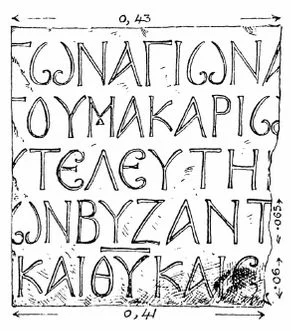
The preserved text:
[- - -]τῶν ἁγίων Α[- - -]
[- - -] τοῦ μακαριω[τάτου- - -]
[- - -]Υ τελευτὴ̣ν [- - -]
[- - - τ]ῶν Βυζαντ[ίων - - -]
[- - -] καὶ θ(εο)ῦ καὶ Σ[ωτῆρος (?) - - -]
'[- - -] of the holy A[- - -] of the most blessed [- - -] completed (or: died) [- - -] the Byzantines [- - -] and God and [Saviour (?) - - -].'
The restoration by Germer-Durand:
[οἶκος] τῶν ἁγίων Ἀ[ναργύ]-
[ρων ἐπὶ] τοῦ μακαριω[τάτου]
[Εὐστοχί]ου τελευτὴν [ἔλαβε]
[σπουδῇ] τῶν Βυζαντ[ίων εἰς]
[δόξαν] Κ(υρίο)υ καὶ θ(εο)ῦ καὶ Σ[ωτῆρος]
'[The house] of the holy [Unmercenaries (Anargyroi)] was completed [under] the most blessed [Eustochios by the zeal] of (the monastery) of the Byzantines [for the glory] of the Lord and God and [Saviour].'
The restoration by Milik:
[οὗτος ὁ εὐαγὴς οἶκος] τῶν ἁγίων Ἀ[ναργύρων Κοσμᾶ καὶ]
[Δαμιανοῦ συσταθεὶς διὰ] τοῦ μακαριω[τάτου ἀρχιεπισκόπου]
[καὶ πατριάρχου Ἰσαακίο]υ τελευτὴν [ἔλαβε σπουδῇ τοῦ δεῖνα]
[καὶ τῆς δεῖνα] τῶν Βυζαντ[ίων μηνὶ - - - ἰνδ(ικτιῶνος) - - -]
[ἔτους τῆς σαρκώσεως Κ(υρίο)υ] καὶ θ(εο)ῦ καὶ Σ[ωτῆρος ἡμῶν Ἰ(ησο)ῦ Χ(ριστο)ῦ - - -]
'[This chaste house] of the holy [Unmercenaries (Anargyroi) Kosmas and Damianos, founded by] the most blessed [archbishop and patriarch Isaakios], was completed [by the care of NN and his wife NN], the Byzantines, [in the month of - - -, indiction - - -, in the year of the incarnation of the Lord], and God, and [our Saviour Christ - - -].'
Text: CIIP 1/2, no. 1010.
Translations: L. Di Segni, lightly modified.
Source
Fragment of a stone lintel. Preserved dimensions H. 0.50 m; W. 0.43 m. Letter height 0.06-0.07 m. High quality lettering.
The fragment was unearthed during the construction of the church of St. Veronica of the Melchites on the Via Dolorosa (at the site of the 6th station), completed in 1895. It is supposed that the stone had been displaced in antiquity from its original location. First published in 1892 by Jean Germer-Durand. Later republished by a number of scholars including Józef Tadeusz Milik who suggested a restoration significantly different from those of former editors. The most recent edition, rightly abstaining from extensive completions, is by Leah Di Segni in the Corpus Inscriptionum Iudaeae/Palaestinae (2012).
Discussion
According to its first editor, Germer-Durand, the inscription comes from a lintel of a church and commemorates its construction and dedication to the holy Unmercenaries (Anargyroi). This supposition is based on the occurrence of the plural term 'saints'/ἅγιοι in line 1, followed by the letter alpha immediately before the lacuna. Milik and Di Segni note, however, that the restoration offered by Germer-Durand is too short for a massive stone lintel, does not take into consideration the presumed length of the lacunas, uses inadequate epithets for the ecclesiastics mentioned, etc.
Milik, who himself suggested more substantial completions, points out that a church and monastery of Kosmas and Damianos in Jerusalem is recorded by John Moschus in the Spiritual meadow (PG 87, col. 2989, EXXXXX). According to Moschus' account the emperor Maurice's sister Damiana, a native of Arabissos in Anatolia, resided there together with her niece. Milik supported the identification of the 'Byzantines', occurring in line 4, as the imperial family, and identified the church and monastery known to Moschus with our inscription, also claiming that the convent was situated close to or even at the find-spot of the fragment. He connected the construction of that church to the period after the murder of Maurice by Phocas (c. 602-609), saying that relatives and supporters of the deposed emperor must have sought refuge in distant regions, for example in Jerusalem (for another foundation in Jerusalem by a woman from Arabissos, see CIIP 1/2, no. 875). He added that the shrine could have had links with the Kosmidion, a famous sanctuary of Kosmas and Damianos in Constantinople (formerly Byzantion), in the district ta Paulinou or in Blachernae, founded in 439 by Paulinos, friend of the emperor Theodosius II ($EXXXX).
Leah Di Segni is rightly reluctant regarding Milik's restoration, as much of his text is highly hypothetical. She also notes that Moschus met Damiana before the death of Maurice. Therefore, the monastery certainly existed before 602. In her opinion the 'Byzantines' are a monastic community founded after 515, also mentioned by Moschus (Spiritual meadow 97, PG 97, col. 2956). She also says that the epithet makarios /makariotatos usually denoted the deceased and need not refer to the patriarch. Di Segni concludes that the inscription may actually be a funerary one, somehow connected to the cemetery or a funerary chapel owned by the monastery of the Byzantines.
We share Di Segni's doubts; however, we must note that the epithet makariotatos appears also in a somewhat similar (but fragmentary and hypothetically reassembled) commemorative plaque for a monastery, probably of Kosmas and Damianos, in north Anatolia, built with the involvement of the 'thrice-blessed' (tris makariotatos) patriarch of Constantinople, see E00796.
For a foundation by a couple of the 'Byzantines' in Jerusalem, see E02733.
Bibliography
Edition:
Cotton, H.M., Di Segni, L., Eck, W., Isaac, B., Kushnir-Stein, A., Misgav, H., Price, J.J., Yardeni, A. and others (eds.), Corpus inscriptionum Iudaeae/Palaestinae: A Multi-Lingual Corpus of the Inscriptions from Alexander to Muhammad, vol. 1, part 2: Jerusalem, nos. 705-1120 (Berlin, Boston: De Gruyter, 2012), no. 1010.
Bieberstein, K., Bloedhorn, H., Grundzüge der Baugeschichte vom Chalkolithikum bis zur Frühzeit der osmanischen Herrschaft (TAVO Beiheft B 100, 1-3; Wiesbaden 1994), vol. 2, 312-313.
Milik, J.T., "La topographie de Jérusalem vers la fin de l'époque byzantine", Mélanges de l'Université Saint-Joseph 37 (1960-1961), 155-156.
Thomsen, P., "Die lateinischen und griechischen Inschriften der Stadt Jerusalem und ihrer nächsten Umgebung. 1. Nachtrag", Zeitschrift des deutschen Palästina-Vereins 64 (1941), no. 13.
Vincent, L.H., Abel, F.M. (eds.), Jérusalem: recherches de topographie, d'archéologie et d'histoire, vol. 2: Jérusalem nouvelle, part 4: Sainte-Anne et les sanctuaires hors de la ville (Paris: J. Gabalda, 1926), 920.
Thomsen, P., Die lateinischen und griechischen Inschriften der Stadt Jerusalem und ihrer nächsten Umgebung (Leipzig: J.C. Hinrichs, 1922), no. 13.
Germer-Durand, J., "Epigraphie chrétienne de Jérusalem", La Revue biblique 1 (1892), 584-585, no. 47.
Further reading:
Abel, DACL 2357-2358.
Reference works:
Bulletin épigraphique (1963), 286.
Images
Associated saints
| Saint | Name in source | Certainty |
|---|---|---|
| Kosmas and Damianos, brothers, physician martyrs of Syria (S00385) | Ἀνάργυροι | Certain |
Cult classifications
- Cult Places
- Cult building - independent (church); Cult building - monastic
- Non Liturgical Activity
- Construction of cult buildings
- People
- Foreigners (including Barbarians); Monarchs and their family; Women
- Places Names after Saint
- Monastery
Record author
Paweł Nowakowski
Entry date
10/05/2017
Citation
Paweł Nowakowski, Cult of Saints, E02788 — https://csla.history.ox.ac.uk/record.php?recid=E02788