
E02840
Clay bread-stamp with Greek inscription invoking the blessing of *Paul (probably the Apostle, S00008), or of one of two martyrs of Caesarea (Paulos, S00164, or Paulos from Yamnia, a companion of *Pamphilos, S00140). Found in Caesarea Maritima (Roman province of Palaestina I), at the site of the presumed 'chapel of St. Paul'. Probably 5th-6th c.
- Language
- Greek
- Date from
- 450
- Date to
- 1000
- Evidence type
- Images and objects; Inscriptions
- Evidence subtype
- Inscribed objects; Other portable objects (metalwork, ivory, etc.)
- Evidence region
- Palestine with Sinai
- Evidence location
- Caesarea Maritima; Caesarea Maritima, Καισάρεια, Kaisareia, Caesarea, Kayseri, Turris Stratonis
- Cult region
- Palestine with Sinai
- Cult location
- Caesarea Maritima; Caesarea Maritima, Καισάρεια, Kaisareia, Caesarea, Kayseri, Turris Stratonis
- Cult date from
- 450
- Cult date to
- 1000
Text
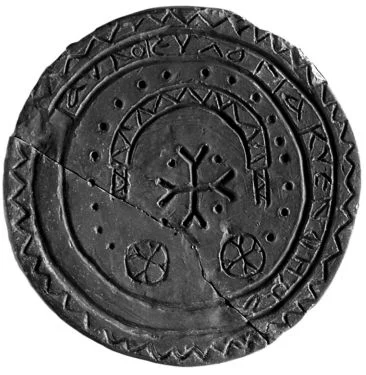
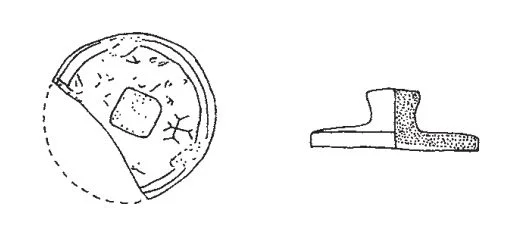
Round bread-stamp of pinkish-red clay with a pyramidal handle. Diameter 0.104 m; Th. 0.01 m. Width of the handle 0.035 m; thickness of the handle 0.03 m. Broken and lost in the lower left-hand quarter (the photograph shows the object restored). Decorated, before hardening, with a cross with split arms under an arch interpreted by the editors as resting on colonnettes. Below the cross are probably two circles (only one survives) containing similar smaller crosses. The arch is surrounded by a row of dots. The outer sector of the surface is occupied by two bands. The inscription runs on the inner band. Letter height 0.005-0.007 m.
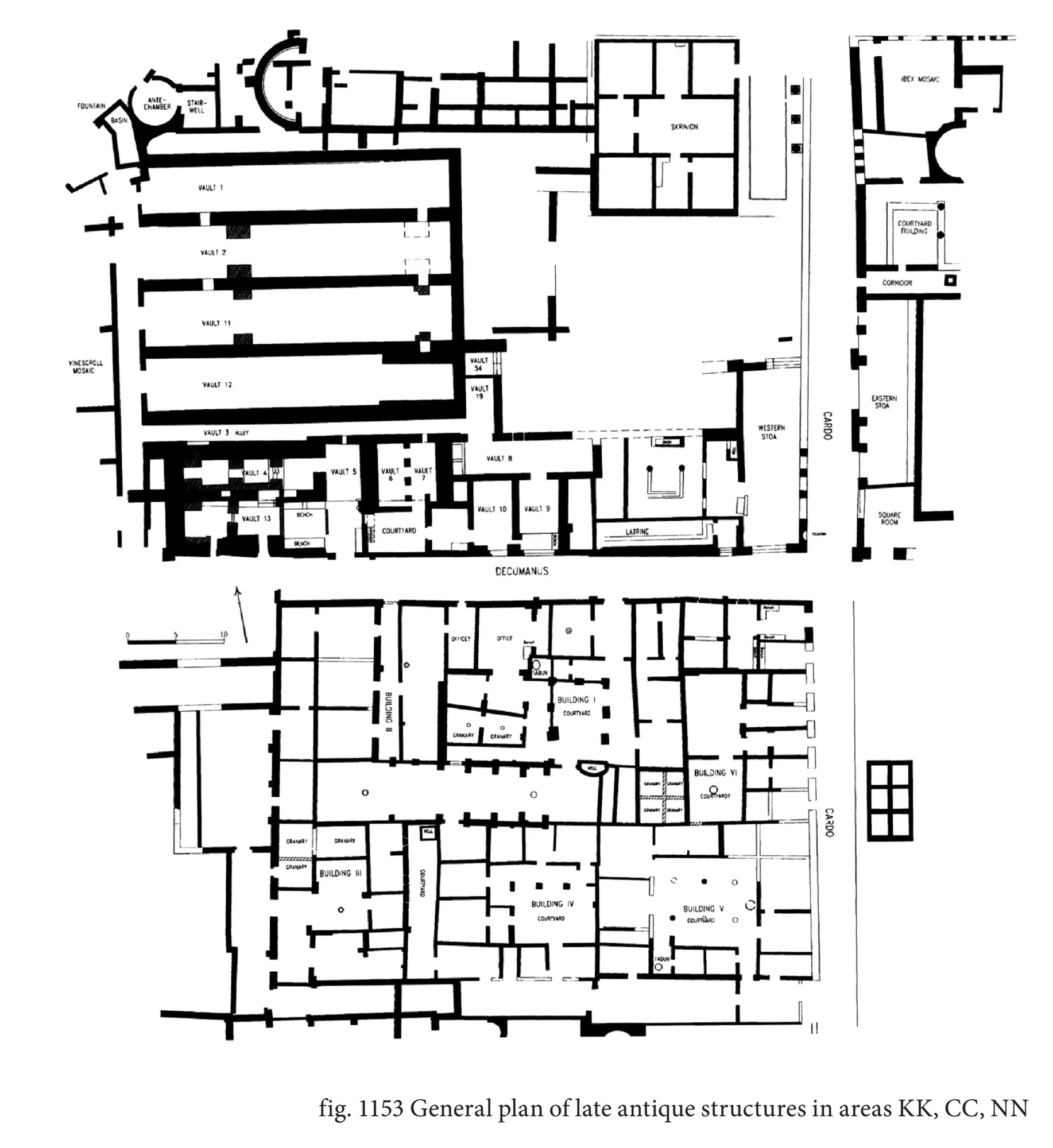
Found in Warehouse I , Area KK 17, locus 12, in a hall at the site of the so-called 'chapel of Paul' within the praetorium at Caesarea Maritima (for a description of this building, see: E02853). Now in the Israel Museum, Jerusalem.
First published by Leah Di Segni in 2000. Since then republished several times by Joseph Patrich, and by Walter Ameling (2011).
Inscription:
εὐλογία Κ(υρίο)υ ἐνφ' ἡμᾶ[ς καὶ τοῦ ἁγίου Π]αύλο(υ)
[ΕΝΦ Ameling, ΕΠΦ = ἐ{π}φ Di Segni]
'(May the) blessing of the Lord (be) upon us, [and (the blessing) of Saint] Paul.'
Text: CIIP 2, no. 1163.
Translation: W. Ameling.
Discussion
The inscription is a bread-stamp used for the production of eulogiae: small breads distributed to pilgrims, the poor, and other people attending mass (after the completion of the rite).
The potter apparently intended to use the common formula εὐλογία Κ(υρίο)υ ἐφ' ἡμᾶς, but for unknown reasons confused the letters in the preposition ('no phonological justification for ἐφ΄ = ἐνφ΄ can be found', says Ameling).
Importantly, the formula on the stamp contains a reference to one Paul. He can either be the Apostle (according to Acts 21:15-27:1 imprisoned in the city, in the praetorium, where the stamp was also found), or one of two martyrs of Caesarea (a confessor beheaded on 25 July 309, S00164, or Paulos of Yamnia, a companion of Pamphilos, S01333; cf. E00391).
The stamp can possibly be connected with a baking oven, installed in the building at a late date, see CIIP 2, 77.
Dating: there is no reliable way to date the object. Based on the shape of the cross Ameling argues for a date after the mid 5th c.
Bibliography
Edition:
Ameling, W., Cotton, H.M., Eck, W., and others, Corpus inscriptionum Iudaeae/Palaestinae: A Multi-Lingual Corpus of the Inscriptions from Alexander to Muhammad, vol. 2: Caesarea and the Middle Coast 1121-2160 (Berlin, Boston: De Gruyter, 2011), no. 1163 (with further bibliography).
Patrich, J., "A Chapel of St. Paul at Caesarea Maritima?", Liber Annuus 50 (2000), 370-371, and Pl. 27,2.
Patrich, J., "Warehouses and granaries in Caesarea Maritima", in Raban, A., Holum, K.G., Caesarea Maritima: A Retrospective after Two Millenia (Leiden – New York: Brill, 1996), 170-172 and Fig. 25.
Di Segni, L., "A Chapel of St. Paul at Caesarea Maritima? The Inscriptions", Liber Annuus 50 (2000), 397-399.
Reference works:
Bulletin épigraphique (1954), 252.
Chroniques d'épigraphie byzantine, 716.
Supplementum Epigraphicum Graecum 50, 1475; 61, 1423.
Images
Associated saints
| Saint | Name in source | Certainty |
|---|---|---|
| Paul, the Apostle (S00008) | Παῦλος | Certain |
| Paulos, martyr of Caesarea of Palestine (S00164) | Παῦλος | Certain |
| Pamphilos, martyr of Caesarea in Palestine, and companions (S00140) | Παῦλος | Certain |
Cult classifications
- Activities
- Production and selling of eulogiai, tokens
- Cult Places
- Cult building - dependent (chapel, baptistery, etc.); Cult building - independent (church); Place associated with saint's life
- Cult Related Objects
- Crosses; Other
- Non Liturgical Activity
- Distribution of alms; Pilgrimage; Visiting graves and shrines
- Relics
- Ampullae, eulogiai, tokens; Contact relic - other; Making contact relics
Record author
Paweł Nowakowski
Entry date
23/05/2017
Citation
Paweł Nowakowski, Cult of Saints, E02840 — https://csla.history.ox.ac.uk/record.php?recid=E02840