
E02844
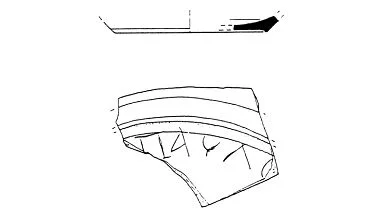
Pottery fragment with a fragmentary Greek graffito just possibly referring to *Paul (the Apostle, S00008). Found in Caesarea Maritima (Roman province of Palaestina I), at the site of the presumed 'chapel of St. Paul'. Probably 5th-6th c.
- Language
- Greek
- Date from
- 400
- Date to
- 800
- Evidence type
- Images and objects; Inscriptions
- Evidence subtype
- Graffiti; Inscribed objects; Other portable objects (metalwork, ivory, etc.)
- Evidence region
- Palestine with Sinai
- Evidence location
- Caesarea Maritima; Caesarea Maritima, Καισάρεια, Kaisareia, Caesarea, Kayseri, Turris Stratonis
- Cult region
- Palestine with Sinai
- Cult location
- Caesarea Maritima; Caesarea Maritima, Καισάρεια, Kaisareia, Caesarea, Kayseri, Turris Stratonis
- Cult date from
- 400
- Cult date to
- 800
Text
Pottery fragment probably from a shallow bowl or platter. Dimensions not specified. The inscription runs along the outer base. Letter height 0.01 m.
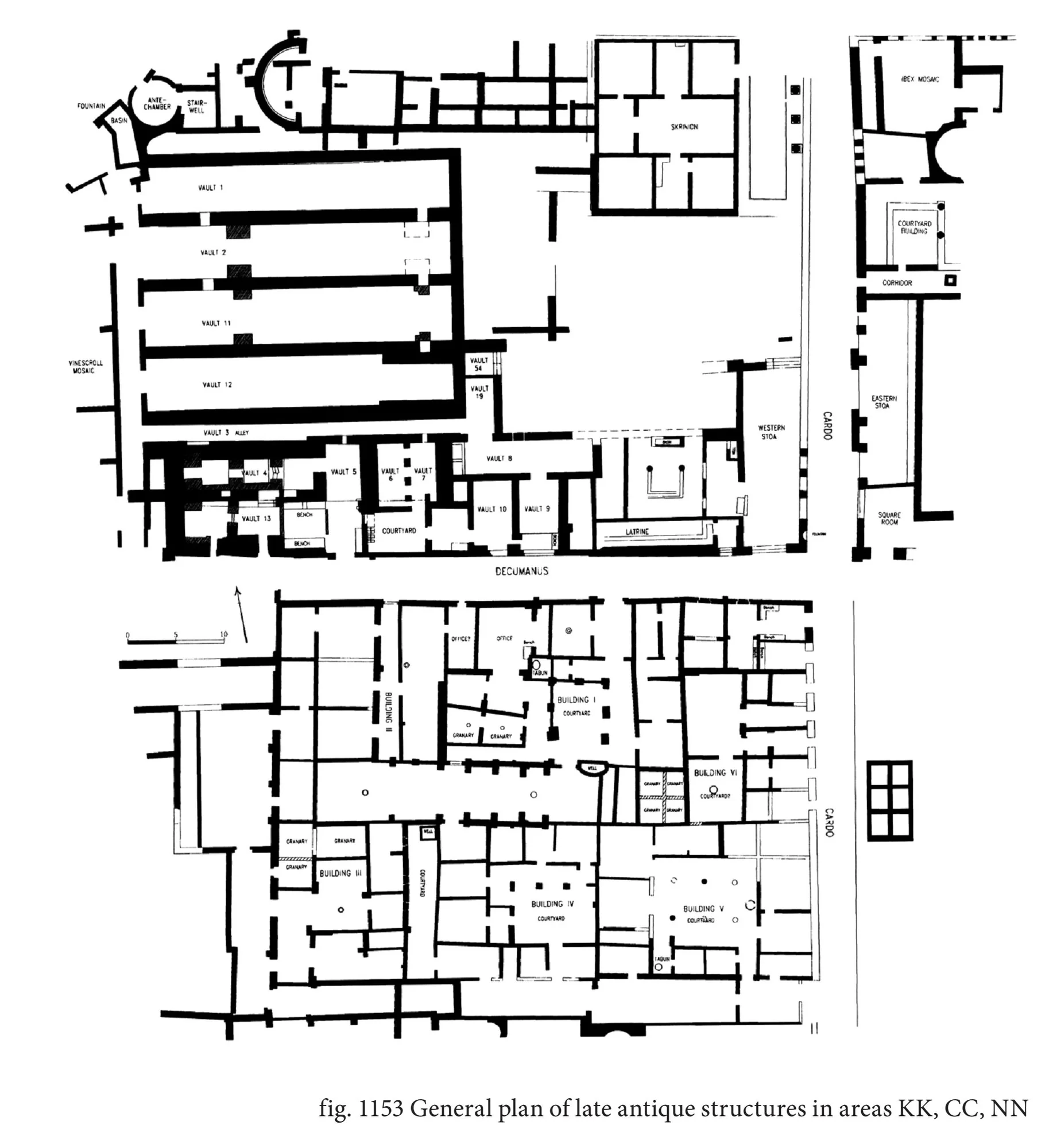
Found in the debris of the collapsed vault in the complex of warehouses (Warehouse I, area KK 17) at the site of the so-called Paul's chapel at Caesarea Maritima/praetorium (for a description of this establishment, see: E02853). Probably originally kept on the second story of that building.
First published by Leah Di Segni and Joseph Patrich in 2000. Republished by Walter Ameling and Avner Ecker (2011).
Inscription:
] Παυλο[
[ ] Παυλό[υ Ameling Ecker Di Segni]
'Paul (or: of Paul).'
Text: CIIP 2, no. 1164.
Discussion
Given the findspot of the inscription (the supposed site of the prison where the Apostle Paul was detained), Leah Di Segni suggested that the partially preserved name Paulos could refer to the Apostle, though she also considered two less likely possibilities: one of two local martyrs of Caesarea, Paulos, a confessor beheaded on 25 July 309, S00164, or Paulos of Yamnia, a companion of Pamphilos, martyred probably in 310, S01333.
However, as owners' inscription are common on pottery, Ameling and Ecker add that we could have here simply the name of the owner of the bowl. The drawing suggests that the inscription was scratched when the vessel had already been fired; and if so, this interpretation seems the most plausible.
Bibliography
Edition:
Ameling, W., Cotton, H.M., Eck, W., and others, Corpus inscriptionum Iudaeae/Palaestinae: A Multi-Lingual Corpus of the Inscriptions from Alexander to Muhammad, vol. 2: Caesarea and the Middle Coast 1121-2160 (Berlin, Boston: De Gruyter, 2011), no. 1164 (with further bibliography).
Patrich, J., "A Chapel of St. Paul at Caesarea Maritima?", Liber Annuus 50 (2000), 370.
Di Segni, L., "A Chapel of St. Paul at Caesarea Maritima? The Inscriptions", Liber Annuus 50 (2000), 400, no. 13.
Reference works:
Bulletin épigraphique (2003), 588.
Chroniques d'épigraphie byzantine, 716.
Supplementum Epigraphicum Graecum 50, 1476.
Images
Associated saints
| Saint | Name in source | Certainty |
|---|---|---|
| Pamphilos, martyr of Caesarea in Palestine, and companions (S00140) | Παῦλος | Uncertain |
| Paulos, martyr of Caesarea of Palestine (S00164) | Παῦλος | Uncertain |
| Paul, the Apostle (S00008) | Παῦλος | Uncertain |
Cult classifications
- Cult Places
- Cult building - independent (church); Place associated with saint's life
- Cult Related Objects
- Other
Record author
Paweł Nowakowski
Entry date
25/05/2017
Citation
Paweł Nowakowski, Cult of Saints, E02844 — https://csla.history.ox.ac.uk/record.php?recid=E02844